Published on · Updated on
Table of Contents
No Olympian complicates the neat idea of divine order quite like Dionysus. He is a god of joyful festivity and terrifying madness in equal measure, born once from a mortal woman and again from his own father’s body, and worshipped through rituals that deliberately dissolved the usual boundaries between human self-control and something far less predictable.
Twice-Born of Zeus and Semele
Dionysus is the son of Zeus and Semele, a mortal princess of Thebes, and his birth is among the strangest in the entire Greek pantheon. Pregnant with Zeus’s child, Semele is deceived by a jealous Hera, disguised as an old confidante, into asking her divine lover to reveal himself to her in his true, full form. Zeus, bound by an earlier oath to grant her any request, reluctantly complies, and the sheer force of his undisguised divine presence incinerates Semele instantly.
Zeus rescues the unborn child from his dying mother’s body and sews him into his own thigh to complete the pregnancy, and Dionysus is born a second time, this time directly from Zeus himself, months later. That double birth gives him the epithet “twice-born,” and ancient sources treat the detail as more than a curiosity: it positions Dionysus as a god whose very existence already crosses the ordinary boundary between mortal and divine, born first from a human womb and then completed within a god’s own body, a fitting origin for a deity whose entire mythology centers on dissolving boundaries other gods leave intact.
God of Wine and Its Discovery
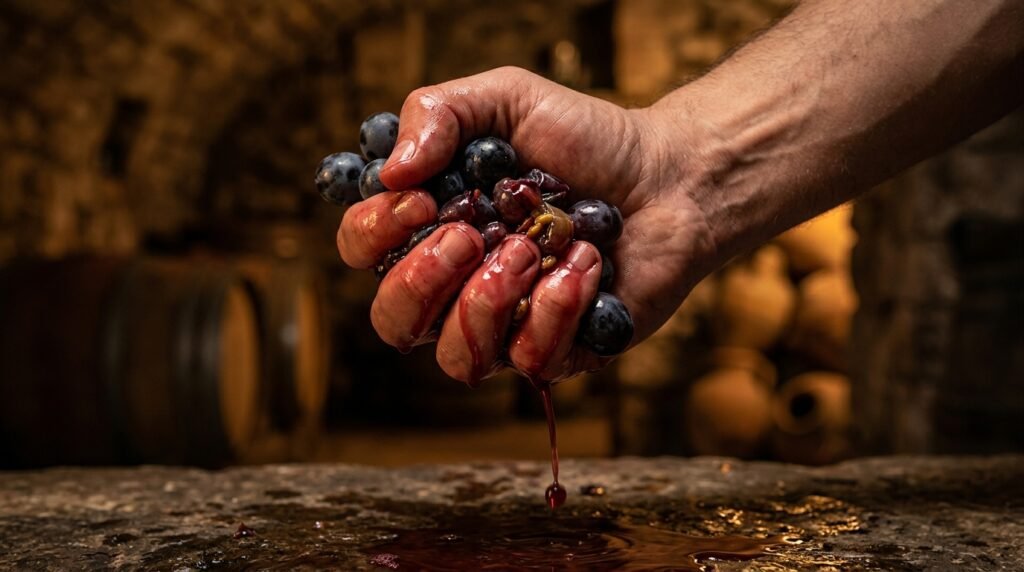
Dionysus’s most consistent identity is as the god of wine, credited across Greek tradition with discovering or inventing viticulture and teaching humanity the cultivation of the grape and the process of winemaking. That gift, like Demeter’s gift of grain, ties Dionysus directly to one of the foundational technologies of settled agricultural civilization, though wine’s effects gave his particular gift a very different character than grain’s steady, sustaining nourishment: wine loosens inhibition, alters perception, and, taken to excess, produces exactly the kind of unpredictable, boundary-dissolving behavior that runs through the rest of his mythology.
Ancient Greek religious practice generally treated wine consumption itself as a genuinely Dionysian religious act, not merely a secular pleasure, and the god’s presence was invoked at symposia, festivals, and theatrical competitions alike, contexts where controlled loosening of ordinary social restraint was considered a meaningful, sanctioned part of communal and religious life rather than simple indulgence.
The Maenads and Ecstatic Worship
Dionysus’s worship centered on ecstatic ritual practiced most famously by the Maenads, female followers who, in myth and in some historical religious practice, left ordinary domestic life behind periodically to roam the mountains in frenzied, wine-fueled worship, believed capable of superhuman strength while under the god’s influence. Ancient sources describe Maenads tearing apart animals, and in the most extreme mythological accounts, mortals, with their bare hands while in this state, a practice called sparagmos, sometimes followed by omophagia, the ritual consumption of the raw flesh.
That combination of religious ecstasy and genuine danger runs through nearly every major myth involving Dionysus’s worship, reflecting a consistent ancient understanding of his domain: liberating and joyful when properly honored, but genuinely destructive toward anyone, mortal or otherwise, who denies or resists it.
Pentheus and the Cost of Denial
Dionysus’s most fully developed myth survives in Euripides’s tragedy The Bacchae, performed posthumously around 405 BCE. King Pentheus of Thebes refuses to acknowledge Dionysus’s divinity and attempts to suppress the ecstatic worship spreading through his city, imprisoning the god, who has arrived in disguised mortal form specifically to establish his cult there. Dionysus, unharmed by the imprisonment, lures the increasingly obsessed Pentheus into dressing as a woman to secretly observe the Maenads’ rites in the mountains.
The Maenads, in a frenzy and led, devastatingly, by Pentheus’s own mother Agave, mistake him for a wild animal and tear him apart with their bare hands. Agave returns to Thebes carrying her son’s head, believing it to be a lion’s trophy, only to have her sanity restored and recognize what she has done. The play stands as one of Greek tragedy’s most unflinching depictions of divine power exacting consequence disproportionate to the offense, and of how completely ecstatic religious frenzy could override even the most fundamental human bonds.
Ariadne, Rescued and Transformed
Dionysus’s romantic mythology takes a notably gentler turn in his relationship with Ariadne, the Cretan princess who had earlier helped the hero Theseus navigate the Labyrinth and slay the Minotaur, only to be abandoned by him on the island of Naxos as he sailed home without her. Dionysus discovers her there, grieving and abandoned, and takes her as his wife, in several traditions granting her immortality, and placing the crown he gives her among the stars as the constellation Corona Borealis.
That myth offers one of the few consistently happy romantic outcomes in Dionysus’s mythology, and later art returns to the scene of his discovery of the sleeping or grieving Ariadne repeatedly, a moment of rescue and transformation that stands in deliberate contrast to the destructive frenzy dominating so much of his other mythology.
The Descent to Retrieve His Mother
In a later but significant tradition, Dionysus descends into the underworld to rescue his mother Semele, successfully bringing her back to Olympus and securing her immortality, an act generally read as Dionysus using his own unusual, boundary-crossing nature, born of both a mortal and a god, to accomplish something few other deities attempt: restoring a mortal parent to permanent divine status. That myth reinforces Dionysus’s broader thematic significance throughout Greek religion as a god specifically associated with crossing the boundary between mortality and immortality, and between the world of the living and the realm of the dead, in ways most other Olympians simply don’t.
Patron of Theater
Dionysus held a uniquely foundational role in the development of Greek theater itself. The major dramatic festivals of ancient Athens, most significantly the City Dionysia, were held explicitly in his honor, and Greek tragedy and comedy both developed directly out of ritual performances connected to his worship. Attending the theater in classical Athens was, in a real sense, participating in an act of religious devotion to Dionysus, not simply secular entertainment, and the god’s own mythology of transformation, disguise, and the dissolution of fixed identity maps closely onto theater’s own core mechanism: performers temporarily becoming someone other than themselves.
Satyrs and the Wilder Side of His Retinue
Beyond the Maenads, Dionysus’s mythological retinue includes satyrs, half-human, half-goat companions associated with revelry, music, and unrestrained appetite, frequently led by the older, perpetually drunk figure Silenus, sometimes described as Dionysus’s tutor. Satyr plays, a distinct genre of ancient Greek drama combining mythological subject matter with bawdy, comic performance, were traditionally staged alongside tragic trilogies at Athenian dramatic festivals, offering audiences a lighter, explicitly Dionysian counterbalance to the heavier tragic material performed in the same religious context.
The Contested Twelfth Seat
Dionysus’s position among the Twelve Olympians carries a genuine ancient ambiguity worth addressing directly. Several traditions describe him taking a seat among the twelve only after Hestia voluntarily steps aside to make room for him, once his worship became sufficiently widespread and significant to warrant formal inclusion among the ruling gods. Other ancient sources maintain different rosters entirely, and the exact composition of “the Twelve” was never perfectly fixed across all of Greek religious practice. What’s consistent is that Dionysus’s inclusion, whenever and however it happened, reflects how genuinely central his worship became to Greek religious and civic life over time, expanding from what may have originally been a more marginal or foreign-associated cult into one of the most widely and enthusiastically celebrated deities in the entire pantheon.
Roman Bacchus
Dionysus’s Roman counterpart, Bacchus, inherits his core identity as god of wine and ecstatic religious celebration, and his name survives directly in the modern English word “bacchanalian,” describing wildly uninhibited revelry. Roman authorities periodically viewed Bacchic worship with genuine suspicion and, in 186 BCE, moved to suppress it sharply through the Senatus Consultum de Bacchanalibus, a formal decree restricting Bacchic rites across Roman territory, reflecting real anxiety about the same boundary-dissolving, potentially destabilizing power that had always defined this god’s mythology, however joyfully it might also be celebrated.
For the full picture of how Dionysus fits among the Twelve Olympians, see the Twelve Olympians guide, part of Godspire’s complete guide to the Greek pantheon.
Frequently Asked Questions
Why is Dionysus called “twice-born”?
Dionysus was first conceived by the mortal Semele, who was killed by the full force of Zeus’s divine presence before completing the pregnancy. Zeus rescued the unborn child and sewed him into his own thigh, and Dionysus was born a second time directly from his father.
What happened to Pentheus in The Bacchae?
King Pentheus denied Dionysus’s divinity and tried to suppress his worship. Dionysus lured him into secretly observing the Maenads’ rites, where his own mother, in an ecstatic frenzy, mistook him for a wild animal and tore him apart.
How did Dionysus meet Ariadne?
Dionysus discovered Ariadne on the island of Naxos after Theseus abandoned her there. He married her and, in several traditions, granted her immortality, later placing her crown among the stars.
What is Dionysus’s Roman equivalent?
Dionysus’s Roman counterpart is Bacchus, whose name is the source of the modern English word “bacchanalian.” Roman authorities formally restricted Bacchic worship in 186 BCE, reflecting ongoing anxiety about its unrestrained, boundary-dissolving nature.

Kaiqui Damasceno is a mythology writer and researcher dedicated to exploring the stories, gods, heroes, and ancient traditions that shaped human culture. Through engaging storytelling and thoughtful analysis, Kaiqui brings mythology to life, uncovering the deeper meanings, conflicts, symbols, and timeless lessons hidden within ancient myths.