Published on · Updated on
Table of Contents
Few figures in Greek mythology occupy as much genuinely contested territory as Hecate. Hesiod, writing at the very foundation of Greek mythological tradition, treats her as one of the most honored and powerful goddesses in the entire cosmos. Later classical sources, centuries removed, reduce her to a shadowy figure of night, witchcraft, and the uncanny. Both versions are real, and understanding Hecate means understanding how thoroughly a single goddess’s reputation can shift across the long span of ancient Greek religious history.
An Honored Titan-Generation Goddess
Hecate is the daughter of the Titans Perses and Asteria, making her a member of the Titan generation’s extended family rather than an Olympian by birth. Hesiod’s Theogony, composed in the late 8th or early 7th century BCE, gives Hecate an unusually extensive and glowing treatment, far more detailed than most other figures of her generation receive, explicitly stating that Zeus honored her above all others, granting her a share of authority across earth, sea, and sky alike, a genuinely rare distinction not extended so explicitly to any other single deity in the same text.
According to Hesiod, Hecate assists mortals directly in specific, practical ways: granting victory and glory to those competing in athletic contests, aiding fishermen and sailors when they pray to her, and helping herdsmen increase their flocks when she chooses to favor them. That portrait is worth taking seriously precisely because it contradicts the later, more sinister reputation Hecate eventually accumulates; in her earliest surviving major appearance, she reads less like a goddess of shadow and more like a genuinely benevolent, broadly helpful figure with authority reaching into daily practical concerns most other deities didn’t directly address.
Mother of Underworld Figures
Through her marriage to Perses, a son of the Titan Crius, or in some traditions through other unions, Hecate becomes associated with several later, more explicitly underworld-connected figures, including, in Orphic tradition, Melinoe and Scylla. That genealogical connection ties Hecate’s own family line directly into the broader cluster of Greek deities governing death, night, and liminal spaces, reinforcing a thread already present in her own character even at her most honored and benevolent.
Witness to Persephone’s Abduction
Hecate plays a small but significant supporting role in the myth of Persephone’s abduction by Hades, preserved most fully in the Homeric Hymn to Demeter. According to that account, Hecate, from within her cave, hears Persephone’s cries as she’s seized but doesn’t witness the abduction directly herself; when Demeter’s frantic search eventually leads her to Hecate, the goddess accompanies Demeter to Helios, the sun god, who did see the entire event from his position in the sky and can confirm what actually happened.
Afterward, once Persephone is partially restored to her mother, Hecate becomes her close companion and attendant, said to precede and follow Persephone during her yearly transitions between the underworld and the world above. That role positions Hecate as a genuine bridge figure between Demeter’s world of growth and Persephone’s underworld authority, present at the exact narrative hinge point where the myth’s central seasonal mechanism operates, fitting neatly with her broader association with thresholds and transitions generally.
Goddess of Crossroads
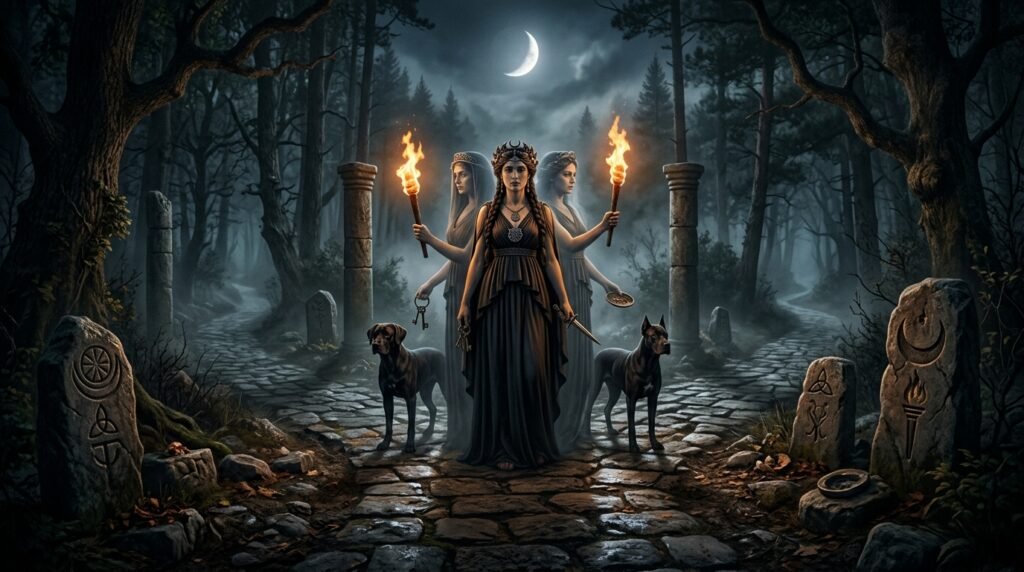
Hecate’s most enduring and consistent association across nearly every period of Greek religious practice is with crossroads, physical points where roads meet and travelers must choose a direction. Small shrines called Hecataea, often simple stone pillars or statues showing Hecate in triple form facing three directions at once, stood at crossroads and doorways throughout the Greek world, offerings left there specifically to secure her protection and favor at exactly the liminal, decision-point locations her domain most directly governed.
That crossroads association extends naturally into her broader identity as goddess of all boundaries and thresholds, doorways, city gates, and the specific, unsettling border between the world of the living and the world of the dead. Offerings called “Hecate’s Suppers” were traditionally left at crossroads on the night of the new moon, intended both as an offering to the goddess herself and, in some interpretations, as a way of drawing away any restless or wandering spirits that might otherwise trouble a household, treating Hecate simultaneously as a goddess to honor and a genuinely powerful force worth actively appeasing.
Triple Form
Hecate is among the most consistently depicted triple-formed deities in Greek religious art, shown as three figures standing back to back, or occasionally as a single figure with three faces looking in three directions simultaneously. Ancient interpretations of this triple form vary considerably; some connect it directly to her crossroads function, watching three directions at once, while others associate the three aspects with the phases of the moon, or with her authority spanning three separate realms, sky, earth, and underworld, echoing the honor Hesiod originally describes Zeus granting her.
This triple imagery later became one of Hecate’s most recognizable and enduring visual signatures, feeding directly into her eventual association, especially prominent in later magical and Wiccan-influenced traditions, with the “Triple Goddess” archetype, though it’s worth being precise that this specific modern framing developed considerably later than the ancient sources themselves and reflects a much later reinterpretation rather than an unbroken ancient tradition.
Goddess of Magic and Necromancy
By the later classical period, particularly in tragedy and in magical papyri from the Hellenistic era onward, Hecate’s association with magic, sorcery, and necromancy becomes considerably more pronounced than anything present in Hesiod’s earlier, more benevolent portrait. She becomes strongly associated with the witch Medea, appearing in several tellings as a kind of patron deity whose power Medea specifically invokes for her own magical workings, and with Circe, the sorceress Odysseus encounters in the Odyssey, both figures drawing directly on Hecate’s authority over the uncanny and the transformative.
This later magical reputation connects closely to her association with the night, the moon, and the crossroads where boundary-crossing magic was traditionally thought most effective. Ancient magical practitioners invoked Hecate specifically when working curses, protective spells, or necromantic rituals intended to communicate with the dead, treating her domain over thresholds as extending naturally into the ultimate threshold between the visible, ordinary world and whatever lay genuinely hidden beyond it.
Companion of Dogs
Hecate holds a consistent association with dogs throughout ancient sources, frequently depicted accompanied by hounds, and dogs, particularly black dogs, were considered sacred to her and sometimes sacrificed in her honor, an unusual practice since dog sacrifice was rare in broader Greek religious custom. Ancient sources sometimes describe the barking of dogs at night as a sign of Hecate’s approaching presence, an eerie, practical omen tied directly to her nocturnal, boundary-crossing character, giving ordinary Greeks a genuinely observable, everyday signal they associated directly with the goddess moving unseen through the night.
Why Her Reputation Shifted
It’s worth asking directly why Hecate’s portrayal shifts so significantly between Hesiod’s early, honorific treatment and her later, more shadowy classical reputation. Part of the explanation likely lies in exactly the qualities that made her useful across such a wide range of human concern: a goddess governing boundaries, transitions, and the unknown naturally accumulates associations with whatever a given era finds most uncertain or unsettling. As formal civic religion increasingly centered on the more clearly defined Olympian gods, Hecate’s own domain, precisely because it resisted easy categorization, increasingly absorbed the anxieties and fascinations later Greek culture attached to magic, night, and the liminal spaces ordinary religious life didn’t fully address elsewhere.
Roman Trivia
Hecate’s Roman counterpart, Trivia, takes her very name directly from the Latin term for a crossroads where three roads meet (tri- plus via), preserving the single most consistent element of Hecate’s identity across the entire span of her ancient worship, from Hesiod’s earliest honorific portrait through her later, more magically charged classical reputation. Roman tradition generally continued and even intensified her association with magic and night, and her worship persisted well into the late Roman period, particularly within magical and mystery-cult contexts that valued exactly the boundary-crossing authority that had defined her since her very first appearance in Greek literature.
For the full picture of how Hecate fits among the underworld and death cluster, see the Underworld and Death guide, part of Godspire’s complete guide to the Greek pantheon.
Frequently Asked Questions
Was Hecate originally an evil or sinister goddess?
No. Hesiod’s Theogony, one of the earliest surviving sources on Hecate, presents her as an honored, broadly helpful goddess given authority by Zeus himself. Her association with magic, witchcraft, and night developed more prominently in later classical tradition.
What is Hecate’s connection to Persephone?
Hecate hears Persephone’s cries during her abduction and later helps Demeter learn what happened. She subsequently becomes Persephone’s close companion, accompanying her during her yearly transitions between the underworld and the world above.
Why is Hecate associated with crossroads?
Hecate governs boundaries and thresholds generally, and crossroads, as literal decision points where roads meet, became her most consistent and enduring domain across the entire span of ancient Greek religious practice, marked by shrines called Hecataea.
What is Hecate’s Roman equivalent?
Hecate’s Roman counterpart is Trivia, whose name comes directly from the Latin for a three-way crossroads, preserving the single most consistent element of Hecate’s identity throughout her ancient worship.

Kaiqui Damasceno is a mythology writer and researcher dedicated to exploring the stories, gods, heroes, and ancient traditions that shaped human culture. Through engaging storytelling and thoughtful analysis, Kaiqui brings mythology to life, uncovering the deeper meanings, conflicts, symbols, and timeless lessons hidden within ancient myths.