Published on · Updated on
Table of Contents
Some Greek deities appear in nearly every major source, their myths retold across centuries of poetry, drama, and art. Melinoe is almost the opposite: a goddess who survives today through a single significant text, a strange and specific origin story, and an appearance genuinely unlike anything else in the Greek underworld pantheon.
A Daughter Born of Deception
Melinoe’s origin appears in the Orphic Hymns, a collection of ritual poems associated with Orphic religious practice and generally dated to the Hellenistic or early Roman period, considerably later than Hesiod’s foundational Theogony. According to this tradition, Melinoe is the daughter of Persephone and Zeus, but her conception involves a specific deception: Zeus approaches Persephone disguised as Hades, Persephone’s own husband, and Melinoe results from that encounter.
That origin story deserves careful, direct treatment rather than casual paraphrase, since it depicts Zeus deceiving Persephone through disguise as her own husband in order to conceive a child with her, a troubling detail that later tradition presents without softening. Ancient sources don’t dwell extensively on Persephone’s own perspective in the account, focusing instead on the unusual, split nature of the daughter born from that union, a genuinely unsettling origin that ancient audiences apparently understood as directly explaining Melinoe’s own equally unsettling nature and appearance.
A Body Divided Between Black and White
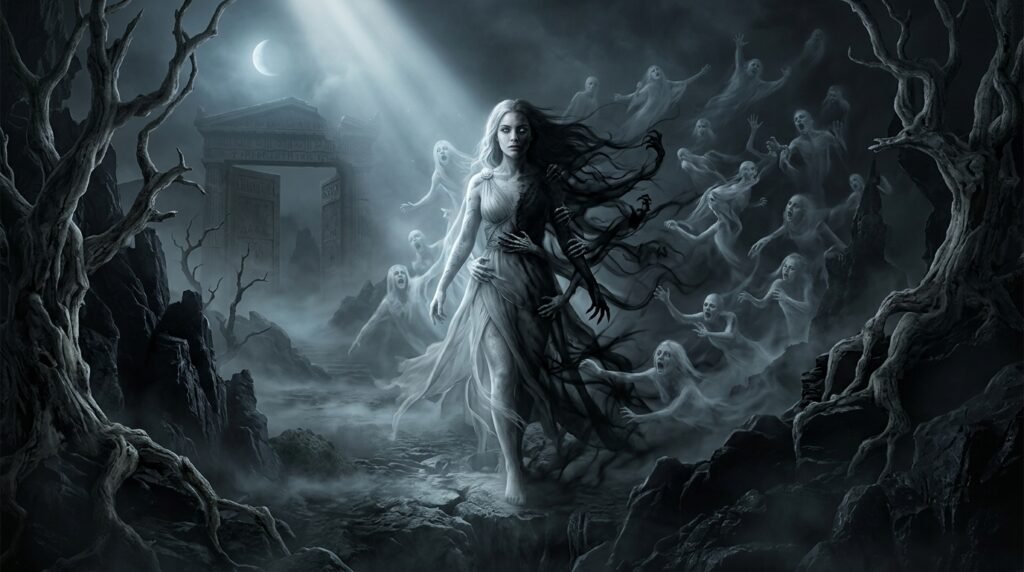
The Orphic Hymn dedicated to Melinoe describes her in strikingly specific physical terms: her body is said to appear half black and half white, or in some readings pale and dark in alternating or divided sections, a direct visual consequence, in this tradition, of her mixed and deceptive conception. That divided appearance sets Melinoe apart from nearly every other figure in Greek mythology, whose forms, however strange or composite in the case of monsters, rarely carry this specific kind of symbolic, bisected physical division tied directly to the circumstances of their birth.
This visual duality connects naturally to her broader function: a goddess whose own body refuses to resolve into one single, stable appearance becomes a fitting personification of exactly the kind of unstable, unsettling experience she’s associated with, apparitions that shift, nightmares that blur waking and sleeping, hauntings that never fully resolve into something the mind can simply categorize and dismiss.
Goddess of Nightmares and Ghostly Apparitions
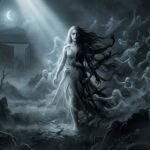
Melinoe’s primary domain, according to the Orphic Hymn, is nighttime terror, specifically the ghostly apparitions and unsettling visions that appear to mortals during sleep or in darkness, sent to torment the mind with what the hymn describes as madness or disturbed thought. She’s associated directly with the restless dead, souls that appear to the living in unwelcome, frightening visitations, positioning her as a goddess specifically responsible for the uncanny, disorienting experience of encountering death’s presence while still very much alive.
That domain places Melinoe within a specific, narrower niche compared to broader death-associated figures like Hades or Thanatos. Where Hades governs the underworld as an ordered realm and Thanatos personifies death’s inevitable, universal arrival, Melinoe governs something more specifically psychological and disruptive: the fear, confusion, and dread that accompanies encountering death’s presence outside its proper, expected place, in dreams, in shadows, in the unsettled edges of ordinary experience rather than in death’s actual, sanctioned moment.
Torches and Nighttime Wandering
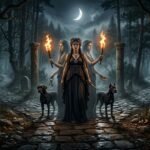
The Orphic Hymn to Melinoe describes her wandering the earth at night accompanied by, or leading, a retinue of spirits, sometimes depicted with torches in later artistic interpretation, an image that connects her visually to Hecate and to Demeter’s own torch-lit search for Persephone, though Melinoe’s nighttime wandering carries a considerably more frightening register than either of those associations. Where Demeter’s torches signal grief and determined searching, and Hecate’s signal guidance and boundary-crossing authority, Melinoe’s nocturnal presence is consistently framed as something to be warded off rather than welcomed, an apparition whose approach itself constitutes the disturbance her hymn describes, rather than a helpful or neutral force moving through the dark.
Connection to the Underworld Family
As Persephone’s daughter, Melinoe belongs directly to the underworld’s own extended ruling family, connecting her to Hades as a stepfather figure of sorts, and to the broader cluster of underworld-associated deities including Hecate, whose own domain over night, magic, and liminal spaces overlaps considerably with Melinoe’s more specific focus on nightmare and apparition. Some later traditions and interpretations blur or connect Melinoe with Hecate directly, given their shared association with ghosts, night, and unsettling supernatural experience, though the Orphic Hymns treat them as distinct figures with their own separate dedicated hymns and functions.
That family placement matters for understanding Melinoe’s role within the broader underworld cluster covered across Greek mythology generally: she isn’t simply death personified again under a different name, but a specific, later theological development addressing a particular, narrower human experience, nighttime dread and ghostly visitation, that earlier, broader figures like Hades and Thanatos didn’t individually cover with the same specificity.
Orphic Religious Context
Understanding Melinoe requires understanding, at least briefly, the broader Orphic religious tradition her hymn comes from. Orphism, associated with the mythical poet and musician Orpheus, developed a distinctive body of ritual practice and belief centered heavily on the soul’s fate after death, purification, and the underworld’s own structure and population, considerably more elaborated and systematized than the underworld mythology found in earlier, more mainstream sources like Homer and Hesiod.
The Orphic Hymns, the primary surviving source for Melinoe, functioned as ritual invocations meant for actual religious use within Orphic practice, addressed directly to a wide range of deities, including several, like Melinoe, who receive little to no attention in more mainstream Greek literary and mythological sources. This context matters because it explains why Melinoe can be genuinely significant within a specific ancient religious framework while remaining comparatively obscure within Greek mythology as most people encounter it today, primarily through Homer, Hesiod, and Athenian tragedy, none of which mention her directly.
A Goddess Without Extensive Narrative Myth
Unlike many Greek deities whose personality and role emerge through an accumulated series of distinct myths and adventures, Melinoe’s surviving characterization rests almost entirely on a single hymn’s description rather than on any developed narrative involving her taking specific action, facing conflict, or interacting directly with other named figures in an ongoing story. This absence isn’t a gap in the historical record so much as a genuine reflection of how she functioned within Orphic religious practice: as a figure invoked and addressed directly in ritual, meant to be approached and appeased rather than told about, her significance residing in cultic function rather than in narrative entertainment the way more thoroughly mythologized Olympians eventually accumulated.
Rituals of Appeasement
Orphic ritual practice associated with Melinoe likely involved specific apotropaic measures, rites intended to ward off or appease her rather than simply invoke her favor the way a petitioner might approach a more benevolent deity. While the precise ritual details haven’t survived in the same depth as her descriptive hymn, the broader pattern within Orphic and popular Greek religious practice generally treated frightening night-associated figures as forces to be managed and kept at a respectful distance rather than actively courted, offerings and prayers functioning more as protective boundaries than as invitations. That approach fits consistently with how Melinoe’s own domain, nightmare and unwelcome apparition, would naturally shape the religious posture of anyone specifically addressing her.
Modern Rediscovery
Melinoe has experienced a notable revival of attention in recent years well beyond specialist classical scholarship, largely due to her appearance as a significant character in popular video games and other contemporary media drawing on Greek mythology for source material. This modern visibility, worth acknowledging directly, sometimes involves creative reinterpretation and expansion considerably beyond what the ancient Orphic Hymn itself actually describes, and readers encountering Melinoe primarily through recent games or fiction should understand that the ancient source material is genuinely sparse, a single hymn’s worth of description, compared to the far more extensively developed character modern adaptations sometimes construct around her.
That gap between ancient source material and modern popular reinterpretation isn’t unique to Melinoe, but it’s worth noting with particular clarity in her case given how comparatively minimal her actual ancient textual footprint is relative to her current level of popular recognition.
For the full picture of how Melinoe fits among the underworld and death cluster, see the Underworld and Death guide, part of Godspire’s complete guide to the Greek pantheon.
Frequently Asked Questions
Who are Melinoe’s parents?
According to the Orphic Hymns, Melinoe is the daughter of Persephone and Zeus, conceived after Zeus deceived Persephone by disguising himself as her husband, Hades.
Why is Melinoe depicted as half black and half white?
The Orphic Hymn dedicated to her describes her body as divided between dark and pale halves, a detail tradition connects directly to the deceptive, mixed circumstances of her conception.
What is Melinoe the goddess of?
Melinoe is associated with ghostly apparitions and nighttime terror, specifically the frightening visions and restless spirits that torment the living, sent to disturb the mind with madness or disordered thought.
Is Melinoe mentioned in Homer or Hesiod?
No. Melinoe appears primarily in the Orphic Hymns, a later collection of ritual poetry associated with Orphic religious practice, and doesn’t appear in the earlier, more mainstream sources of Homer and Hesiod.

Kaiqui Damasceno is a mythology writer and researcher dedicated to exploring the stories, gods, heroes, and ancient traditions that shaped human culture. Through engaging storytelling and thoughtful analysis, Kaiqui brings mythology to life, uncovering the deeper meanings, conflicts, symbols, and timeless lessons hidden within ancient myths.