Published on · Updated on
Table of Contents
Greek mythology rarely lets a single force go unpersonified, and death is no exception. Thanatos isn’t a ruler of the dead, a judge, or a guide, he’s something more elemental than any of those roles: death itself, given a name, a form, and, in at least one memorable myth, a body that can be physically overpowered.
Son of Night
Thanatos is a son of Nyx, the primordial personification of Night, born, according to Hesiod’s Theogony, without a father, alongside a cluster of siblings that includes Hypnos (Sleep), the Moirai (the Fates), Nemesis (Retribution), and Eris (Strife). That genealogy places Thanatos among a specific family of forces Hesiod groups together as things night brings into the world uninvited, conditions and events humans experience as arriving rather than as something anyone chooses.
Being Nyx’s son rather than an Olympian’s places Thanatos slightly outside the more visible drama of Zeus’s extended family, closer in character to the primordial forces than to the gods who scheme, marry, and quarrel on Olympus. He doesn’t attend feasts or take sides in wars the way Ares or Athena do; he simply does what his nature requires, arriving when a mortal’s time is finished.
Distinct From Hades
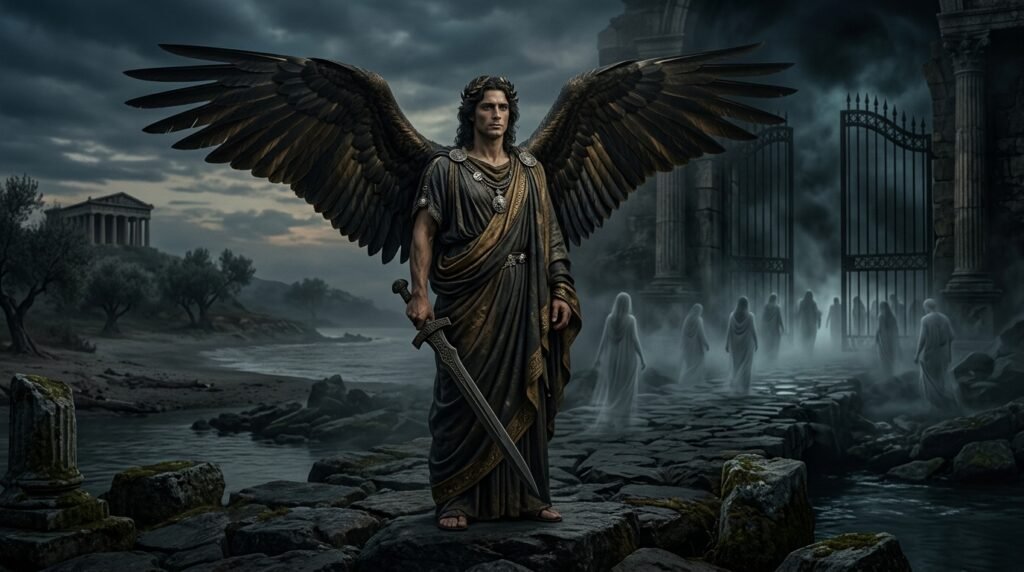
A common point of confusion is worth addressing directly: Thanatos is not the same figure as Hades, and ancient sources keep the two clearly separate. Hades rules the underworld, the vast populated realm where souls reside after death; Thanatos personifies the specific act and moment of dying itself, the transition rather than the destination. A useful way to hold the distinction: Hades is death’s kingdom, Thanatos is death’s arrival. Ancient Greek art and poetry generally depict Thanatos as a winged figure, sometimes gentle, sometimes stern, present at the moment a soul departs the body, while Hades remains seated in his own separate domain below, governing what happens afterward rather than the instant itself.
Twin to Sleep
Thanatos’s twin brother Hypnos, who personifies sleep, appears alongside him constantly in both literature and art, and the pairing is deliberate rather than incidental. Homer’s Iliad describes the two brothers together carrying the body of the fallen hero Sarpedon from the battlefield, Hypnos and Thanatos working in tandem to convey him gently to his homeland for proper burial, an image that treats sleep and death as close relatives performing complementary, cooperative work rather than opposed forces.
That kinship reflects a broader ancient intuition still recognizable today: sleep as death’s gentler cousin, a nightly rehearsal of the same fundamental stillness, entered and exited far more forgivingly. Ancient Greek funerary art frequently depicts the two brothers as winged youths standing at either end of a deathbed, visually reinforcing how closely intertwined the two states were considered, related but never confused with one another.
Tricked by Sisyphus
Thanatos’s most developed individual myth involves Sisyphus, the cunning king of Corinth condemned in the underworld’s most famous punishment, endlessly pushing a boulder up a hill only to watch it roll back down each time. That punishment, in most tellings, stems directly from an earlier offense against Thanatos himself: when Thanatos arrives to escort Sisyphus to the underworld, Sisyphus tricks him, in some versions asking to see how a set of chains or handcuffs work and then binding Thanatos with them, leaving him trapped and unable to perform his function.
With Thanatos incapacitated, death itself effectively stops working across the world; no one can die, a situation ancient sources treat as a genuine crisis rather than a blessing, since it disrupts the natural order in ways that trouble even the gods. Ares, particularly frustrated that battles no longer produce casualties, robbing warfare of its consequence, is generally credited with freeing Thanatos and restoring death’s function. Sisyphus’s punishment in the underworld is partly a consequence of this earlier trick, along with a separate deception involving his own funeral arrangements, making him doubly guilty of trying to outmaneuver death itself, a presumption Greek myth treats as deserving its own uniquely fitting, eternal consequence.
A God Rarely Worshipped
Unlike most figures in the Greek pantheon, Thanatos received little to no direct cult worship across the ancient Greek world. Ancient Greeks generally didn’t build temples to death or offer sacrifices seeking his favor the way they did for gods governing more welcome domains. This absence reflects a broader, consistent pattern: forces representing unavoidable, universal conditions rather than negotiable outcomes tended to receive far less active religious attention than gods whose favor might plausibly be won or lost through proper devotion. There was little practical reason to court Thanatos specifically; he arrives for everyone eventually, regardless of how any individual mortal has behaved toward him personally.
Distinguishing Gentle and Violent Death
Later Greek tradition, particularly Euripides, sometimes distinguishes between different qualities of death Thanatos brings, occasionally personifying a gentler passing separately from violent or premature death. This distinction connects to Thanatos’s sisters, the Keres, spirits associated specifically with violent death in battle or through disaster, sometimes described as darker, more aggressive counterparts to Thanatos’s own comparatively calm, inevitable function. Where Thanatos represents death as universal and, in its own way, orderly, the Keres represent death’s more chaotic, premature, and violent manifestations, a division that let Greek mythology hold two different emotional registers about death within a single extended family of personified forces.
Thanatos in Art
Ancient Greek vase painting and sculpture consistently depict Thanatos as a winged youth, frequently shown gently lifting or carrying a departed soul, an image that avoids the menacing, skeletal imagery later Western traditions would eventually attach to death. This visual softness matters for understanding how ancient Greeks actually related to the concept: Thanatos isn’t consistently rendered as a figure to fear or resist, but often as a quiet, almost tender presence completing a necessary transition, particularly in scenes depicting the deaths of respected warriors and heroes, where his role alongside Hypnos emphasizes peaceful, dignified passage rather than violent ending.
Thanatos and the Language of Modern Medicine
Beyond Freud’s specific psychoanalytic usage, Thanatos’s name has quietly embedded itself throughout modern vocabulary describing death and dying, from “euthanasia,” literally meaning “good death” and combining the Greek eu (good) with thanatos, to various medical and academic terms describing end-of-life care and the study of death itself, thanatology being the most direct example. That linguistic persistence is worth noting precisely because it mirrors the ancient god’s own character: unlike more elaborately mythologized figures whose names survive mainly through story, Thanatos’s legacy lives largely in the vocabulary humans still reach for when they need calm, clinical language to discuss something otherwise difficult to name directly, continuing the same quiet, functional role in language that the god himself played in myth.
Roman Mors and Later Legacy
Thanatos’s Roman counterpart, Mors, inherits the same basic personification of death, though Roman tradition generally developed the figure with less narrative detail than the Greek original, treating death more as an abstract concept invoked in poetry than as a figure with his own developed mythology. Thanatos’s name survives directly in modern scientific and psychological vocabulary, most notably in Sigmund Freud’s later use of “Thanatos” to describe a theorized death drive standing in opposition to Eros, life’s driving force, a usage that borrows the ancient god’s name specifically to capture the same fundamental opposition Greek mythology had already built into its own family structure of personified forces.
The Balance Between Life and Death
Some later philosophical and mystical traditions within Greek thought treat Thanatos not as an ending to be feared but as one half of a necessary cosmic balance, life and death understood as complementary rather than opposed, each giving the other meaning. This framing appears especially in Orphic and later Stoic-influenced thought, where accepting Thanatos’s inevitability becomes less a source of dread and more a starting point for living well, precisely because life’s value depends on its eventual limit. That reading doesn’t erase the genuine grief ancient Greeks associated with loss, but it does explain why Thanatos himself, as opposed to premature or violent death, could be approached in art and philosophy with something closer to calm acceptance than terror.
For the full picture of how Thanatos fits among the underworld and death cluster, see the Underworld and Death guide, part of Godspire’s complete guide to the Greek pantheon.
Frequently Asked Questions
Is Thanatos the same as Hades?
No. Hades rules the underworld as a kingdom of the dead, while Thanatos personifies the act and moment of dying itself. Ancient sources keep the two figures clearly distinct.
How is Thanatos related to Hypnos?
Thanatos and Hypnos are twin brothers, both sons of Nyx (Night), personifying death and sleep respectively. Ancient art and literature frequently depict them working together, most famously carrying the body of the fallen hero Sarpedon in Homer’s Iliad.
What happened when Sisyphus tricked Thanatos?
Sisyphus bound Thanatos with chains, temporarily stopping death from functioning anywhere in the world. Ares eventually freed him, and Sisyphus’s later punishment in the underworld stems partly from this deception.
Did ancient Greeks worship Thanatos?
Thanatos received little direct cult worship, unlike most Greek gods. As a universal, unavoidable force rather than one whose favor could be won through devotion, there was little practical incentive for organized worship.

Kaiqui Damasceno is a mythology writer and researcher dedicated to exploring the stories, gods, heroes, and ancient traditions that shaped human culture. Through engaging storytelling and thoughtful analysis, Kaiqui brings mythology to life, uncovering the deeper meanings, conflicts, symbols, and timeless lessons hidden within ancient myths.