Published on · Updated on
Table of Contents
Most Greek myths about a god fleeing an unwanted pursuer end with capture, transformation into something diminished, or rescue by another god. Asteria’s story ends somewhere stranger: she becomes an entire island, one that later shelters her own sister during one of Greek mythology’s most consequential births.
Daughter of Coeus and Phoebe
Asteria is a daughter of the Titans Coeus and Phoebe, sister to Leto, and her name relates directly to the Greek word for star, connecting her to falling stars and celestial signs rather than to the fixed, visible stars generally. Hesiod’s Theogony, composed in the late 8th or early 7th century BCE, places her within this quieter branch of the Titan generation, a family better known through what its members set in motion than through extensive independent myth of their own.
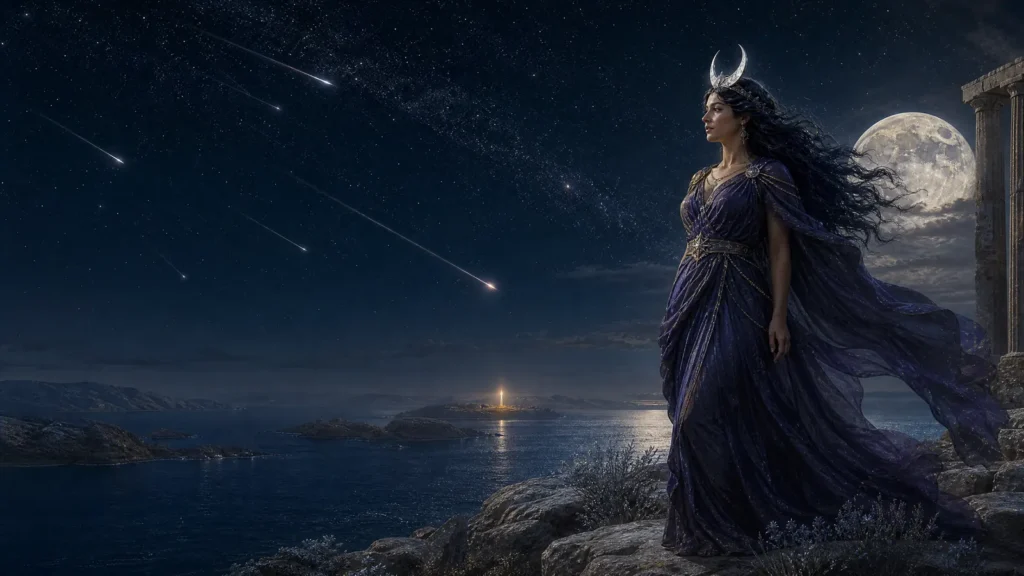
Asteria shouldn’t be reduced to a generic “star goddess.” Her mythology is less about commanding the night sky directly and more about the sudden, episodic, hard-to-predict experiences associated with it: a falling star glimpsed for an instant, a dream arriving during sleep, a sign that appears and vanishes before it can be fully grasped. That episodic quality runs through nearly everything associated with her.
Fleeing Zeus
Asteria’s defining myth involves Zeus’s pursuit of her, a story that follows a pattern familiar from several other Titan-generation figures but resolves in an unusually permanent way. Rather than accept the union, Asteria transforms herself into a quail and leaps into the sea to escape him. In the sea, she becomes an island, sometimes called Ortygia (from the Greek word for quail) in earlier tradition, later identified with Delos.
That transformation is worth reading as more than a simple escape. Transformation in Greek myth can function as punishment, disguise, rescue, or a permanent redefinition of identity, and for Asteria it reads primarily as a deliberate strategy of resistance rather than something imposed on her from outside. The price is real: she no longer occupies the same kind of existence as her fellow Titans, fixed now as a specific, physical place rather than a mobile, independent goddess. But the escape succeeds entirely on her own terms.
From Asteria to Delos
The island Asteria becomes plays a second, equally significant role in Greek mythology years later. When Leto, Asteria’s own sister, becomes pregnant by Zeus and is refused shelter everywhere by Hera’s decree that no solid land may host the birth, she eventually reaches the island her sister had become. Because it was not yet fixed to the seafloor, and therefore not solid land in the strict sense of Hera’s prohibition, the island was free to shelter Leto, allowing Apollo and Artemis to be born there.
The Homeric Hymn to Apollo preserves this connection directly, describing the island’s own hesitation and eventual agreement to host the birth, later rewarded with a great temple and lasting sacred prestige once Apollo comes of age. Read together, the two sisters’ stories form a rare, connected sequence in Greek myth: one sister’s act of resistance against Zeus becomes, years later, the exact refuge that allows the other sister’s children by the same god to be born safely.
Mother of Hecate
Beyond her transformation, Asteria has a second significant mythological role. Hesiod identifies her as the wife of Perses, a son of the Titan Crius, and together they are the parents of Hecate, a goddess associated with magic, crossroads, and liminal spaces who receives an unusually extensive and honorific treatment in Hesiod’s Theogony despite her relatively minor role in later classical myth.
That connection matters for placing Asteria within the broader Titan family. It doesn’t mean Asteria and Hecate should be treated as interchangeable; Asteria belongs to an earlier generation and remains tied specifically to falling stars, dreams, and her own transformation into an island, while Hecate develops into a distinct goddess of night magic and boundary-crossing in her own right. But the genealogical link connects two otherwise separate branches of Titan-generation mythology, Coeus and Phoebe’s line through Asteria, and Crius’s line through Perses, into a single family through Hecate’s birth.
A Goddess of Episodic Signs
What makes Asteria distinctive among the Titan generation is that her power was never represented as a fixed office, unlike, for instance, her sister Leto’s clear role as mother to Apollo and Artemis. Asteria’s symbolism is episodic by nature: a shooting star appears and is gone, a dream arrives and fades on waking, an omen surfaces and passes. That quality made her a natural, if quiet, presence in later traditions concerned with divination through dreams and night signs, a role consistent with, though never as fully developed as, her daughter Hecate’s own later association with magic and the liminal spaces between clearly defined states.
Asteria and the Second-Generation Family
Positioned within the broader Titan generation, Asteria belongs to the same cluster of figures as her sister Leto, children of Coeus and Phoebe whose own significance rests largely on the Olympian descendants they produce or the roles they enable for others. Where Leto’s importance is direct, mother to Apollo and Artemis, Asteria’s is structural: she becomes the physical location that makes her sister’s motherhood possible at all, and separately, through Hecate, she extends the family’s reach into an entirely different domain of Greek religious practice. That dual legacy, one sister defined by what she bears directly and the other by what she becomes and enables, gives their shared genealogy an unusual narrative symmetry rarely matched elsewhere among the Titans’ children.
Frequently Asked Questions
Why did Asteria transform into an island?
Fleeing Zeus’s pursuit, Asteria transformed herself into a quail and leapt into the sea rather than submit to him, becoming the island later associated with Delos.
How is Asteria connected to the birth of Apollo and Artemis?
The island Asteria became later sheltered her sister Leto, who was refused a birthplace everywhere else under Hera’s decree. Because the island wasn’t yet fixed to the seafloor, it counted as an exception, allowing Apollo and Artemis to be born there.
Who are Asteria’s children?
With Perses, a son of the Titan Crius, Asteria is the mother of Hecate, the goddess associated with magic, crossroads, and liminal spaces.
What does the name Asteria mean?
Asteria’s name relates to the Greek word for star, particularly falling or shooting stars, connecting her to sudden, episodic celestial signs rather than the fixed night sky generally.

Kaiqui Damasceno is a mythology writer and researcher dedicated to exploring the stories, gods, heroes, and ancient traditions that shaped human culture. Through engaging storytelling and thoughtful analysis, Kaiqui brings mythology to life, uncovering the deeper meanings, conflicts, symbols, and timeless lessons hidden within ancient myths.