Published on · Updated on
Table of Contents
Few Greek gods accumulate as many overlapping responsibilities as Apollo. He governs prophecy, music, healing, archery, and the arts collectively, a combination that seems scattered until you notice what actually connects them: each domain, in its own way, depends on clarity, precision, and the ability to perceive what others cannot yet see or hear.
Twin Son of Zeus and Leto
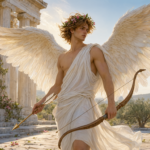
Apollo is the son of Zeus and the Titaness Leto, twin brother to Artemis, born on the floating island of Delos after Leto’s desperate search for a place willing to host the birth, since Hera had forbidden any solid land from doing so. According to the Homeric Hymn to Apollo, composed sometime in the 7th or 6th century BCE, Apollo announces his own divine purpose almost immediately after birth, declaring that the lyre, the curved bow, and prophecy through Zeus’s will would be his domains from that moment forward.
That precocious self-declaration sets a pattern that runs through Apollo’s entire mythology: he is consistently portrayed as a god whose authority feels less imposed from outside and more like something inherent to his nature, arriving fully formed rather than accumulated gradually through conflict or negotiation the way some other Olympian roles are established.
Claiming Delphi
Apollo’s most consequential myth involves his establishment of the oracle at Delphi, the site that becomes the most influential prophetic sanctuary in the entire Greek world. According to the dominant tradition, Apollo travels to Delphi shortly after his birth and kills Python, a monstrous serpent guarding the site, sometimes described as a child of Gaia and an early guardian of primordial earth-based prophecy. Killing Python allows Apollo to claim the sanctuary for himself, though the god must undergo a period of purification and exile afterward as penance for the killing, since even divine violence against a creature tied to Gaia carried real consequence.
A separate, more peaceful tradition, preserved in Aeschylus’s Eumenides, describes a gentler succession instead: the oracle passing from Gaia to Themis to Phoebe and only then to Apollo, inherited rather than seized. Ancient sources never fully reconciled these two accounts, the violent conquest and the peaceful inheritance, and both circulated simultaneously. It’s worth noting the two traditions aren’t necessarily incompatible so much as emphasizing different aspects of the same transition: even a lawful inheritance can involve displacing an older guardian, and Apollo’s own epithet Phoebus, meaning “bright” or “radiant,” directly echoes Phoebe’s name, a linguistic trace connecting him to the peaceful-succession version of the story regardless of which myth a given source favored.
The Pythia and the Mechanics of Prophecy
Once established at Delphi, Apollo’s oracle operated through a priestess known as the Pythia, who delivered prophecies while seated on a tripod, reportedly in an altered state ancient sources attribute to vapors rising from a chasm beneath the temple, though modern geological and archaeological investigation into whether such vapors actually existed remains genuinely debated among scholars. Petitioners would travel to Delphi, offer sacrifice, and pose questions that priests would then interpret and often translate into famously ambiguous verse, a practice that gave the oracle a reputation for answers that were technically true but frequently misunderstood by the humans seeking them.
The oracle’s influence on actual Greek political and civic life is difficult to overstate. City-states consulted Delphi before founding colonies, going to war, or making major legal changes, and the sanctuary’s perceived neutrality, situated outside any single city-state’s direct political control, gave its pronouncements a credibility that purely local prophetic sources couldn’t match.
God of Music and the Arts
Apollo’s association with music centers on the lyre, an instrument he acquires under unusual circumstances: the infant Hermes, on the very day of his own birth, steals cattle belonging to Apollo and, when confronted, offers Apollo a lyre he had just invented from a tortoise shell as recompense. Apollo, delighted with the instrument, accepts the trade, and the lyre becomes permanently associated with him afterward, frequently shown in his hands in ancient art.
Apollo’s musical authority also produces one of Greek mythology’s more brutal cautionary tales. The satyr Marsyas, having found a discarded flute invented and then rejected by Athena, challenges Apollo to a musical contest, with the Muses serving as judges and the winner permitted to do whatever he wished to the loser. Apollo wins, by some accounts through a technicality involving playing his lyre upside down or singing while playing, a feat Marsyas cannot match on the flute, and then flays Marsyas alive as the price of the satyr’s presumption. That severity echoes a broader pattern in Greek myth: mortals or lesser beings who challenge a god’s specific area of mastery tend to face punishment disproportionate to the offense itself, a lesson about hubris told through consequence rather than argument.
Daphne and the Cost of Unwanted Pursuit
Apollo’s romantic mythology is frequently unhappy, and his pursuit of the nymph Daphne, most fully preserved in Ovid’s Metamorphoses, is among the most famous examples. Struck by one of Eros’s arrows, Apollo becomes consumed with desire for Daphne, who has no interest in him and flees. As Apollo closes the distance during the chase, Daphne prays to her father, a river god, for rescue, and is transformed into a laurel tree at the exact moment of capture. Apollo, unable to have her as he wished, instead adopts the laurel as his sacred plant, worn from that point forward by victors in his honor, most famously at the Pythian Games held at Delphi.
That myth is worth reading with some care rather than purely as a romantic tragedy. Ovid frames the pursuit itself as unwanted and desperate on Daphne’s part throughout, and her transformation functions as an escape rather than a reward, a detail modern readers increasingly emphasize when discussing the story’s actual content rather than softening it into simple unrequited love.
Niobe and the Defense of a Mother’s Honor
Apollo and Artemis together carry out one of Greek mythology’s more severe acts of collective retribution against the Theban queen Niobe, who boasts that she deserves greater honor than their mother Leto, since Niobe has borne far more children. In response, Apollo kills Niobe’s sons with his arrows while Artemis kills her daughters, leaving Niobe devastated and eventually transformed into a permanently weeping stone. That myth reinforces something consistent about how the twins are depicted together: fiercely, almost automatically protective of their mother’s honor, with a severity that leaves little room for proportion.
God of Healing, and Its Limits
Apollo holds a significant association with healing and medicine, a role later specialized and largely inherited by his own son Asclepius, whose skill eventually grows so great that he begins raising the dead, provoking Zeus to strike him down with a thunderbolt to preserve the natural boundary between mortality and immortality. Apollo’s own healing authority, in other words, comes with an implicit limit built into the mythology itself: healing can extend life, but Greek myth consistently treats any attempt to fully abolish death as a transgression against cosmic order too significant even for a god’s own son to survive unpunished.
Hyacinthus and Further Tragedy
Apollo’s romantic mythology includes another loss, this one involving the beautiful youth Hyacinthus, whom Apollo loves and accidentally kills during a discus-throwing contest, sometimes with the added detail that the wind god Zephyrus, jealous of Apollo’s affection, deliberately blows the discus off course. From Hyacinthus’s spilled blood, Apollo causes a flower to grow, marked with petals some ancient sources read as spelling out a cry of grief. The recurring pattern across Apollo’s romantic myths, desire followed by loss and then transformation into something permanent, a tree, a flower, a memorial, suggests a god whose attachments consistently outlast their original object, converted instead into lasting symbols under his own domain.
Roman Apollo
Apollo holds a genuinely unusual position among major Greco-Roman deities: the Romans adopted him directly under his original Greek name rather than substituting a native equivalent the way they did for Zeus (Jupiter), Hera (Juno), or Poseidon (Neptune). That direct adoption reflects how thoroughly Apollo’s specific combination of prophecy, healing, and artistic patronage resonated with Roman religious needs without requiring translation into an existing native deity, and his cult grew significantly under emperors like Augustus, who claimed particular personal favor from the god.
For the full picture of how Apollo fits among the Twelve Olympians, see the Twelve Olympians guide, part of Godspire’s complete guide to the Greek pantheon.
Frequently Asked Questions
How did Apollo claim the oracle at Delphi?
According to the dominant tradition, Apollo killed the serpent Python, who guarded the site, shortly after his own birth. A separate tradition describes a peaceful succession instead, with the oracle passing from Gaia to Themis to Phoebe and finally to Apollo.
Why does Apollo carry a lyre?
The infant Hermes stole cattle belonging to Apollo and, when caught, offered Apollo a lyre he had just invented from a tortoise shell as compensation. Apollo accepted the trade, and the lyre became one of his defining symbols.
What happened to Daphne?
Daphne was transformed into a laurel tree to escape Apollo’s unwanted pursuit. Apollo afterward adopted the laurel as his sacred plant, later worn by victors at his own Pythian Games.
Why is Apollo’s name the same in Greek and Roman mythology?
Unlike most major Greco-Roman deities, the Romans adopted Apollo directly under his original Greek name rather than substituting a native Roman god, reflecting how well his specific domains suited Roman religious practice without requiring translation.

Kaiqui Damasceno is a mythology writer and researcher dedicated to exploring the stories, gods, heroes, and ancient traditions that shaped human culture. Through engaging storytelling and thoughtful analysis, Kaiqui brings mythology to life, uncovering the deeper meanings, conflicts, symbols, and timeless lessons hidden within ancient myths.