Published on · Updated on
Table of Contents
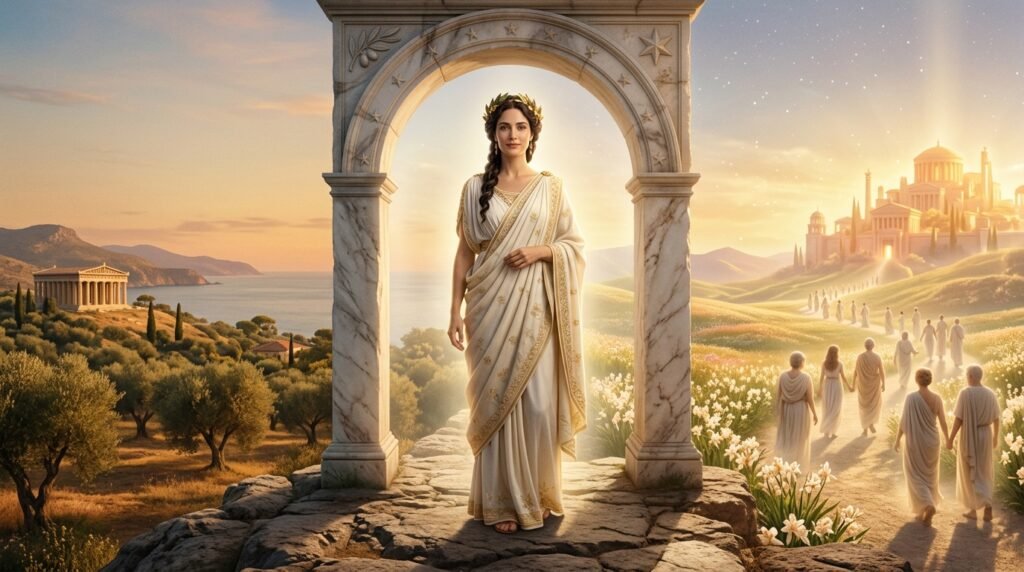
Greek mythology distinguishes between kinds of dying with more care than modern usage often assumes. Where Thanatos personifies death in its universal, unavoidable totality, Macaria represents something narrower and, in its own way, more comforting: the specific idea of a good death, one that comes peacefully, honorably, or at the right time, rather than violently, prematurely, or in vain.
A Name That Means Blessedness
Macaria’s name derives directly from the Greek word makaria, related to makarios, meaning blessed or happy, the same root that appears in the Christian Beatitudes’ opening word centuries later in an entirely different religious tradition. That etymology is the clearest available guide to her actual function, since ancient sources offer relatively little sustained narrative about her compared to more thoroughly mythologized deities. She personifies not death generally, already Thanatos’s domain, but specifically the blessed, welcome kind, an ending that comes as relief or honor rather than as tragedy.
Daughter of Hades in Some Traditions
Some later ancient sources identify Macaria as a daughter of Hades, positioning her within the underworld’s own ruling family alongside figures like Melinoe, though this genealogical detail is far less consistently attested across ancient sources than the parentage given for more prominent Olympian-generation deities. That placement, when it appears, makes clear sense functionally: a personification of blessed death fits naturally within the underworld’s own extended household, closely related to the god who ultimately receives every soul, whether that soul’s ending was blessed or otherwise.
Her specific mother, in traditions that address the question at all, is generally left unspecified or varies by source, a genealogical vagueness that reflects her broader status as a relatively minor, abstractly personified figure rather than one with an extensively developed individual mythology of her own.
A Separate Mortal Heroine of the Same Name
A distinct and considerably better-documented figure also named Macaria appears in Greek myth and tragedy: a mortal daughter of Heracles, featured prominently in Euripides’s tragedy Heracleidae (The Children of Heracles), performed in the mid-5th century BCE. In this play, Macaria voluntarily offers herself as a human sacrifice to secure victory for her family and their Athenian protectors against the pursuing forces of Eurystheus, the king who had persecuted Heracles throughout his life and continued threatening his children after his death.
An oracle declares that victory requires the sacrifice of a noble maiden, and Macaria, without being compelled, steps forward and volunteers herself, delivering a notably composed and dignified speech about accepting death willingly rather than living with the shame of having let someone else’s daughter die in her place while she survived through cowardice. Her death in the play is portrayed with genuine reverence, framed explicitly as noble, chosen, and meaningful rather than as tragedy alone, an ending that secures her family’s survival and honor through her own deliberate, willing sacrifice. Euripides gives her speech real rhetorical weight, treating her choice as a deliberate act of reasoning rather than passive resignation, a mortal woman actively constructing the very meaning of a blessed death through her own words and decision rather than simply receiving that quality from the manner of her dying alone.
The Connection Between the Two Macarias
Ancient sources generally treat the divine personification and the mortal heroine of Heracles as separate figures connected primarily by shared name rather than by any explicit mythological identification between them, though the thematic overlap is difficult to miss and likely isn’t entirely coincidental. The mortal Macaria’s death in Euripides’s play embodies precisely the quality the divine Macaria’s name describes: a death chosen, dignified, and blessed rather than one suffered helplessly or in vain, willingly accepted specifically because it achieves something meaningful rather than being simply endured.
Some later commentators and modern scholars have suggested the heroine’s story may have developed specifically to illustrate or dramatize the abstract concept the goddess’s name represents, giving audiences a concrete, emotionally resonant narrative example of what “blessed death” actually looks like in practice, even if the two figures were never formally merged or identified as the same being within the surviving ancient sources themselves.
Blessed Death in the Broader Underworld Cluster
Positioned alongside Thanatos, Hypnos, Hecate, and Melinoe within the broader cluster of Greek deities governing death and the underworld, Macaria occupies a genuinely distinct niche: where Thanatos personifies death’s universal inevitability and Melinoe personifies its capacity to disturb and frighten through nightmare and apparition, Macaria represents death’s more consoling possibility, the version every ancient Greek presumably hoped for when their own time eventually came. That distinction mattered enormously to a culture without modern medicine’s capacity to meaningfully extend life or reliably prevent premature death; having a specific concept, and a specific personified figure, for the good version of an otherwise universally feared outcome offered a genuine, if modest, form of comfort within Greek religious and philosophical thought about mortality.
Comparing Macaria to Similar Concepts Elsewhere
The distinction Macaria represents, between death as universal fact and death as a specific quality of ending, is worth situating within a broader ancient pattern rather than treating as uniquely Greek. Roman tradition similarly distinguished between different registers of dying without necessarily personifying each distinction as separately as Greek myth sometimes did, and later philosophical schools, particularly Stoicism, spent considerable effort articulating exactly what separated a good death from a bad one independent of any specific mythological figure at all. Macaria’s existence as a named, if minor, goddess suggests Greek popular religion found real value in giving even abstract, philosophically complex distinctions a concrete mythological anchor, a personified figure worth naming and, presumably, occasionally invoking, rather than leaving the entire concept to philosophical discussion alone.
The Islands of the Blessed
Macaria’s name shares its root with makarioi nesoi, the Islands of the Blessed, a mythical paradise reserved in various ancient traditions for particularly virtuous mortals, heroes, or those specially favored by the gods, sometimes identified with Elysium or treated as a related but distinct afterlife destination. While no surviving source directly connects Macaria the personification to these islands in an explicit mythological narrative, the shared linguistic root reflects a broader ancient conceptual cluster: blessedness, whether describing an afterlife destination, a particular quality of death, or a general state of favored happiness, consistently drew on the same underlying vocabulary throughout Greek religious and philosophical thought, different applications of a single, valued concept the Greeks clearly considered worth naming precisely and repeatedly across multiple contexts.
Euthanasia and the Ancient Roots of a Modern Word
Macaria’s underlying concept connects directly to a word still in active use today: euthanasia, literally “good death” in Greek, combining eu (good) with thanatos. While the modern term developed its specific contemporary medical and ethical meaning considerably later than antiquity, the underlying linguistic logic, that death itself can be qualified as good or bad depending on its circumstances rather than treated as a single undifferentiated event, traces its conceptual root directly back to exactly the distinction Macaria’s own name and function embody. Ancient Greek religious vocabulary essentially arrived first at the same fundamental idea modern medical ethics continues wrestling with: that how a death occurs matters morally and emotionally in ways separate from the simple fact that it occurs at all.
A Minor Figure With Outsized Conceptual Weight
It’s worth being honest about the scope of what survives regarding Macaria specifically: she receives nowhere near the developed individual mythology of major figures like Hades or Persephone, and much of what can be said about her rests on etymology and inference rather than extensive ancient narrative. Yet the concept she embodies, that death itself admits meaningful gradations, that how and why someone dies matters as much as the simple fact of dying, represents a genuinely significant piece of how ancient Greeks thought about mortality generally. Macaria’s relative narrative thinness doesn’t diminish the importance of the distinction she represents; it simply reflects how Greek religious thought sometimes assigned a name and a minimal personification to an idea without necessarily building an extensive story around it, treating the concept itself as sufficiently meaningful without requiring elaborate myth to justify its inclusion within the broader underworld pantheon.
For the full picture of how Macaria fits among the underworld and death cluster, see the Underworld and Death guide, part of Godspire’s complete guide to the Greek pantheon.
Frequently Asked Questions
What does Macaria’s name mean?
Macaria’s name derives from the Greek word for blessedness or happiness, reflecting her role as the personification of a good, honorable, or welcome death, distinct from death’s more universal or violent forms.
Is Macaria the same as the daughter of Heracles?
Ancient sources generally treat them as separate figures sharing the same name. The mortal Macaria, daughter of Heracles, appears in Euripides’s Heracleidae, sacrificing herself nobly, a story that closely embodies the concept the divine Macaria’s name represents.
How is Macaria different from Thanatos?
Thanatos personifies death universally and inevitably, arriving for everyone regardless of circumstance. Macaria represents specifically the blessed, welcome version of death, an ending that comes with honor or relief rather than violence or tragedy.
Who are Macaria’s parents?
Some later sources identify her as a daughter of Hades, though her specific mother varies or goes unspecified across the limited ancient sources that address her genealogy directly.

Kaiqui Damasceno is a mythology writer and researcher dedicated to exploring the stories, gods, heroes, and ancient traditions that shaped human culture. Through engaging storytelling and thoughtful analysis, Kaiqui brings mythology to life, uncovering the deeper meanings, conflicts, symbols, and timeless lessons hidden within ancient myths.