Published on · Updated on
Table of Contents
Every culture needs a way to talk about what happens after life ends, and Greek mythology answers with an entire populated realm, its own ruler, its own geography, and a small cluster of gods whose domains touch death, sleep, and the border between them. This guide covers the seven figures most closely associated with the underworld and its rule.
Hades: Ruler of the Dead
Hades, son of the Titans Cronus and Rhea, receives dominion over the underworld when he, Zeus, and Poseidon divide the cosmos after the Titanomachy. Despite his fearsome reputation in popular retellings, ancient sources present Hades less as an active villain and more as a grim, largely fair administrator, a god who enforces the boundary between the living and the dead rather than one who actively seeks out victims. His most famous myth, the abduction of Persephone, sets the entire mythology of the underworld’s connection to the living world in motion, and his own domain, vast and populated by every soul that has ever died, makes him, in terms of subjects ruled, arguably the most powerful of the three brothers, even though his rarely leaving the underworld keeps him comparatively distant from the more visible drama of Olympus.
Persephone: Queen of the Underworld
Persephone, daughter of Zeus and Demeter, becomes Hades’s wife and queen after he abducts her from a meadow and carries her below. Her mother’s grief-stricken search and the resulting famine force Zeus to intervene, but Persephone’s consumption of pomegranate seeds while in the underworld binds her to return there for part of every year, an arrangement ancient Greeks used to explain the alternating seasons. Persephone herself occupies a genuinely dual role unmatched by most other Greek deities: goddess of spring’s return and renewed vegetation during her time above, and a genuinely authoritative queen of the dead during her time below, presiding alongside Hades over judgment and the underworld’s own social order rather than remaining a passive captive throughout the myth’s later developments.
Thanatos: Personified Death
Thanatos is the direct personification of death itself, distinct from Hades, who rules the realm of the dead rather than personifying the act of dying. Hesiod’s Theogony places him among the children of Nyx, primordial Night, twin brother to Hypnos, Sleep, a pairing ancient sources treat as reflecting genuine kinship between the two states: sleep as death’s gentler, temporary cousin. Thanatos appears directly in myth most memorably in the story of Sisyphus, who manages to trick and briefly imprison him, an act that halts death itself across the world until Ares, frustrated that battles no longer produced casualties, forcibly frees him.
Hypnos: God of Sleep
Hypnos, Thanatos’s twin, personifies sleep, and Greek myth consistently uses the pair to illustrate a close conceptual relationship between rest and death without ever collapsing the two into the same thing. Hypnos appears in the Iliad assisting Hera in a scheme to distract Zeus, lulling him to sleep so Hera can secretly intervene in the Trojan War, a task Hypnos undertakes only reluctantly given his earlier narrow escape from Zeus’s anger after a similar favor. His son Morpheus, god of dreams, extends the family’s domain further into the specific, image-filled experience of dreaming itself, distinct from sleep’s more general unconsciousness.
Hecate: Goddess of Crossroads and Magic
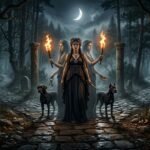
Hecate, daughter of the Titans Perses and Asteria, holds an unusually elevated position in Hesiod’s Theogony despite her relatively minor role in later classical myth, honored by Zeus with authority spanning earth, sea, and sky alike. Her association with crossroads, night, magic, and liminal spaces connects her closely to the underworld cluster generally, and she plays a notable supporting role in the myth of Persephone’s abduction, said to be the only witness, alongside Helios, to hear Persephone’s cries and later becoming her attendant and guide during her underworld sojourns. Later tradition, particularly in magical and Orphic texts, expands Hecate’s role considerably, associating her with a triple-formed aspect and a far more central position in underworld and boundary magic than Hesiod’s earlier account suggests.
Melinoe: A Ghostly Daughter of Persephone
Melinoe appears in later Orphic tradition as a daughter of Persephone and Zeus, born after Zeus, disguised as Hades, deceives Persephone, an origin story that gives her form a genuinely unsettling half-and-half quality, described in the Orphic Hymns as appearing with one side of her body black and the other white. She is associated with ghosts and the frightening apparitions that appear at night, sent to torment mortals with madness, a considerably more obscure figure than the other members of this cluster but a clear extension of the underworld’s association with the unsettling and the liminal into a specific, named goddess of nocturnal fright.
Macaria: Blessed Death
Macaria’s name relates directly to the Greek word for blessedness, and ancient tradition, though sparse on direct mythological narrative involving her, generally treats her as a personification of blessed death, the peaceful, welcome end available to those who have lived well, standing in implicit contrast to death experienced as violent or premature. A separate mortal heroine bearing the same name, daughter of Heracles, who sacrifices herself to secure victory for her family, is sometimes discussed alongside the divine Macaria, though ancient sources generally treat the two as distinct figures connected mainly by shared name and by the heroine’s own death carrying a similarly noble, willingly accepted quality.
A Cluster Defined by Necessary Boundaries
What unites these seven figures isn’t shared temperament so much as shared function: each governs some necessary boundary condition of mortal existence that Greek religious thought needed accounted for. Hades and Persephone provide the underworld its ruling structure and its connection to the cycle of seasons above. Thanatos and Hypnos personify death and sleep as related but genuinely distinct states. Hecate governs the liminal spaces between worlds where magic and transition become possible. Melinoe and Macaria extend the cluster’s reach into the specific experiences of nighttime dread and peaceful passing, respectively. Together, they form Greek mythology’s most complete answer to a question every culture eventually has to address: not simply what happens after death, but what governs the entire structured passage into it.
For the full structure this fits into, see the complete Greek Gods and Goddesses guide, or explore the Twelve Olympians guide for the ruling gods above.

Kaiqui Damasceno is a mythology writer and researcher dedicated to exploring the stories, gods, heroes, and ancient traditions that shaped human culture. Through engaging storytelling and thoughtful analysis, Kaiqui brings mythology to life, uncovering the deeper meanings, conflicts, symbols, and timeless lessons hidden within ancient myths.