Published on · Updated on
Table of Contents
The British classicist M.L. West, whose comparative work “Indo-European Poetry and Myth” remains a touchstone for scholars tracing shared inheritances across ancient religions, noted that Poseidon’s three domains, the sea, earthquakes, and horses, look arbitrary only if you assume they were assembled independently. Read through the lens of Indo-European comparative mythology, they cohere: all three represent forms of sudden, overwhelming, barely controllable force, the exact quality Georges Dumézil assigned to his “second function” of warrior violence, distinct from Zeus’s sovereign first function. This article follows that thread to show Poseidon not as “the sea god” in isolation, but as the Greek expression of a much older conceptual category: elemental force that humans can propitiate but never fully master.
A Name Older Than the Sea Itself
Linear B tablets from Mycenaean Pylos record the name Poseidon (as po-se-da-o) centuries before Homer, and in this earliest layer he appears with comparable or even greater prominence than Zeus in some palace contexts, suggesting his cult predates the classical hierarchy where Zeus clearly outranks him. Some linguists parse his name as “husband” or “lord” of something, possibly Da, an early word for earth, which would make “earthquake-god” his more original function, with sea god status developing afterward as maritime trade grew in importance to Greek city-states.
Brother to a King, Ruler in His Own Right
Poseidon is a son of the Titans Cronus and Rhea, swallowed at birth alongside his siblings and later freed when Zeus forces Cronus to disgorge them. After the Titanomachy, tradition holds that Poseidon, Zeus, and Hades drew lots for the three great domains, sky, sea, and underworld, with Poseidon receiving the sea. This detail matters for understanding his temperament in later myth: unlike gods whose authority derives entirely from Zeus’s favor, Poseidon holds his domain by an original, independent allotment, which may explain why he repeatedly challenges Zeus’s authority elsewhere, including joining Hera and Athena in a failed conspiracy to bind Zeus, an episode Homer references directly in the Iliad.
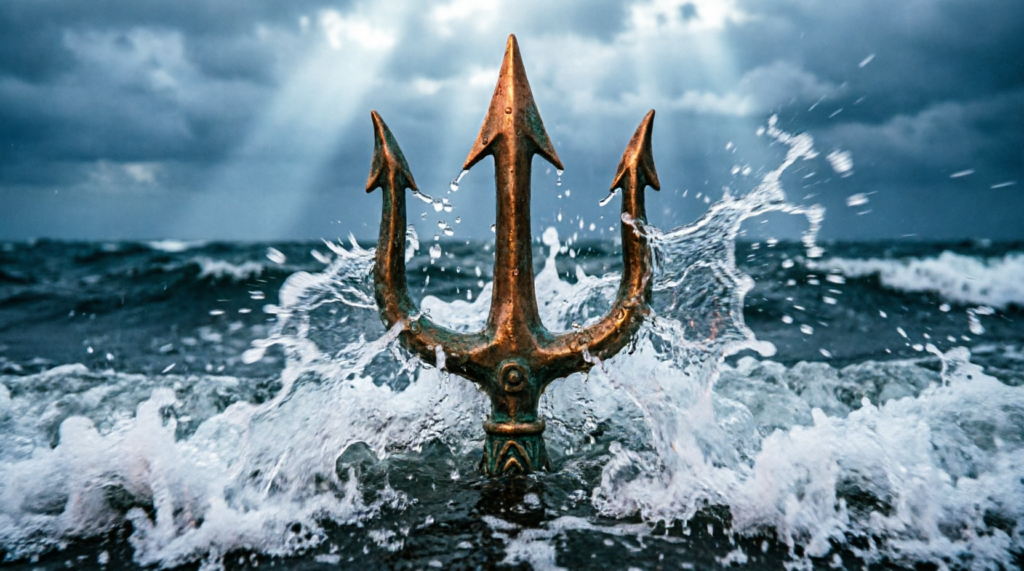
The Trident and the Physics of Ancient Disaster
Ancient Greece sits on some of the most seismically active ground in the Mediterranean, and the epithet Ennosigaios, “earth-shaker,” appears constantly attached to Poseidon’s name across Homeric epic. This was not poetic flourish; it reflected lived, repeated experience. When the ground split open or a coastal town collapsed, Greek communities had an explanatory and propitiatory framework already built into their religion: Poseidon was displeased, and needed appeasement. This function predates and coexists with his oceanic identity throughout the historical record, and several ancient sanctuaries, particularly at Corinth on its narrow isthmus, positioned major Poseidon cult sites at points where seismic risk and maritime commerce both concentrated.
Horse-Maker: The Second Function Made Literal
Multiple traditions credit Poseidon with creating the first horse, sometimes through a failed seduction of Demeter, who transformed into a mare to escape him, only for Poseidon to become a stallion and pursue her regardless, producing the horse Arion. This myth is uncomfortable by modern standards and ancient sources do not soften it, but it establishes something structurally important: Poseidon’s connection to horses is not decorative. Horses in the ancient Mediterranean represented warfare, aristocratic status, and rapid, often violent movement, precisely the register of controlled danger that defines Poseidon’s entire portfolio, extending his elemental unpredictability from the sea onto land through the animal that most embodied barely-tamed power in daily Greek life.
Losing to Athena, and Not Taking It Well
Poseidon’s contest with Athena for patronage of Athens, in which he strikes the Acropolis to produce a saltwater spring while Athena offers an olive tree, and the city chooses Athena’s more practically valuable gift, is often told as a charming founding myth. Ancient sources are less charming about the aftermath: several traditions describe Poseidon flooding the surrounding plain in fury at his defeat, a detail rarely included in family-friendly retellings but consistent with a god whose entire identity is organized around forces that punish underestimation.
The God Who Made Odysseus Suffer for a Decade
Poseidon’s most sustained mythological role comes in the Odyssey, where his wrath at Odysseus for blinding his son, the Cyclops Polyphemus, drives the entire plot. Poseidon cannot kill Odysseus outright, since fate has decreed his survival, but he can, and does, delay, wreck, and torment him across a full decade of wandering, a demonstration that even gods bound by fate’s broader outcomes retain enormous latitude in how much suffering occurs along the way.
Consort of the Deep, Father of Monsters and Heroes
Poseidon’s marriage to the Nereid Amphitrite makes him ruler of an already-populated undersea court, and their son Triton, often depicted with a fish tail, becomes a minor sea deity in his own right. Beyond this primary marriage, Poseidon fathers an unusually high concentration of monstrous or dangerous offspring across Greek myth, including the Cyclops Polyphemus and, through Medusa, the winged horse Pegasus, born from her blood after Perseus beheads her, a detail that circles back to Poseidon’s horse association even in his most violent unions.
The Isthmian Games and Poseidon’s Corinthian Stronghold
Corinth, straddling the narrow isthmus connecting the Peloponnese to mainland Greece, held Poseidon as its principal deity and hosted the Isthmian Games in his honor, one of the four Panhellenic athletic festivals alongside Olympia’s games for Zeus, Delphi’s for Apollo, and Nemea’s for Zeus again. The isthmus itself was a site of genuine seismic vulnerability and maritime necessity simultaneously, ships were sometimes hauled overland across it via the diolkos to avoid the dangerous sea route around the Peloponnese, making it a landscape where Poseidon’s dual identity as earth-shaker and sea-ruler converged with unusual literalness. Pausanias, writing his travel guide to Greece in the 2nd century CE, describes the Isthmian sanctuary in detail, noting statues and dedications that had accumulated there across centuries of continuous worship, evidence of a cult that remained vital long after many other regional sanctuaries had declined.
Neptune: Continuity with a Narrower Portfolio
Poseidon’s Roman counterpart, Neptune, inherited his identity as sea god relatively cleanly, but Roman tradition placed comparatively less emphasis on the earthquake and horse associations that loom so large in Greek sources, reflecting Rome’s different relationship to both maritime commerce and the specific seismic geography of the Greek mainland. Neptune’s major Roman festival, the Neptunalia in July, coincided with the height of the dry season and is generally understood by scholars as a ritual seeking protection against drought and water scarcity, a notably different emphasis from Poseidon’s Greek associations with the sea’s destructive rather than merely life-giving potential, illustrating how the same inherited deity could be reshaped by a different society’s more pressing practical anxieties.
Frequently Asked Questions
Why is Poseidon associated with earthquakes, horses, and the sea?
Comparative mythologists connect all three domains as expressions of sudden, overwhelming, barely-controllable force, reflecting an Indo-European conceptual category rather than an arbitrary combination of separate powers.
Did Poseidon exist before he was primarily a sea god?
Linear B tablets from Mycenaean Pylos record his name centuries before Homer, with some evidence suggesting an original connection to earth and earthquakes that predates his later prominence as ruler of the sea.
How did Poseidon lose the patronage of Athens to Athena?
Poseidon struck the Acropolis to produce a saltwater spring, while Athena offered an olive tree. The city judged Athena’s gift more practically valuable and chose her as patron, reportedly provoking Poseidon to flood the surrounding plain in anger.
Why does Poseidon torment Odysseus throughout the Odyssey?
Odysseus blinded Poseidon’s son, the Cyclops Polyphemus. Unable to kill Odysseus outright due to fate, Poseidon instead delays and torments his journey home for a full decade.
Who was Poseidon’s wife?
Poseidon’s wife was the Nereid Amphitrite, making him ruler of an already-populated undersea court. Their son Triton, often depicted with a fish tail, became a minor sea deity in his own right, frequently shown blowing a conch shell to calm or raise the waves.
What is Poseidon’s Roman equivalent?
Poseidon’s Roman equivalent is Neptune, whose July festival, the Neptunalia, focused more on protection from drought than on the earthquake and horse associations that so thoroughly dominate Poseidon’s Greek identity.
What were the Isthmian Games?
The Isthmian Games were one of the four Panhellenic athletic festivals of ancient Greece, held at Corinth in honor of Poseidon, alongside Olympia’s games for Zeus, Delphi’s for Apollo, and Nemea’s for Zeus again.
Which monsters are counted among Poseidon’s children?
Poseidon’s offspring include the Cyclops Polyphemus and, through Medusa, the winged horse Pegasus, born from her blood after Perseus beheaded her, a detail that circles back to Poseidon’s enduring association with horses even in his most violent unions.
What was Arion?
Arion was an immortal, extraordinarily fast horse born from Poseidon’s pursuit of Demeter after she transformed into a mare to escape him. Poseidon became a stallion and pursued her regardless, producing the horse as offspring.

Kaiqui Damasceno is a mythology writer and researcher dedicated to exploring the stories, gods, heroes, and ancient traditions that shaped human culture. Through engaging storytelling and thoughtful analysis, Kaiqui brings mythology to life, uncovering the deeper meanings, conflicts, symbols, and timeless lessons hidden within ancient myths.