Published on · Updated on
Table of Contents
Every other Olympian is defined primarily by what they govern. Hephaestus is defined at least as much by what he makes, a god whose actual output, weapons, armor, thrones, automatons, and the very jar that releases suffering into the human world, shapes the outcomes of more surrounding myths than almost any other single Olympian’s direct intervention.
Cast Out From Olympus
Hephaestus’s origin carries an unusual and somewhat unresolved detail: ancient sources disagree on both his parentage and the reason for his most famous early humiliation. Hesiod’s Theogony describes Hera producing Hephaestus alone, without a father, seemingly in direct retaliation after Zeus fathers Athena from his own head without Hera’s involvement, a kind of parthenogenetic mirror between the two births. Other traditions instead name both Zeus and Hera as his parents in the conventional way.
The more consistent detail across sources involves Hephaestus’s expulsion from Olympus and resulting lameness. In one version, Hera, disgusted by his appearance at birth, casts the infant Hephaestus from Olympus herself, and he is caught and raised by the sea goddesses Thetis and Eurynome, later returning to Olympus as an accomplished craftsman to take a form of revenge: he sends his mother an enchanted golden throne that traps her the moment she sits in it, releasing her only after the other gods persuade him to return, sometimes only after Dionysus gets him drunk and escorts him back personally. In a separate tradition, it’s Zeus who hurls Hephaestus from Olympus, this time for taking Hera’s side during one of the couple’s frequent disputes, and Hephaestus falls for an entire day before landing on the island of Lemnos, an impact severe enough to explain his permanent lameness in this version of events.
God of Fire and the Forge
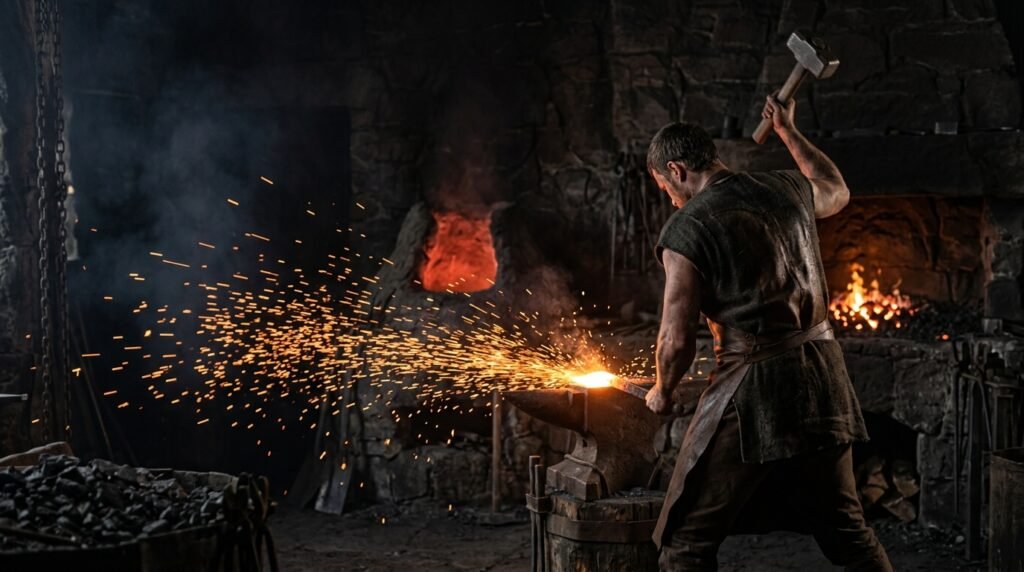
Hephaestus governs fire specifically as a tool of transformation and craft, distinct from Hestia’s own association with fire as the sacred, stationary hearth flame at the center of home and temple alike. His forge is frequently located beneath active volcanoes, most famously Mount Etna in Sicily, where later tradition describes him working alongside the Cyclopes, the primordial one-eyed craftsmen who once forged Zeus’s own thunderbolt, now serving as skilled assistants in Hephaestus’s own volcanic workshop.
That underground, volcanic setting reflects something coherent about how ancient Greeks understood both natural phenomena and skilled labor simultaneously: volcanic eruption and the intense, transformative heat of metalworking shared an obvious physical resemblance, and attributing both to the same god’s ongoing labor gave a coherent religious explanation for otherwise unpredictable geological activity.
Creator of the Gods’ Greatest Objects
Hephaestus’s workshop produces an extraordinary range of significant objects across Greek mythology, arguably giving him more direct narrative influence through his creations than most other Olympians achieve through personal action. He forges Zeus’s thunderbolts in several traditions, crafts Achilles’s magnificent shield in the Iliad, described across dozens of lines of poetry in loving, detailed description of its imagery, and creates Hermes’s winged sandals and helmet. He builds automated, self-moving tripods to assist the gods at their feasts and, in one particularly striking detail, forges golden handmaidens with the appearance of living women, capable of speech and movement, to support him as he walks given his lameness, arguably among the earliest artificial intelligence or robot figures in Western literature.
Perhaps his most consequential single creation, though, is Pandora, the first woman, fashioned from earth and water at Zeus’s direct command as part of the punishment devised against humanity following Prometheus’s theft of fire. Hephaestus doesn’t simply build Pandora’s physical form; he gives her voice and strength as well, working alongside several other gods who contribute beauty, skill, and, in some readings, deception, before she is sent to earth carrying the sealed jar whose opening releases suffering into the human world. That single creation places Hephaestus, a god otherwise generally sympathetic in how ancient sources portray him, at the direct origin point of one of Greek mythology’s most consequential and devastating myths.
Married to Aphrodite
Hephaestus’s marriage to Aphrodite, goddess of love and desire, places him alongside one of the most conventionally desired figures in the entire pantheon, a pairing ancient sources generally treat as an uneasy, imperfect match. Aphrodite’s ongoing affair with Ares becomes the subject of one of Greek mythology’s more memorable episodes: informed of the affair by Helios, who witnesses everything during his daily path across the sky, Hephaestus forges a net so fine it’s invisible to the eye, rigs it above his own marriage bed, and catches the pair together the next time they meet there, summoning the other gods to witness the humiliating scene before eventually agreeing to release them.
That myth positions Hephaestus in a distinctive narrative role within Greek mythology: not the powerful, physically imposing figure typical of major gods, but a wronged husband who nonetheless gets the better of his more conventionally impressive rival through cleverness and craft rather than direct confrontation, a victory of skill over strength that echoes his broader identity throughout Greek myth generally.
The Birth of Athena
Hephaestus plays a small but structurally pivotal role in one of Greek mythology’s most significant births. After Zeus swallows his pregnant first wife Metis to prevent a prophesied son from overthrowing him, he later suffers an agonizing headache, and Hephaestus, axe in hand, splits Zeus’s skull open, allowing Athena to emerge fully grown and fully armed. Some later sources instead credit this act to Prometheus, but the more common tradition gives Hephaestus the honor of physically enabling Athena’s dramatic entrance into the world, a fittingly hands-on, craft-adjacent role for a god otherwise defined by what he builds and shapes with his own hands.
Prometheus and a Reluctant Punishment
Hephaestus’s craft skills are also called upon for a considerably darker purpose: chaining Prometheus to his mountain as punishment for stealing fire and giving it to humanity. Several ancient sources, most notably Aeschylus’s Prometheus Bound, depict Hephaestus as genuinely reluctant to carry out this specific task, sympathetic to Prometheus’s situation given their shared, if distant, association with fire and craft, yet ultimately compelled by Zeus’s direct authority to complete the binding regardless of his own personal feelings about it. That reluctance gives Hephaestus a moment of genuine moral complexity rarely afforded to gods simply executing Zeus’s commands elsewhere in the tradition, forced to use his own skill against a figure whose fundamental gift to humanity, fire itself, closely parallels his own domain.
A God Depicted With Real Physical Difference
Hephaestus holds a genuinely unusual position among the Olympians as the only major god consistently depicted with a physical impairment, his lameness a recurring, unremoved feature across nearly every surviving telling of his mythology rather than something later corrected or overcome. Ancient Greek art and literature generally prized physical perfection as a marker of divine status, making Hephaestus’s consistent portrayal with a visible physical difference a genuine outlier within that broader aesthetic convention. Ancient sources don’t resolve this tension by minimizing his disability or treating it as incidental; instead, his lameness remains a consistent, acknowledged part of his identity throughout, while his exceptional skill and cleverness are presented as entirely undiminished by it, arguably even sharpened by the specific circumstances of his exile and self-reliance following his fall from Olympus.
Cult Worship and Athens
Hephaestus received meaningful cult worship particularly in Athens, closely associated there with Athena in a shared patronage of craft, technology, and artisanal skill befitting a city whose economy and cultural identity depended significantly on skilled manufacturing and trade. The Hephaisteion, a well-preserved temple overlooking the Athenian Agora and among the best-preserved ancient Greek temples still standing today, testifies to the genuine civic significance his cult held in Athens specifically, even if his worship remained less central than Zeus’s or Athena’s own across the wider Greek world generally.
Roman Vulcan
Hephaestus’s Roman counterpart, Vulcan, inherits his core identity as god of fire and the forge, and his name survives directly and unmistakably in the modern English word “volcano,” among the clearest examples of any Greco-Roman deity’s name persisting into ordinary contemporary vocabulary through the specific geological phenomenon most closely associated with his mythological workshop. Roman religious practice generally treated Vulcan with a somewhat different emphasis than Hephaestus received in Greek tradition, associating him more directly with fire’s destructive potential and holding festivals aimed specifically at averting harmful fires, a practical civic concern reflecting Rome’s own dense urban vulnerability to accidental conflagration.
For the full picture of how Hephaestus fits among the Twelve Olympians, see the Twelve Olympians guide, part of Godspire’s complete guide to the Greek pantheon.
Frequently Asked Questions
Why is Hephaestus depicted as lame?
Ancient sources disagree on the exact cause. One tradition describes Hera casting him from Olympus at birth due to his appearance; another describes Zeus hurling him from Olympus for taking Hera’s side in a dispute, with the fall itself causing his lameness.
What is Hephaestus’s most famous creation?
Among many significant objects, Hephaestus’s most consequential single creation is arguably Pandora, the first woman, fashioned at Zeus’s command as part of humanity’s punishment following Prometheus’s theft of fire.
How did Hephaestus catch Aphrodite and Ares together?
Hephaestus forged an invisible net and rigged it above his own marriage bed, trapping his wife Aphrodite and her lover Ares together, then summoned the other gods to witness the humiliating scene.
What is Hephaestus’s Roman equivalent?
Hephaestus’s Roman counterpart is Vulcan, whose name is the direct source of the modern English word “volcano,” reflecting his close mythological association with fire and the forge.

Kaiqui Damasceno is a mythology writer and researcher dedicated to exploring the stories, gods, heroes, and ancient traditions that shaped human culture. Through engaging storytelling and thoughtful analysis, Kaiqui brings mythology to life, uncovering the deeper meanings, conflicts, symbols, and timeless lessons hidden within ancient myths.