Published on · Updated on
Table of Contents
Hephaestus is the only Olympian consistently described as disabled, born lame or, in some tellings, made lame by his fall from Olympus, and ancient sources treat this fact with a complexity that rewards close attention rather than modern assumptions. He is simultaneously rejected for his disability, thrown from Olympus by an ashamed mother in several tellings, and unmatched in skill, producing weapons and objects no other god could replicate. This combination, physical difference paired with singular, indispensable craft, has made Hephaestus a genuinely interesting case study for scholars examining how ancient societies understood disability, not as simple deficiency but as coexisting with, and in his myth even enabling, exceptional capability.
Rejected at Birth
Hephaestus is son of Zeus and Hera, though several traditions describe Hera bearing him alone, without Zeus, a deliberate mirroring of Zeus’s own solo production of Athena. Born lame or disfigured, by most accounts, he is thrown from Olympus by his ashamed mother, a fall some sources say lasted a full day before he landed in the sea, where sea deities Thetis and Eurynome secretly raised him for nine years in an underwater grotto.
Revenge Through Craft, Not Force
Hephaestus’s response to his rejection is characteristically indirect and clever rather than violent. He crafts a magnificent golden throne and sends it to Hera as a gift; the moment she sits, invisible bonds trap her, and no god but Hephaestus himself can release her. He initially refuses to return to Olympus to free his own mother, relenting only when Dionysus gets him drunk and escorts him back, a resolution achieved through cunning and eventual persuasion rather than any direct confrontation.
The God of Fire and the Forge
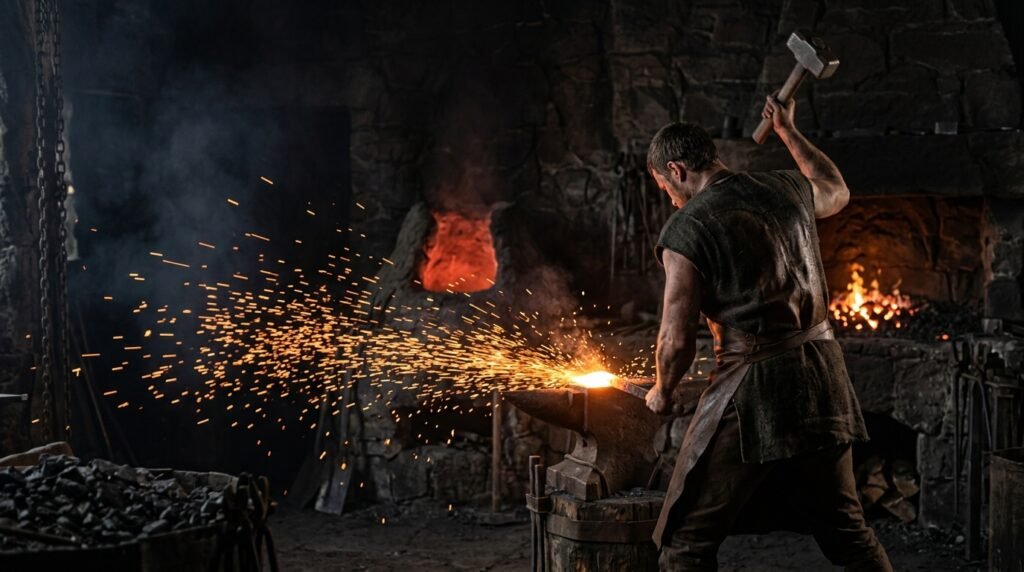
Hephaestus governs metalworking, the forge, and craftsmanship broadly. His workshop is traditionally located beneath a volcano, most often identified with Mount Etna, where he labors alongside the Cyclopes, and his creations include Zeus’s thunderbolt, Achilles’s armor described in extraordinary detail across an entire book of the Iliad, and numerous other divine objects no other craftsman, mortal or immortal, could produce.
Lemnos: Where the God Actually Landed
The island of Lemnos held particular significance in Hephaestus’s cult, identified by several ancient sources as the actual site of his fall from Olympus, and archaeological evidence confirms genuine metalworking activity on the island dating to antiquity, a rare instance where a god’s specific mythological geography aligns with the real economic activity, metalworking, that a location was actually known for in the ancient Mediterranean.
Catching His Wife in the Act
Hephaestus’s marriage to Aphrodite is portrayed throughout Greek myth as unhappy. Her most famous affair, with the war god Ares, ends when the sun god Helios reports it to Hephaestus, who crafts an invisible, unbreakable net, catches the lovers in bed, and invites the other gods to witness their humiliation, a scene ancient sources treat with open comedy, demonstrating that Hephaestus’s intelligence and craft could achieve what his physical strength alone could not.
Creator of Pandora
On Zeus’s command, Hephaestus shapes the first woman, Pandora, from earth and water, giving her physical form before other gods endow her with various qualities, including beauty, skill, and, in Hesiod’s telling, deceptive cunning. She is then sent to earth as retribution for Prometheus’s theft of fire, making Hephaestus, through this act of craft, directly responsible for setting in motion one of Greek mythology’s most consequential stories of human suffering.
Vulcan: A Roman God of Fire and Protection
Hephaestus’s Roman counterpart Vulcan inherited his core identity as god of the forge and fire, but Roman cult practice emphasized protection from fire specifically, given the constant danger fire posed to densely built Roman cities. Vulcan’s festival, the Volcanalia in August, involved rituals specifically aimed at preventing destructive fires during the driest part of the Roman year.
Frequently Asked Questions
Why was Hephaestus thrown from Olympus?
Born lame or disfigured, he was thrown from Olympus by his ashamed mother Hera. He fell into the sea, where the sea deities Thetis and Eurynome secretly raised him for nine years.
How did Hephaestus get revenge on Hera?
He crafted a golden throne that trapped Hera in invisible bonds the moment she sat in it. Only Hephaestus could release her, which he did after Dionysus got him drunk and brought him back to Olympus.
How did Hephaestus catch his wife's affair?
The sun god Helios reported Aphrodite’s affair with Ares to Hephaestus, who crafted an invisible, unbreakable net, caught the lovers in bed, and invited the other gods to witness their humiliation.
What is Hephaestus's Roman equivalent?
Hephaestus’s Roman equivalent is Vulcan, whose cult emphasized protection from fire, with his festival, the Volcanalia, involving rituals to prevent destructive fires during Rome’s driest season.

Kaiqui Damasceno is a mythology writer and researcher dedicated to exploring the stories, gods, heroes, and ancient traditions that shaped human culture. Through engaging storytelling and thoughtful analysis, Kaiqui brings mythology to life, uncovering the deeper meanings, conflicts, symbols, and timeless lessons hidden within ancient myths.