Published on · Updated on
Table of Contents
Most gods govern a single, clearly defined domain. Hermes governs the spaces between domains: the road between cities, the threshold between rooms, the line between honest trade and outright theft, and, most consequentially, the boundary between the world of the living and the world of the dead. He is, from the day of his birth, Greek mythology’s clearest embodiment of movement, cunning, and crossing over.
Son of Zeus and Maia
Hermes is the son of Zeus and Maia, one of the seven Pleiades and herself a daughter of the Titan Atlas, born in a secluded cave on Mount Cyllene in Arcadia. The Homeric Hymn to Hermes, likely composed in the 6th century BCE, opens with one of Greek mythology’s most memorable accounts of precocious mischief: Hermes, still an infant on the very day of his birth, climbs out of his cradle and sets off to prove himself.
That single detail sets the tone for his entire mythology. Where most gods grow into their defining traits over time, Hermes arrives fully formed as a trickster, inventor, and boundary-crosser from his first hours of existence, treating the ordinary rules that might constrain a newborn as simply another boundary to slip past.
Stealing Apollo’s Cattle
Hermes’s first recorded act is theft. Still an infant, he sneaks away from his cradle and steals a herd of sacred cattle belonging to his half-brother Apollo, driving them backward to disguise their tracks and even fashioning sandals from tree bark to further confuse any pursuit. When Apollo eventually discovers the theft and confronts him, Hermes, remarkably, denies everything with a straight face, pointing out that he’s only a newborn, barely capable of standing, let alone driving cattle across the countryside.
The dispute is eventually brought before Zeus, who finds the whole episode amusing and orders Hermes to return the cattle. Rather than end there, the story pivots into reconciliation: Hermes, having earlier that same day invented the lyre by stretching strings across a hollowed tortoise shell, offers the instrument to Apollo as recompense. Apollo, delighted with this new invention, accepts, and the two half-brothers part on good terms, Apollo gaining the lyre that becomes one of his defining symbols, and Hermes gaining Apollo’s own cattle and, in some versions, his herding staff as well. It’s a myth that establishes Hermes’s core character in miniature: audacious, disarmingly clever, and ultimately more interested in clever exchange than in lasting conflict.
God of Travelers, Trade, and Thieves
Hermes’s domain expands naturally outward from that founding myth. He becomes the god of travelers and roads, protector of merchants and trade, and, more ambiguously, patron of thieves and those who profit through cunning rather than force. That combination might seem contradictory, honest commerce and outright theft under the same god, but ancient Greek thought saw a real connective thread: both activities depend on movement, negotiation, and the strategic crossing of boundaries, whether physical borders between territories or the boundary between what belongs to one person and another.
Herms, the stone boundary markers topped with a carved head and, traditionally, an erect phallus, stood at crossroads, property lines, and city gates throughout the Greek world, invoking Hermes’s protection over exactly the liminal spaces his mythology already centered on. The mass mutilation of Athens’s herms on the eve of the Sicilian Expedition in 415 BCE became one of the most notorious religious scandals of the Peloponnesian War, a reminder of how seriously ancient Greeks took Hermes’s boundary-markers as objects of genuine civic and religious significance, not mere decoration.
Messenger of the Gods
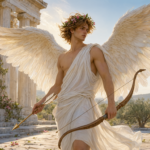
Hermes’s most consistent role throughout Greek myth is as the messenger of the gods, particularly of Zeus, tasked with delivering divine commands and news across vast distances with unmatched speed. His winged sandals, talaria, and winged cap or helmet make him instantly recognizable across ancient art, visual shorthand for a god whose entire function depends on rapid, unimpeded movement between realms that other gods and mortals cross far less easily.
That messenger role appears throughout Homer’s epics and beyond: Hermes delivers Zeus’s command to Calypso that she must release Odysseus, guides Priam safely through the Greek camp to recover Hector’s body in the Iliad, and appears at critical junctures throughout later mythology whenever a message needs to move quickly and reliably between Olympus and the mortal world, or between different corners of the divine realm itself.
Guide of Souls to the Underworld
Beyond his role among the living, Hermes carries the distinct title Psychopomp, “guide of souls,” responsible for escorting the recently deceased from the world of the living down to the underworld. That role places him in a genuinely unusual position among the Olympians: nearly alone among the major gods, Hermes moves freely and repeatedly between the realm of the living, the halls of Olympus, and the underworld itself, a god defined by crossing exactly the boundaries other deities generally respect and rarely traverse in person.
This psychopomp function connects directly to his broader identity as god of thresholds. Death, in this framing, is simply the final and most significant boundary a mortal crosses, and Hermes’s role guiding souls across it extends his existing domain over roads, doorways, and borders into its most consequential possible application.
The Caduceus
Hermes is frequently depicted carrying a herald’s staff, the caduceus, typically shown with two serpents entwined around it. Ancient sources connect the staff’s origin to a myth in which Hermes separates two fighting serpents, who then wind themselves peacefully around it, a story functioning as an origin tale for the staff’s association with peaceful negotiation and safe passage for messengers and heralds. It’s worth noting a common modern confusion directly: the caduceus, Hermes’s herald staff, is frequently mistaken in contemporary usage for the Rod of Asclepius, a single serpent wound around an unwinged staff and the actual traditional symbol of medicine and healing. The two symbols, despite their visual similarity, come from entirely separate mythological figures and traditions, and the caduceus’s modern association with medicine in some contexts is generally considered a historical error rather than an authentic ancient connection.
Patron of Athletes and Games
Hermes held significant patronage over athletic competition and the gymnasium, reflecting his broader association with speed, skill, and youthful vigor. Statues of Hermes frequently stood at the entrances to ancient Greek gymnasia, and he was honored alongside Heracles as a patron of the wrestling schools where young Greek men trained, a role that extended his domain from literal roads and boundaries into the more abstract territory of competitive achievement and physical excellence.
A Trickster Among the Gods
Beyond his specific myths, Hermes holds a broader reputation throughout Greek literature as the cleverest and most resourceful of the Olympians, frequently enlisted by Zeus and other gods specifically because a situation requires cunning rather than raw force. He assists in freeing Zeus’s siblings from Cronus in some traditions, plays a key role in several trickster narratives involving other gods and mortals, and generally represents the value ancient Greek culture placed on metis, cunning practical intelligence, as a virtue equal to, and sometimes more effective than, physical strength alone.
Roman Mercury
Hermes’s Roman counterpart, Mercury, inherits his core identity as messenger god and patron of trade, travelers, and boundaries, and his name survives directly in the modern English word “mercurial,” describing a quick-changing, unpredictable temperament that echoes Hermes’s own defining speed and cunning. Mercury’s association with commerce grew especially prominent in Roman religious practice, reflecting Rome’s own extensive trade networks and the practical, everyday importance of a god overseeing safe and successful exchange across long distances.
Hermes and the Rescue of Persephone
Hermes’s role as psychopomp appears with particular significance in the myth of Persephone’s abduction. Once Zeus arbitrates a compromise allowing Persephone to spend part of the year above ground with her grieving mother Demeter, it is Hermes who is sent down to the underworld to retrieve her, guiding her back across the same boundary between the living and the dead that he alone among the major Olympians could cross so routinely. That detail reinforces how central his threshold-crossing function was to the broader mythological structure of Greek religion: whenever a story needed a god capable of moving safely and reliably between realms other deities left strictly separated, Hermes was the consistent choice.
For the full picture of how Hermes fits among the Twelve Olympians, see the Twelve Olympians guide, part of Godspire’s complete guide to the Greek pantheon.
Frequently Asked Questions
What did Hermes steal as an infant?
On the day of his birth, Hermes stole a herd of sacred cattle belonging to his half-brother Apollo, later resolving the dispute by offering Apollo the lyre he had just invented as compensation.
What does “psychopomp” mean in relation to Hermes?
Psychopomp means “guide of souls.” Hermes was responsible for escorting the recently deceased from the world of the living to the underworld, one of the few Olympians who moved freely between both realms.
Is the caduceus the correct symbol for medicine?
No, though it’s a common modern confusion. Hermes’s caduceus, with two entwined serpents and wings, is a herald’s staff associated with commerce and safe passage. The actual traditional symbol of medicine is the Rod of Asclepius, featuring a single serpent on an unwinged staff.
What is Hermes’s Roman equivalent?
Hermes’s Roman counterpart is Mercury, who retains his core identity as messenger god and patron of trade and travelers, and whose name is the source of the modern English word “mercurial.”

Kaiqui Damasceno is a mythology writer and researcher dedicated to exploring the stories, gods, heroes, and ancient traditions that shaped human culture. Through engaging storytelling and thoughtful analysis, Kaiqui brings mythology to life, uncovering the deeper meanings, conflicts, symbols, and timeless lessons hidden within ancient myths.