Published on · Updated on
Table of Contents
Every night, without asking permission or announcing his arrival, Hypnos does his work on nearly every living creature on earth. Few gods in Greek mythology exercise power so total and so routinely accepted, and few are so rarely thanked for it.
Son of Night, Twin to Death
Hypnos is a son of Nyx, primordial Night, born according to Hesiod’s Theogony without a father, twin brother to Thanatos, the personification of death. That pairing places sleep and death within the same immediate family, siblings rather than distant opposites, and Greek mythology consistently draws on that kinship to describe sleep as death’s gentler, temporary cousin, a nightly visit from the same underlying force that eventually arrives to stay.
Hypnos’s genealogy connects him to a broader cluster of siblings Hesiod groups together as forces born of Night without a father: the Moirai (Fates), Nemesis (Retribution), Eris (Strife), and Thanatos himself. Like his brother, Hypnos operates less like an Olympian courting favor and more like a primordial condition simply doing what its nature requires, indifferent to status, wealth, or virtue among those it visits.
Lord of an Underworld Cave
Ancient sources, most notably the poet Ovid in his Metamorphoses, describe Hypnos dwelling in a cave near the underworld, a place of permanent twilight where no rooster crows, no dog barks, and no branch stirs, a setting engineered entirely around the absence of anything that might interrupt rest. The river Lethe, whose waters induce forgetfulness, flows past the cave’s entrance, murmuring continuously, its steady sound itself functioning as a kind of ambient invitation to sleep. Poppies and other soporific plants grow thick around the cave’s mouth, and Hypnos himself reclines within on a soft, black-curtained bed, attended by his son Morpheus and Morpheus’s brothers, each specializing in a different category of dream.
That imagined geography matters because it positions Hypnos’s domain adjacent to, but distinct from, the underworld itself, close enough to share its hush and stillness, far enough to remain a separate, survivable state rather than death’s actual territory.
Father of Dreams
Hypnos is the father, by most traditions with the goddess Pasithea, one of the Graces, of Morpheus and his brothers, who together govern the specific content of dreams rather than sleep’s general unconsciousness. Morpheus specializes in dreams involving human figures, capable of assuming and mimicking any person’s exact appearance and manner within a sleeper’s vision. His brothers Phobetor and Phantasos handle dreams involving animals and inanimate objects respectively, a surprisingly systematic division of dream-labor that reflects how carefully later Greek and Roman poetic tradition thought through the actual mechanics of what sleep produces, not simply rest itself but an entire secondary, image-filled experience layered on top of it.
That distinction between Hypnos and his sons matters directly: Hypnos governs whether a person sleeps at all, the state of unconsciousness itself, while Morpheus and his brothers govern what fills that unconsciousness once it arrives, a division of labor between the fact of sleep and its actual, often strange content.
Assisting Hera Against Zeus
Hypnos’s most developed individual myth appears in Homer’s Iliad, where Hera enlists his help in a scheme to distract Zeus during the Trojan War. Having already tricked Zeus once before into a deep sleep to help Heracles’s mother against Zeus’s own wishes, an act that earned him Zeus’s lasting fury, Hypnos is initially reluctant to risk provoking the king of the gods a second time. Hera persuades him only by offering one of the younger Graces, Pasithea, as a bride, a reward significant enough to overcome his understandable caution.
Hypnos lulls Zeus into deep, sudden sleep, allowing Hera to secretly assist the Greek forces against Zeus’s explicit wishes while he remains unconscious and unaware. That episode reveals something genuinely distinctive about Hypnos’s power within the mythological hierarchy: he is one of the very few figures in Greek myth capable of directly overpowering Zeus himself, if only temporarily and through the specific, universal mechanism of sleep rather than force or cunning of the more conventional kind. Even the king of the gods cannot resist sleep once Hypnos chooses to induce it, a limitation no amount of raw divine power can overcome.
Carrying Sarpedon From the Battlefield
Alongside his twin Thanatos, Hypnos appears in one of the Iliad’s most tender scenes, gently lifting the body of the fallen hero Sarpedon, a son of Zeus killed in battle, and carrying him home for proper burial rites rather than leaving him on the battlefield. The two brothers work together here as a matched, cooperative pair, Sleep and Death jointly performing an act of care rather than cruelty, an image that shaped how ancient Greek funerary art repeatedly depicted the pair afterward: twin winged youths standing gently at either end of a deathbed, their combined presence marking a peaceful, dignified transition rather than a violent or frightening one.
Sleep as Divine Necessity, Not Weakness
It’s worth resisting a modern instinct to read sleep, and by extension Hypnos, as a lesser or passive force compared to the more actively dramatic gods. Ancient Greek thought treated sleep as a genuinely necessary, structurally significant part of the cosmic order, not a gap or absence but an active state with its own god, its own geography, and its own capacity to override even Zeus’s will. That the most powerful figure in the entire pantheon can be rendered briefly powerless by Hypnos’s touch says something real about how ancient Greeks understood the limits of even divine authority: strength, cunning, and status all eventually yield to the same nightly, universal requirement every living thing shares.
Symbols and Depictions
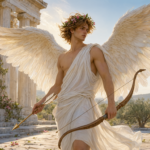
Hypnos is consistently depicted in ancient art as a winged youth, sometimes shown carrying a horn from which he pours a sleep-inducing liquid, or holding poppies and other plants associated with soporific effect. His wings, sometimes shown at his temples rather than his back, distinguish him visually from his brother Thanatos while marking the same essential quality of swift, silent, unannounced arrival. Statues and reliefs of Hypnos frequently emphasize a gentle, almost weightless quality to his movement, consistent with sleep’s own experienced arrival, rarely forced, generally settling over a person gradually rather than all at once. In some depictions he carries a small opium poppy stem in each hand, sometimes brushing them against a subject’s forehead as the literal instrument of inducing sleep, a detail that gave later herbalists and physicians a direct mythological reference point when discussing the plant’s own sedative properties.
A Universally Necessary God
Unlike Thanatos, who received little direct cult worship as a force few mortals wished to actively court, Hypnos held slightly more practical significance in certain ancient contexts, particularly medicine and healing. Sleep’s restorative role made it a genuinely welcome and actively sought divine influence, and asklepieia, the healing sanctuaries dedicated to Asclepius, incorporated practices around incubation, sleeping within the sanctuary specifically to receive healing dreams or divine guidance, a practice that implicitly relied on Hypnos’s own domain even when formal prayers were directed primarily toward Asclepius himself.
Hypnos and the Practice of Dream Incubation
Beyond his connection to Asclepius’s healing sanctuaries, Hypnos’s domain touched a wider ancient practice of deliberately seeking prophetic or instructive dreams through ritual sleep, sometimes performed at oracular sites specifically associated with dream interpretation rather than waking prophecy. Petitioners would sleep within a sanctuary after specific purification rites, hoping to receive guidance, healing, or insight directly through a dream rather than through a priestess’s spoken oracle. That practice treated Hypnos’s domain as more than mere rest; sleep itself became a legitimate channel for divine communication, a threshold state where ordinary waking judgment stepped aside and something else, whether medical insight or genuine prophecy, could reach the sleeper more directly than it might during conscious hours.
Roman Somnus
Hypnos’s Roman counterpart, Somnus, inherits his core identity and much of his specific mythology intact, including the cave dwelling described by Ovid and his role as father to Morpheus. Somnus’s name survives directly in modern medical and pharmaceutical vocabulary, most visibly in “insomnia,” describing the specific, frustrating absence of the god’s usual nightly visit, and in various sleep-related clinical terms that continue drawing on the same Latin root centuries after Roman religious practice itself faded.
For the full picture of how Hypnos fits among the underworld and death cluster, see the Underworld and Death guide, part of Godspire’s complete guide to the Greek pantheon.
Frequently Asked Questions
How is Hypnos related to Thanatos?
Hypnos and Thanatos are twin brothers, both sons of Nyx (Night), personifying sleep and death respectively. Ancient sources consistently pair them as related but distinct forces, sleep functioning as death’s gentler, temporary counterpart.
Who are Hypnos’s children?
Hypnos is the father of Morpheus and his brothers Phobetor and Phantasos, who govern the specific content of dreams involving human figures, animals, and inanimate objects respectively.
How did Hypnos help Hera deceive Zeus?
Hera persuaded Hypnos to put Zeus into a deep sleep during the Trojan War, allowing her to secretly assist the Greek forces against his wishes. Hypnos agreed only after being offered the Grace Pasithea as a bride.
What is Hypnos’s Roman equivalent?
Hypnos’s Roman counterpart is Somnus, who inherits his core mythology, including his cave dwelling and role as father to Morpheus. Somnus’s name survives in modern words like “insomnia.”

Kaiqui Damasceno is a mythology writer and researcher dedicated to exploring the stories, gods, heroes, and ancient traditions that shaped human culture. Through engaging storytelling and thoughtful analysis, Kaiqui brings mythology to life, uncovering the deeper meanings, conflicts, symbols, and timeless lessons hidden within ancient myths.