Published on · Updated on
Table of Contents
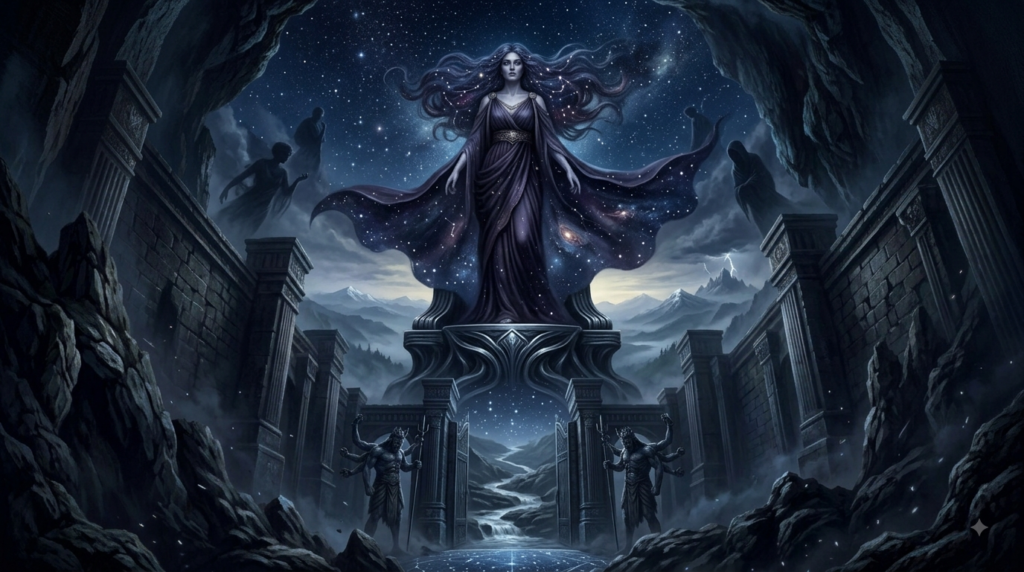
Nyx is the Greek personification of Night, one of the very first beings to exist, powerful enough that even Zeus, ruler of Olympus, is described hesitating rather than risking her anger. This article is about Nyx from Greek mythology specifically, not any modern brand, character, or unrelated use of the name.
Who Is Nyx in Greek Mythology?
Nyx appears in Hesiod’s Theogony, composed in the late 8th or early 7th century BCE, among the earliest generation of beings, born from Chaos alongside her sibling Erebus (Darkness). Her position in that opening sequence tells you almost everything about her importance: she isn’t a minor figure who shows up once the world is already organized, she’s part of the raw material the world is built from.
Her name is, quite simply, the Greek word for “night.” That directness matters. Where later gods often have names describing a role or a domain they preside over, Nyx’s name and her identity are essentially the same thing, a pattern she shares with other primordial figures like Gaia and Pontus, whose names are also the ordinary Greek words for what they personify.
Nyx’s Children: Sleep, Death, and More
With Erebus, Nyx produces Aether (bright upper air) and Hemera (Day), meaning that light itself, in Hesiod’s cosmology, is born from the union of darkness and night. On her own, without any partner, Hesiod says Nyx also gives birth to an extraordinary list of personified forces: Hypnos (Sleep), Thanatos (Death), the Oneiroi (Dreams), Nemesis (Retribution), Momus (Blame), Apate (Deceit), the Keres (violent death-spirits), and several others.
This family isn’t a random assortment. Nearly every one of Nyx’s children represents something that arrives when human control loosens, while a person sleeps, while judgment slips, while death approaches. Ancient Greek poets used genealogy as a way to explain how ideas relate to each other, and by making Sleep and Death siblings, both born of Night, Hesiod is making a quiet but pointed observation: the two are close enough in nature to belong to the same family, resembling each other closely enough that later Greek art frequently depicted them as twin youths.
Why Was Zeus Afraid of Nyx?
The clearest evidence of Nyx’s exceptional status comes not from a myth about her directly, but from a brief, famous scene in Homer’s Iliad. Hypnos, god of Sleep and one of Nyx’s children, recounts how he once helped Hera put Zeus to sleep. When Zeus woke and was furious, Hypnos fled and sought refuge with his mother, Night, and Zeus, despite his anger, held back rather than risk offending her.
This moment doesn’t show Nyx defeating Zeus in any physical confrontation. Instead, it demonstrates something arguably more significant in Greek myth’s internal logic: that some primordial powers exist outside the normal chain of Olympian authority entirely. Zeus can punish rebellious gods and hurl thunderbolts at Titans, but Night belongs to an older category of existence that even he treats with caution, a distinction ancient audiences would have understood as being about cosmic seniority rather than raw physical strength.
Was Nyx a Titan?
No. This is a common point of confusion, since Nyx is clearly ancient and powerful, qualities people often associate with the Titans. But Nyx belongs to an earlier tier of Greek cosmology, the primordial generation, born directly from Chaos, while the Titans are children of Uranus and Gaia, a full generation later. Nyx predates the Titans, rather than being one of them, placing her closer in cosmic seniority to figures like Chaos and Gaia than to Cronus or Rhea.
Nyx and Erebus: Night and Darkness
Nyx is frequently paired with Erebus, the personification of primal darkness, and the two are often described as siblings or consorts depending on the source. The distinction between them is subtle but real in Greek thought: Night is the recurring cycle that falls over the world every evening, while Erebus represents a heavier, more absolute darkness, closer to the gloom of the underworld than to an ordinary nightfall.
Their union produces Aether and Hemera, light and day, meaning that in Hesiod’s account, brightness doesn’t exist as an independent force from the beginning. It has to be generated, and its origin point is darkness itself, a structural choice in Hesiod’s cosmology that recurs throughout the primordial generation: order and visibility emerge from prior conditions of formlessness and obscurity rather than existing from the very start.
Nyx in Orphic Tradition
Beyond Hesiod, Nyx also holds a notably elevated position in Orphic cosmogony, the separate religious-poetic tradition preserved mostly in fragments and later summaries. Some Orphic sources describe her as an oracular or prophetic figure, dwelling in a cave at the edge of the world and possessing knowledge that predates even the gods who eventually consult her, a considerably more active and authoritative role than the largely genealogical position she occupies in Hesiod’s account. That elevation suggests different religious communities within the broader Greek world emphasized different aspects of her character, with Orphic circles apparently drawn to Nyx as a source of hidden cosmic wisdom rather than simply the mother of Sleep and Death.
Nyx’s Roman Name: Nox
The Roman equivalent of Nyx is Nox, a figure who appears throughout Latin poetry carrying much the same associations, night, mystery, and a kind of solemn, ancient authority. Roman writers like Ovid and Virgil use Nox in ways that closely echo the Greek tradition, treating her as a dignified, primal presence rather than reworking her into something substantially different, a continuity that held for most of the primordial figures whose Roman names changed while their essential character remained largely intact.
For the full picture of how Nyx fits among the other primordial gods, see the Primordial Gods guide, part of Godspire’s complete guide to the Greek pantheon.
Frequently Asked Questions
Is Nyx a Titan?
No. Nyx is a primordial deity, born directly from Chaos, which places her a full generation earlier than the Titans, who are children of Uranus and Gaia.
Who are Nyx’s children?
With Erebus, Nyx is the mother of Aether and Hemera. On her own, Hesiod credits her with producing Hypnos (Sleep), Thanatos (Death), the Oneiroi (Dreams), Nemesis, and several other personified forces associated with night and its effects.
Why did Zeus fear Nyx?
In Homer’s Iliad, Zeus refrains from punishing Hypnos (Sleep) once Hypnos takes refuge with his mother, Nyx, a moment that suggests even Zeus recognized limits to his authority when it came to primordial powers like Night.
What is the difference between Nyx and Erebus?
Nyx personifies night as a recurring daily cycle, while Erebus represents a deeper, more absolute darkness, closer in character to the gloom of the underworld. The two are often paired as siblings or consorts in ancient sources.
What is Nyx’s Roman name?
Nyx’s Roman counterpart is Nox, who carries similar associations with night and ancient authority throughout Latin poetry.

Kaiqui Damasceno is a mythology writer and researcher dedicated to exploring the stories, gods, heroes, and ancient traditions that shaped human culture. Through engaging storytelling and thoughtful analysis, Kaiqui brings mythology to life, uncovering the deeper meanings, conflicts, symbols, and timeless lessons hidden within ancient myths.