Published on · Updated on
Table of Contents
Before Apollo ever became associated with the sun in the popular imagination, an older, more literal god already drove it across the sky every single day. Helios doesn’t govern light the way Apollo governs music or prophecy — he simply is the sun, in transit, watched by nothing except his own endless daily route.
The Titan-Generation Son of Hyperion
Helios is the son of the Titans Hyperion and Theia, and brother to Selene, the moon, and Eos, the dawn — a family that together accounts for nearly every visible daily phenomenon in the sky. Hesiod’s Theogony, composed in the late 8th or early 7th century BCE, places him firmly within the generation between the Titans and the Olympians, distinct from his father Hyperion, with whom he is frequently and understandably confused, since both carry strong solar associations and Homer occasionally uses “Hyperion” as an epithet applied directly to Helios himself.
The clearer, more systematic distinction, especially as later Greek tradition settles it, treats Hyperion as the Titan father, the source of the family’s association with light, and Helios as the son who actually performs the visible, repeated daily act of carrying the sun across the sky.
Driving the Chariot
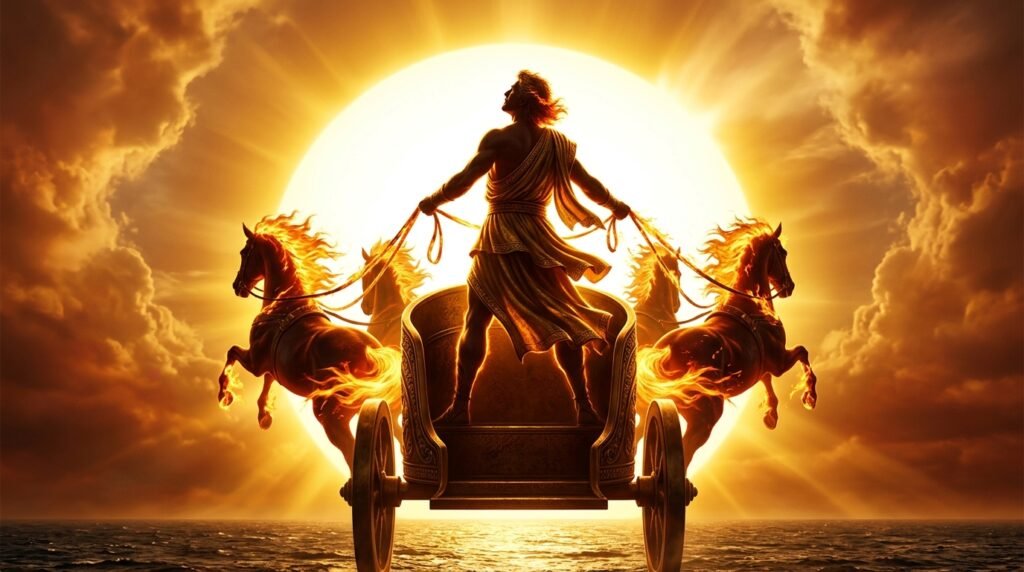
Helios’s defining task, described across a wide range of ancient sources, is straightforward but relentless: each day, he drives a chariot pulled by fiery horses from the eastern edge of the world to the west, and each night, he is carried back to his starting point, sometimes described as floating across the encircling river Oceanus in a great golden cup or bowl, ready to begin the same journey again the next morning. Unlike Atlas or Prometheus, Helios’s role isn’t a punishment; it’s simply his function, performed without complaint or apparent hardship across an uncountable number of repetitions.
That relentless visibility becomes central to Helios’s other major role in Greek myth: because he crosses the entire sky every day, he sees everything that happens beneath him, making him one of Greek mythology’s most reliable witnesses whenever a god or mortal needs proof of an event no one else observed.
The Witness Who Cannot Be Fooled
Helios’s role as an all-seeing witness surfaces repeatedly across Greek myth. In the Odyssey, it’s Helios who reports to Demeter that Hades has abducted Persephone, since he alone watched it happen from above, giving the grieving goddess the information she needs to demand her daughter’s return. In a separate and much earthier episode of the Odyssey, it’s also Helios who catches Ares and Aphrodite in their affair and reports it directly to Aphrodite’s husband, Hephaestus, allowing Hephaestus to catch the lovers in an ingeniously constructed net.
That recurring narrative function, the god whose daily route makes deception genuinely impossible, gives Helios a quieter but consistent kind of authority throughout Greek myth. He rarely acts as a primary character in his own right; instead, he functions as the cosmos’s built-in truth-detector, invoked whenever a story needs an unimpeachable source.
Phaethon and the Chariot He Couldn’t Control
Helios’s most famous individual myth involves his mortal son, Phaethon, whose parentage other children mock and doubt. Seeking proof of his divine father, Phaethon travels to Helios’s palace and demands a favor to settle the matter once and for all. Helios, having already sworn by the unbreakable oath of the river Styx to grant whatever his son asks, is bound to comply even after Phaethon’s request turns out to be reckless beyond anything he anticipated: to drive the sun chariot himself for one day.
Phaethon cannot control the divine horses. The chariot swings wildly off its usual path, scorching parts of the earth into desert and freezing others as it veers too far away, until Zeus, to prevent total catastrophe, strikes Phaethon down with a thunderbolt, sending him falling into the river Eridanus. The myth functions as one of Greek mythology’s clearest illustrations of a specific danger: divine power in untrained or overconfident hands, and the reckless pursuit of proof or glory beyond one’s actual ability to handle its consequences. It’s also notable for showing Helios in a genuinely vulnerable position, bound by his own oath to grant a request he immediately recognizes as a disaster, unable to refuse even his own son’s ruin.
Helios and the Island of Rhodes
Beyond his cosmic function, Helios held a uniquely central place in the actual religious life of one specific location: the island of Rhodes, where he was the chief civic deity, credited in local myth with claiming the island for himself as it rose from the sea, and later famously commemorated by the Colossus of Rhodes, a monumental bronze statue of Helios and one of the Seven Wonders of the Ancient World, constructed in the early 3rd century BCE to celebrate the island’s successful defense against a siege. That statue, though it stood for only a few decades before an earthquake toppled it, remains one of the most concrete pieces of evidence for how seriously an entire Greek city could take a god whose mythology elsewhere reads as relatively quiet and functional rather than dramatic.
Cattle, Oaths, and Odysseus
Helios also owns sacred cattle, herds tended on the island of Thrinacia and left completely untouched by mortals for generations, until Odysseus’s starving crew, against explicit warning, slaughters and eats some of them during their long journey home in the Odyssey. Helios, outraged, threatens to shine in the underworld instead of the sky unless Zeus punishes the offense, and Zeus complies, destroying Odysseus’s ship with a thunderbolt and killing the entire crew responsible, leaving Odysseus as the story’s sole survivor. The episode reinforces the same pattern visible throughout Helios’s mythology: he rarely intervenes directly, but when his domain or his possessions are violated, the consequences that follow are swift, severe, and enforced through Zeus rather than through any personal confrontation.
Later Identification With Apollo
By the classical and especially the Hellenistic period, Helios becomes increasingly identified or merged with Apollo in popular religious and literary imagination, despite the two beginning as clearly distinct figures with separate genealogies, Helios as Titan-generation offspring of Hyperion, Apollo as an Olympian son of Zeus and Leto. That merging was never fully official or consistent across all of Greek religious practice, but it became common enough that later audiences, and many modern retellings, often default to Apollo as “the sun god” without realizing an older, more literal solar deity existed first and never entirely disappeared from the tradition.
For the full picture of how Helios fits among the Titans’ children, see the Second Generation guide, part of Godspire’s complete guide to the Greek pantheon.
Frequently Asked Questions
Is Helios the same as Apollo?
Not originally. Helios is a Titan-generation god, son of Hyperion and Theia, who literally personifies and drives the sun. Apollo is a separate Olympian god, son of Zeus and Leto, associated with prophecy, music, and healing. The two became increasingly identified with each other in later Greek and Roman tradition, but they begin as distinct figures.
What happened to Phaethon?
Phaethon, Helios’s mortal son, convinced his father to let him drive the sun chariot for a day to prove his divine parentage. Unable to control the horses, he sent the chariot dangerously off course, and Zeus struck him down with a thunderbolt to prevent a greater catastrophe.
Why is Helios often used as a witness in Greek myths?
Because he crosses the entire sky every day, Helios sees everything that happens on earth, making him a reliable source whenever a myth needs proof of an event no other god or mortal witnessed directly, such as Persephone’s abduction or Aphrodite’s affair with Ares.
What is the Colossus of Rhodes?
The Colossus of Rhodes was a monumental bronze statue of Helios, one of the Seven Wonders of the Ancient World, built in the early 3rd century BCE to celebrate Rhodes’s successful defense against a siege. Helios was the island’s chief civic deity.

Kaiqui Damasceno is a mythology writer and researcher dedicated to exploring the stories, gods, heroes, and ancient traditions that shaped human culture. Through engaging storytelling and thoughtful analysis, Kaiqui brings mythology to life, uncovering the deeper meanings, conflicts, symbols, and timeless lessons hidden within ancient myths.