Published on · Updated on
Table of Contents
Aphrodite doesn’t govern desire alone. Around her, Greek mythology builds an entire extended family of smaller gods, each personifying one specific piece of what draws people together, what persuades, what completes a union, and what marks the passage from youth into full adulthood. This guide covers the eight figures most closely associated with love, beauty, and desire beyond Aphrodite’s own dedicated article.
Eros: Desire Itself
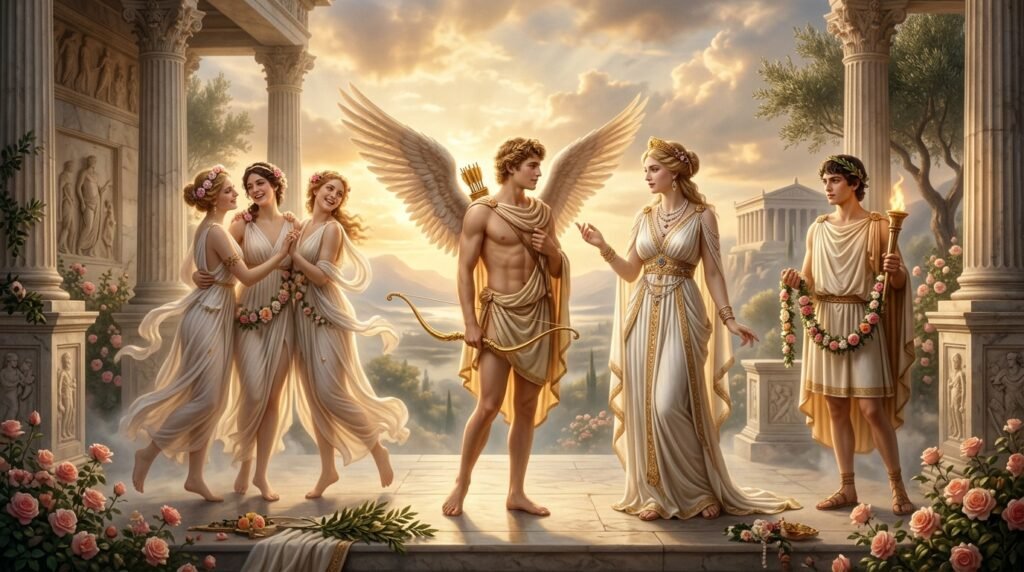
Eros presents Greek mythology with a genuine puzzle: two distinct, seemingly incompatible origin stories that ancient sources never fully reconciled. Hesiod’s Theogony names Eros among the very first primordial beings, born alongside Chaos and Gaia at the absolute beginning of the cosmos, a fundamental force present before most of the pantheon existed to be desired at all. Later tradition, far more familiar to modern audiences, instead makes him the son of Aphrodite, frequently by Ares, a mischievous, winged archer whose golden arrows inspire uncontrollable passion in whoever they strike. Ancient Greek religious thought, as preserved in Hesiod’s Theogony, seems to have held both versions simultaneously, an older cosmic Eros and a younger, more narratively active one, without treating the contradiction as a problem requiring resolution.
Himeros: Longing and Yearning
Himeros personifies the specific ache of longing, desire directed at someone or something not yet possessed, distinct from the more general concept Eros represents. He appears frequently in Aphrodite’s own retinue, sometimes described as her companion or attendant alongside Eros himself, and ancient poetry uses his name specifically to describe the particular sensation of yearning that precedes fulfillment, the reaching rather than the having. Sappho and other early lyric poets invoke Himeros directly when describing the physical, almost painful quality of unfulfilled desire, treating him as a distinct enough force to warrant his own name separate from Eros’s broader domain.
Pothos: Desire for the Absent
Closely related to Himeros, Pothos personifies desire specifically for someone or something absent, gone, or otherwise unreachable, a more melancholic register of longing than Himeros’s more general ache. Ancient sources sometimes distinguish the two precisely along this line: Himeros for desire in the moment, Pothos for desire stretched across distance or loss, yearning for what cannot currently be held regardless of whether it once was. Pothos appears in later Hellenistic art and poetry particularly in funerary and departure contexts, personifying the specific grief-adjacent desire felt for someone who has died or traveled far away, a nuance considerably more specific than Eros’s own broader domain covers.
Anteros: Requited Love and Its Absence
Anteros occupies a genuinely dual position within this family of desire-gods, personifying both requited love, affection returned in equal measure, and, in a separate but related tradition, vengeance against those who scorn love offered sincerely. According to one account, Aphrodite, concerned that her son Eros remained perpetually a child, was told he needed a sibling to grow, and Anteros’s birth allowed Eros to finally mature, an origin story that treats requited love itself as the necessary condition for desire to develop into something more complete. In his second, harsher role, Anteros punishes those who reject genuine love cruelly, a reminder that Greek mythology’s gods of attraction weren’t purely gentle; even love carried a capacity for consequence when mishandled.
Peitho: Persuasion
Peitho personifies persuasion specifically in its romantic and rhetorical dimension, the specific quality of convincing speech or charm that succeeds in winning someone over. She appears closely associated with Aphrodite throughout ancient sources, sometimes as her attendant, sometimes nearly merged with her in cult practice, since successful seduction and courtship in Greek thought depended as much on persuasive charm as on beauty alone. Peitho’s domain extended beyond romance into political rhetoric as well, reflecting a broader ancient recognition that the same underlying quality, the power to move someone’s will through words and presence rather than force, operated similarly whether the goal was love or public consensus.
Hymenaios: God of the Wedding Feast
Hymenaios, sometimes called Hymen, personifies the wedding song and the marriage ceremony itself, invoked directly in ancient wedding processions through ritual chants bearing his name. Accounts of his parentage vary considerably, with different sources naming Apollo and one of the Muses, or Dionysus and Aphrodite, among other combinations, a genealogical inconsistency that reflects how his cult developed primarily around ritual function rather than a single fixed mythological narrative. Some traditions describe Hymenaios dying young, on his own wedding day in certain versions, giving Greek wedding songs an undercurrent of bittersweet awareness that even the most celebrated unions exist within a world where joy and loss remain closely, sometimes tragically, intertwined.
Hebe: Goddess of Youth
Hebe, daughter of Zeus and Hera, personifies youth specifically in its physical prime, the vigor and beauty of early adulthood rather than childhood itself. She served as cupbearer to the gods on Olympus before that role passed to Ganymede, and she becomes the wife of Heracles after his apotheosis and acceptance among the Olympians, a union that rewards the hero’s mortal struggles with eternal youthful vitality alongside a goddess whose very name embodies exactly that quality. Hebe’s domain connects naturally to this broader cluster of love and attraction deities, since youth’s physical bloom was, in ancient Greek aesthetic and romantic thought, inseparable from desirability itself, beauty and youthful vigor treated as closely related expressions of the same underlying appeal.
The Graces: Beauty, Charm, and Joy
The Graces, or Charites, are typically named as three sister goddesses, Aglaea (Splendor), Euphrosyne (Mirth), and Thalia (Good Cheer), daughters of Zeus and the Oceanid Eurynome according to Hesiod, though other traditions offer different parentage. They personify beauty, charm, grace, and creative inspiration collectively rather than desire in its more urgent, physical sense, frequently depicted dancing together in close, interlinked formation, an image that itself represents the harmonious, joyful quality they embody. The Graces appear consistently in Aphrodite’s retinue, attending her and helping prepare her for appearances before other gods, and they extend their influence into festivity, poetry, and the arts generally, treated as the source of whatever quality makes a gathering, a work of art, or a person’s presence genuinely delightful rather than merely adequate.
Why This Cluster Sits Outside the Twelve Olympians
It’s worth addressing directly why none of these eight figures appear among the Twelve Olympians despite governing a domain as universally significant as love and attraction. Aphrodite herself holds the Olympian seat for this entire conceptual territory, and the figures covered in this guide function as her extended retinue and family rather than as independent, competing centers of worship. That structural choice reflects a broader pattern in how Greek religious thought organized itself: major domains generally received one primary Olympian representative, while the specific, granular pieces of that domain, desire’s different registers, persuasion’s specific mechanics, youth’s particular vitality, were distributed among a supporting cast of minor deities who elaborated the main god’s territory without displacing her central authority. Understanding these eight figures as Aphrodite’s extended household rather than as rivals or equals clarifies how they actually functioned within ancient religious practice and poetic tradition alike.
How Ancient Poets Used This Family of Gods
Greek and later Roman poets treated this cluster less as a fixed theological system and more as a flexible vocabulary for describing the actual texture of romantic experience with precision unavailable through Aphrodite’s name alone. A poet describing unrequited longing could invoke Himeros or Pothos specifically rather than simply naming Aphrodite generally, giving the audience an immediate, precise emotional register the broader goddess’s name wouldn’t communicate on its own. This precision mattered enormously in a poetic tradition built heavily around performance and immediate audience recognition; naming Peitho specifically in a courtship scene signaled persuasion’s active work in a way that simply saying “Aphrodite favored him” would leave considerably vaguer. That specificity is part of why this cluster, despite containing relatively minor individual deities compared to the major Olympians, proved so durable and useful across centuries of Greek and Roman literature: each name did real, distinct descriptive work no single broader god could replace.
The Cluster’s Connection to Marriage and Social Order
Beyond individual romantic experience, several figures in this cluster connect directly to marriage as a formal social institution rather than desire in its purely private sense. Hymenaios presided specifically over the wedding ceremony itself, invoked in ritual song meant to formalize a union publicly and religiously, transforming private desire into a recognized social bond with real legal and familial consequence in ancient Greek society. Peitho’s persuasive function extended into this same territory, since successful courtship in many ancient contexts required negotiation not just between two individuals but between families, and the same quality of effective, charming persuasion applied to convincing a bride’s family as much as to winning a bride’s own affection. This dimension is worth emphasizing because it corrects a modern tendency to read this entire cluster as concerned purely with private romantic feeling; ancient Greek religious thought treated desire, persuasion, and marriage as continuous with one another, private experience flowing directly into public, socially binding ceremony through this same connected family of gods.
A Family of Related but Distinct Forces
What unites these eight figures isn’t interchangeability but precision: Greek mythology consistently preferred naming each specific piece of the experience of attraction and union separately rather than folding everything into Aphrodite’s single domain. Eros and Himeros and Pothos map three different registers of desire itself, present, yearning, and absent. Peitho governs the persuasion that makes desire effective. Anteros governs whether that desire is returned. Hymenaios marks the ceremony that formalizes it, and Hebe and the Graces surround the whole cluster with the youthful vitality and joyful charm that made desire worth pursuing in the first place. Together, they form Greek mythology’s most granular map of attraction, a subject most cultures compress into a single god or concept, broken here into precise, individually named pieces.
For the full structure this fits into, see the complete Greek Gods and Goddesses guide, or explore Aphrodite’s own article for the goddess this entire cluster surrounds.

Kaiqui Damasceno is a mythology writer and researcher dedicated to exploring the stories, gods, heroes, and ancient traditions that shaped human culture. Through engaging storytelling and thoughtful analysis, Kaiqui brings mythology to life, uncovering the deeper meanings, conflicts, symbols, and timeless lessons hidden within ancient myths.