Published on · Updated on
Table of Contents
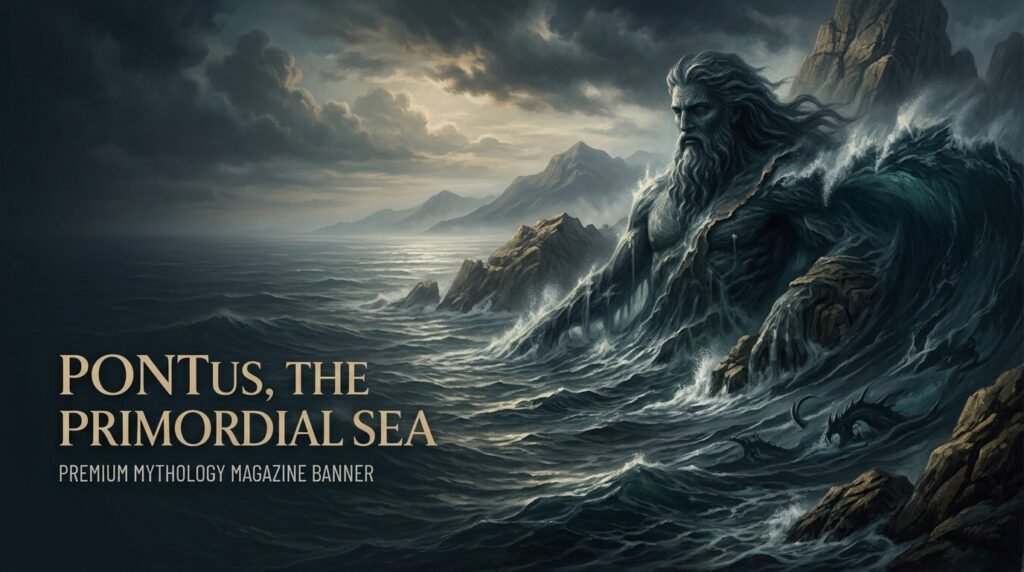
Long before Poseidon claimed a throne beneath the waves, Greek mythology already had an answer to a more basic question: why does the sea exist at all? That answer is Pontus, not a ruler of the ocean, but the ocean itself, given divine identity at the very beginning of the cosmos.
Born Without a Father
Hesiod’s Theogony, composed in the late 8th or early 7th century BCE, describes Gaia producing Pontus “without sweet union,” without a partner, the same way she produces Uranus. That detail places Pontus firmly among the primordial generation rather than treating him as a later addition to the family. He isn’t born into an existing world that needed a sea god; he’s part of how the world’s basic geography comes into being in the first place.
Later mythographers occasionally trace Pontus to different or expanded parentage, but Hesiod’s account, the earliest and most influential surviving version, remains the anchor point. Pontus belongs to the same tier of existence as Gaia herself: elemental, foundational, and largely uninterested in the personal drama that defines later generations of gods.
Two Very Different Bloodlines
With Gaia, Pontus fathers five children, Nereus, Thaumas, Phorcys, Ceto, and Eurybia, and this family says a great deal about how the Greeks imagined the sea’s dual nature.
Nereus, often called the “Old Man of the Sea,” represents the ocean’s calmer, trustworthy side. Hesiod specifically notes that Nereus doesn’t lie, an unusual compliment in a mythology full of tricksters and shape-shifters. Thaumas, whose name relates to wonder, becomes father to Iris, the rainbow, and in some traditions to the Harpies, connecting the sea to sudden weather and strange apparitions.
Phorcys and Ceto represent something much darker. Their descendants, in standard genealogies, include the Graeae and the Gorgons, placing some of Greek mythology’s most feared monsters directly within Pontus’s family line. Between Nereus on one side and Phorcys and Ceto on the other, Pontus’s children map the sea’s full emotional range: safe harbor and honest counsel in one branch, hidden danger and monstrous transformation in the other.
Pontus Is Not Poseidon
It’s worth being precise about a distinction that gets blurred in casual retellings. Poseidon is an Olympian, a political and narrative presence with temples, myths, a trident, and a habit of intervening directly in human affairs, contesting cities, causing earthquakes, punishing sailors who cross him. Pontus predates all of that. He belongs to cosmogony rather than to the world of active, story-driven gods.
If Poseidon is a character who does things, Pontus is closer to a condition that simply is, the sea as raw fact rather than the sea as governed territory. That’s also likely why Pontus has almost no attested cult worship in the ancient record, while Poseidon had major sanctuaries throughout the Greek world. Ancient religious practice generally directed prayer toward gods who intervened in daily life, not toward primordial personifications explaining how the world’s structure came to be.
Pontus and the Broader Sea Family
Beyond his own children, Pontus sits at the root of an enormous later network of marine figures. His grandchildren and further descendants, through Nereus and the Nereids, through Ceto’s monstrous line, through Thaumas and Electra, populate huge stretches of later Greek myth, from the fifty Nereids who attend Poseidon’s court to the Gorgon Medusa herself, eventually slain by Perseus. Almost none of these later, more famous figures ever interact with Pontus directly in surviving stories. He functions as an origin point rather than a participant, a name genealogies trace back to rather than a character myths are told about.
How Ancient Sources Describe Pontus
Ancient sources describe Pontus briefly but with real genealogical weight. Hesiod remains the essential text, and later mythographers, including the compiler traditionally known as Pseudo-Apollodorus, largely repeat and systematize his framework rather than replacing it with independent material. That scarcity of anecdote isn’t a gap waiting to be filled with invented stories; ancient audiences generally accepted that some primordial figures existed to establish cosmic structure and genealogy rather than to star in their own adventures, and Pontus is among the clearest examples of that pattern in the entire tradition.
Pontus in Later Greek and Roman Geography
The Greek word pontos, from which Pontus takes his name, remained in ordinary use as a general term for open sea long after the primordial god himself had faded from active worship, and it eventually lent its name to real, mapped places: the historical region of Pontus along the southern shore of the Black Sea, later home to the powerful Hellenistic Kingdom of Pontus under rulers like Mithridates VI. That naming wasn’t a coincidence so much as a natural extension of how the Greeks used the word itself, geographic terms and divine names sharing a common root because the sea, in whichever sense you meant it, always traced back to the same underlying concept. Readers researching ancient history sometimes stumble across “Pontus” as a kingdom or province and assume a direct mythological connection; the link is linguistic and conceptual rather than a case of the god himself being worshipped there above other regions.
For the full picture of how Pontus fits among the other primordial gods, see the Primordial Gods guide, part of Godspire’s complete guide to the Greek pantheon.
Frequently Asked Questions
Is Pontus the same as Poseidon?
No. Pontus is the primordial sea itself, born directly from Gaia at the beginning of the cosmos. Poseidon is a later Olympian god who actively rules and governs the sea within the world of myth and cult worship.
Who are Pontus’s children?
With Gaia, Pontus fathers Nereus, Thaumas, Phorcys, Ceto, and Eurybia. Their descendants include figures as different as the wise Nereids and the monstrous Gorgons, reflecting the sea’s dual reputation in Greek imagination.
Was Pontus worshipped in ancient Greece?
There’s little evidence of an established cult for Pontus. Like several other primordial deities, he belongs mainly to poetic and cosmological tradition rather than to the everyday religious practice directed at gods like Poseidon.
How is Pontus connected to famous monsters like Medusa?
Medusa descends from Pontus through his son Phorcys and daughter Ceto, whose union produces the Gorgons and several other feared monstrous lineages in Greek mythology, making Pontus a distant genealogical root behind many of the tradition’s most fearsome creatures.

Kaiqui Damasceno is a mythology writer and researcher dedicated to exploring the stories, gods, heroes, and ancient traditions that shaped human culture. Through engaging storytelling and thoughtful analysis, Kaiqui brings mythology to life, uncovering the deeper meanings, conflicts, symbols, and timeless lessons hidden within ancient myths.