Published on · Updated on
Table of Contents
Uranus is the Greek personification of the sky — the primordial husband of Gaia (Earth) and, in most ancient accounts, the very first ruler of the cosmos. This article is about the mythological deity, not the seventh planet from the sun, though the two are directly connected: astronomers named the planet after this god specifically to keep the solar system’s naming pattern consistent with Greek mythological genealogy.
Who Is Uranus in Greek Mythology?
Uranus is one of the primordial deities described in Hesiod’s Theogony, composed in the late 8th or early 7th century BCE, born from Gaia alone, without a father, so that she would have “an equal to herself, to cover her on every side.” That phrase captures his basic function: Uranus is the dome of the visible heavens, stretched out to enclose and protect the earth beneath him.
Unlike later Olympian gods with temples, priests, and detailed personal mythology, Uranus has almost no cult presence in the archaeological record. He belongs almost entirely to poetry and cosmogony, a foundational figure rather than a god people actually prayed to for help with daily concerns like harvests or safe travel.
Uranus and Gaia: Sky and Earth United
After Gaia produces Uranus, the two unite, and Uranus becomes both her son and her husband, an uncomfortable detail by later standards, but one Hesiod states plainly and without commentary, treating it as simply how the earliest generation of the cosmos came to be organized. Together they produce the twelve Titans, the three Cyclopes, and the three Hundred-Handed Ones, an extraordinary and varied divine family.
Uranus, however, comes to fear these children. Rather than allowing them to be born into the world, he forces each one back inside Gaia’s body as soon as they emerge, trapping them and causing her enormous pain. This single act of paternal fear sets the entire chain of Greek mythological succession in motion, establishing a pattern of fathers fearing their children that repeats with Cronus and, in a different way, with Zeus himself.
The Castration of Uranus
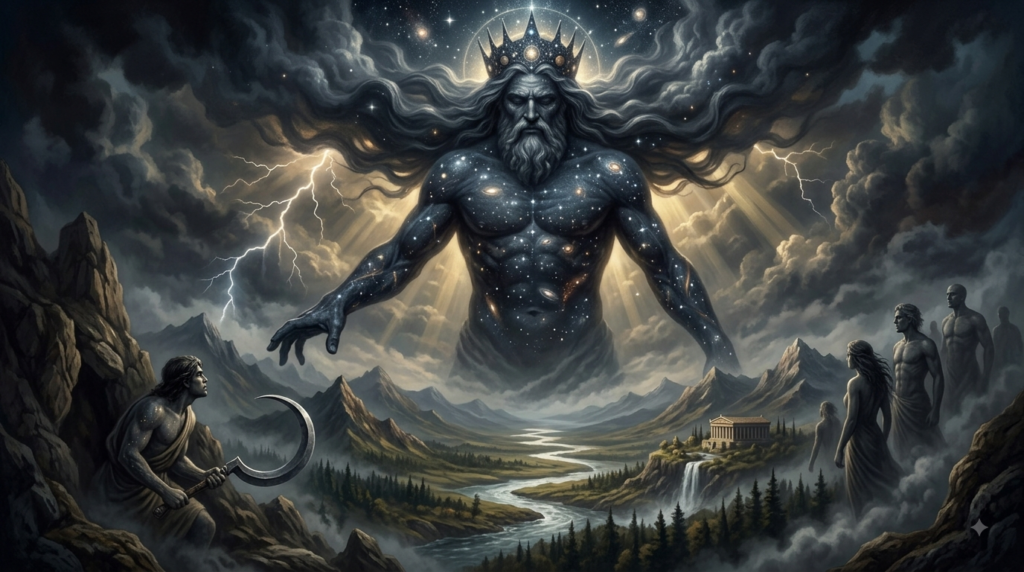
Unable to bear the suffering any longer, Gaia crafts a great sickle from grey flint and asks her imprisoned children which of them will use it against their father. Only Cronus, youngest of the Titans, is willing. When Uranus next descends to lie with Gaia, Cronus ambushes him from hiding and castrates him with the sickle, ending Uranus’s direct rule over the cosmos.
The consequences of this act are physically dramatic. Uranus’s blood, falling onto Gaia, gives rise to the Erinyes (the Furies), the Giants, and the Meliae (ash-tree nymphs). His severed flesh, thrown into the sea, gathers sea-foam around it — and from that foam, according to Hesiod, Aphrodite is born near the island of Cyprus. Homer offers an entirely different account of Aphrodite’s origin, making her the daughter of Zeus and Dione instead; Greek mythology preserved both traditions side by side without ever forcing a single resolution, a pattern that shows up repeatedly across the tradition wherever competing regional or poetic accounts existed.
Was Uranus a Titan?
No, this is one of the most common points of confusion. Uranus is the father of the Titans, not a member of that generation himself. He belongs to the primordial tier of Greek cosmology, born directly from Gaia, one generation earlier than Cronus, Rhea, Oceanus, and the rest of the Titan siblings.
After his overthrow, Uranus makes one final, consequential act: he warns Cronus that he, too, will one day be overthrown by one of his own children. That prophecy sets up the entire next stage of Greek myth, as Cronus, terrified of the same fate, begins swallowing his own children whole, until Zeus, hidden away by his mother Rhea, survives to fulfill exactly the warning Uranus gave.
Uranus in Orphic and Later Philosophical Thought
Beyond Hesiod’s account, Uranus also surfaces in Orphic cosmogony, the separate religious-poetic tradition that offers alternative creation sequences involving figures like Chronos, Ananke, and the cosmic egg. In some Orphic material, the sky god’s role becomes less about dynastic succession and more about representing the outer boundary of the physical cosmos itself, a shift that mirrors how several primordial figures were gradually reinterpreted by later thinkers less interested in family drama and more interested in cosmological structure. Presocratic philosophers, working centuries after Hesiod, occasionally borrowed the imagery of sky and earth as a starting point for their own speculation about the physical origins of the universe, even when they explicitly rejected the mythic framework surrounding it.
Uranus’s Roman Counterpart: Caelus
The Roman equivalent of Uranus is Caelus, the personification of the sky in Latin literature. As with several other primordial Greek deities, Caelus never developed into a major, actively worshipped figure in Roman civic religion; he remains, much like Uranus, a poetic and cosmological presence rather than a temple god with an established cult and regular festivals.
Why Is the Planet Uranus Named After This God?
William Herschel discovered the seventh planet in 1781 and initially proposed naming it “Georgium Sidus” (“George’s Star”) in honor of King George III. Astronomers outside Britain resisted that name, preferring to continue the mythological naming pattern already established with Mercury, Venus, Mars, Jupiter, and Saturn.
German astronomer Johann Elert Bode specifically proposed Uranus because, in Greek mythology, Uranus is the father of Cronus (Saturn’s Greek counterpart), meaning the new planet, sitting one step further from the sun than Saturn, would carry the name of Saturn’s own mythological father. The name Uranus eventually won out internationally, though “Georgium Sidus” persisted in some British astronomical writing for decades afterward, a small reminder of how recently and deliberately these mythological names were assigned to the modern solar system.
For the full picture of how Uranus fits among the other primordial gods, see the Primordial Gods guide, part of Godspire’s complete guide to the Greek pantheon.
Frequently Asked Questions
Is Uranus a Titan in Greek mythology?
No. Uranus is a primordial deity and the father of the Titans, one generation older than Cronus, Rhea, and the rest of the Titan siblings.
Why was Uranus overthrown?
Uranus forced his children back inside Gaia’s body to prevent their birth, causing her constant pain. In response, Gaia helped their son Cronus ambush and castrate Uranus, ending his rule.
What did Uranus’s blood create?
According to Hesiod, blood from Uranus’s castration falling onto Gaia produced the Erinyes (Furies), the Giants, and the Meliae. His severed flesh, cast into the sea, is said to have given rise to Aphrodite in one version of her birth myth.
What is Uranus’s Roman name?
Uranus’s Roman counterpart is Caelus, the personification of the sky in Latin poetry and mythology.
Why is the planet Uranus named after the Greek god?
Astronomer Johann Elert Bode proposed the name specifically because Uranus is the mythological father of Cronus (Saturn), keeping the planet names consistent with Greek genealogy as the solar system’s naming pattern moved outward from the sun.

Kaiqui Damasceno is a mythology writer and researcher dedicated to exploring the stories, gods, heroes, and ancient traditions that shaped human culture. Through engaging storytelling and thoughtful analysis, Kaiqui brings mythology to life, uncovering the deeper meanings, conflicts, symbols, and timeless lessons hidden within ancient myths.