Published on · Updated on
Table of Contents
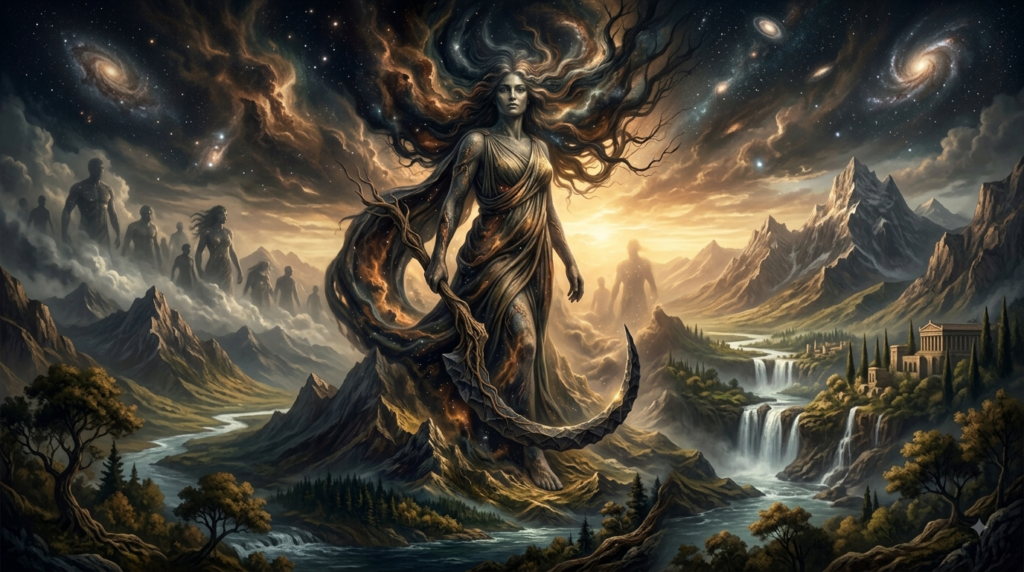
Gaia is the Greek personification of Earth itself — not a goddess who lives on the earth or watches over it, but the literal ground, soil, and land given divine identity and voice. She is one of the very first beings to exist in Greek cosmology, appearing immediately after Chaos in Hesiod’s Theogony, and she goes on to become the mother of nearly every major divine lineage that follows: the Titans, the Cyclopes, the Giants, and — depending on the source — several of the world’s most feared monsters.
Who Is Gaia in Greek Mythology?
Gaia’s name comes directly from the Greek word for “earth” or “land,” and that direct link between name and substance is central to who she is. Unlike Zeus or Athena, whose names don’t describe a physical thing, Gaia’s identity and the ground beneath your feet are, in a real sense, the same entity wearing two descriptions.
Hesiod places her arrival immediately after Chaos, calling her “Gaia the broad-breasted, the ever-sure foundation of all.” That phrase — “ever-sure foundation” — captures her function precisely. Everything that happens in Greek myth, every war, every birth, every betrayal, happens on top of her. She isn’t a background setting so much as a participant who happens to also be the stage.
Gaia’s Children: The Titans, Cyclopes, and Hundred-Handers
Alone, without any partner, Gaia produces Uranus (the Sky), the mountains, and Pontus (the Sea). She then unites with her own son Uranus to produce an extraordinary family: the twelve Titans, the three one-eyed Cyclopes, and the three Hundred-Handed Ones (Hecatoncheires), monstrous beings each with fifty heads and a hundred arms.
This is one of Greek mythology’s more unsettling family structures, and ancient audiences would have understood it that way too. Gaia is simultaneously Uranus’s mother and his mate — a detail that later Greek writers rarely dwelled on but never erased from the record either. Out of that union comes the entire Titan generation, including Cronus, who will go on to overthrow his own father with a weapon his mother personally provides.
The Castration of Uranus: Gaia’s Role
Uranus, afraid of the power of his own children, forces each of them back inside Gaia’s body as soon as they’re born, refusing to let any of them emerge into the world. Hesiod describes this as a source of immense physical pain for Gaia — Earth herself, straining under the weight of children who can never be born, held perpetually inside her.
Gaia’s response is decisive. She creates a great sickle out of grey flint, gathers her imprisoned children, and asks for a volunteer willing to use it against their father. Only Cronus, the youngest Titan, agrees. When Uranus next descends to unite with Gaia, Cronus ambushes him and castrates him, finally freeing his siblings and separating sky from earth. The blood that falls onto Gaia’s body from this act gives rise to the Erinyes (Furies), the Giants, and, in some tellings, the Meliae (ash-tree nymphs) — meaning that even in the moment of her liberation, Gaia continues generating new divine beings from violence she didn’t choose but ultimately orchestrated.
Gaia and the Birth of Monsters
Gaia’s motherhood doesn’t stop with the Titans. Later in Greek mythology, she becomes the mother — or grandmother, depending on the genealogy — of some of the tradition’s most dangerous creatures. When Zeus imprisons the Titans in Tartarus after the Titanomachy, Gaia, angry at their treatment, unites with Tartarus himself to produce Typhon, a monstrous storm-serpent powerful enough to nearly overthrow Zeus in single combat.
This pattern recurs throughout Greek myth: Gaia repeatedly acts as a check on divine overreach. She warns, she conspires, and when she believes the current cosmic order has gone too far, she generates a new threat to challenge it. She is never a passive backdrop; she is an active participant in the balance of power between generations of gods, even generations far removed from her own.
Gaia’s Connection to the Oracle at Delphi
According to a tradition preserved in several ancient sources, including the opening of Aeschylus’s Eumenides, the sacred site at Delphi — later famous as Apollo’s oracle — originally belonged to Gaia. The lineage of ownership, as Aeschylus presents it, passes from Gaia to the Titaness Themis, then to another figure named Phoebe, and finally to Apollo.
That succession story matters because it frames Apollo’s most famous sanctuary not as something he simply built, but as something he inherited from an older, earth-based tradition of prophecy. Before there was a shining Olympian god of prophecy, there was, in myth at least, an earth goddess whose ground itself was believed to speak, a tradition consistent with the broader ancient Greek association between chthonic, earth-connected powers and the ability to see beyond ordinary human knowledge.
Autochthony and Athenian Identity
Gaia’s role as literal ground extends into one of Athens’s most important civic myths: autochthony, the idea that the earliest Athenians sprang directly from the earth rather than migrating from elsewhere. The clearest example is Erichthonius, a founding figure of Athenian kingship, born when Hephaestus’s failed pursuit of Athena results in his seed falling to the earth, which Gaia then receives and from which the infant Erichthonius emerges. Athena raises him, and vase paintings sometimes show Gaia rising only partway from the ground to hand the child upward, a striking visual compromise between goddess and geography.
That myth wasn’t merely decorative. Athenians used the idea of autochthony to argue for a specific kind of political legitimacy: unlike other Greek cities whose populations could be traced to invaders or settlers, Athens could claim its people were born directly from Athenian soil itself, with Gaia as the literal mother of the city’s earliest royal line.
Gaia’s Roman Counterpart: Tellus
The Roman equivalent of Gaia is Tellus, sometimes called Terra Mater, “Mother Earth.” Unlike Gaia, who belongs mostly to poetry and cosmogony in the surviving Greek evidence, Tellus had an active, documented civic and agricultural cult in Rome, including her own festivals tied to the farming calendar, most notably the Fordicidia, which involved the sacrifice of pregnant cows to secure the fertility of the land. The overlap in meaning between the two figures is strong, but their visibility in actual ancient religious practice is quite different, with the Roman goddess occupying a far more central place in everyday civic ritual than her Greek counterpart ever did.
For the full picture of how Gaia fits among the other primordial gods, see the Primordial Gods guide, part of Godspire’s complete guide to the Greek pantheon.
Frequently Asked Questions
Is Gaia older than Zeus?
Yes, significantly. Gaia belongs to the primordial generation that exists before the Titans, and the Titans themselves are a full generation older than Zeus and the other Olympians.
Who are Gaia’s most famous children?
With Uranus, Gaia is the mother of the twelve Titans (including Cronus and Rhea), the three Cyclopes, and the three Hundred-Handed Ones. She is also connected to the birth of the Giants, the Erinyes, and the monster Typhon.
Why did Gaia want Uranus overthrown?
Uranus was forcing Gaia’s children back inside her body to prevent their birth, causing her ongoing pain. Gaia responded by helping her son Cronus castrate and depose him.
Is Gaia a Titan?
No. Gaia is a primordial deity, a generation older than the Titans. The Titans are her children, not her peers.
What is Gaia’s Roman name?
Gaia’s Roman counterpart is Tellus, also known as Terra Mater (“Earth Mother”), who had her own distinct cult and festivals, including the Fordicidia, in ancient Roman religion.

Kaiqui Damasceno is a mythology writer and researcher dedicated to exploring the stories, gods, heroes, and ancient traditions that shaped human culture. Through engaging storytelling and thoughtful analysis, Kaiqui brings mythology to life, uncovering the deeper meanings, conflicts, symbols, and timeless lessons hidden within ancient myths.