Published on · Updated on
Table of Contents
Ask a dozen readers what Erebus actually is, and you’ll likely get a dozen slightly different answers, a god, a place, a synonym for Hades, a name for the underworld’s entrance. All of these have some basis in the ancient sources, which is precisely what makes Erebus worth untangling carefully rather than flattening into a single tidy definition.
Darkness as a Named Power
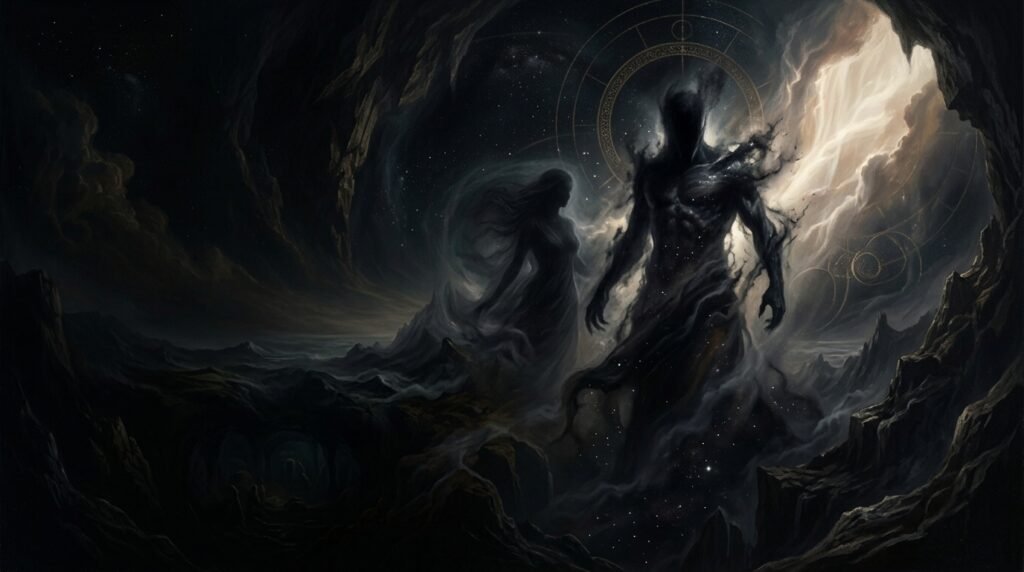
In Hesiod’s Theogony, composed in the late 8th or early 7th century BCE, Erebus emerges from Chaos alongside Nyx, Night, the two born in the same breath, without a stated parent beyond Chaos itself. Where Nyx personifies the recurring cycle of night that falls over the world each evening, Erebus represents something heavier and less domestic: a primal, absolute darkness closer to the black interior of a sealed cave than to an ordinary nightfall.
That distinction matters more than it might first seem. Greek poets generally didn’t treat “dark” as a single undifferentiated concept. Night comes and goes; Erebus, in the earliest sources, reads as something closer to a permanent condition, the darkness that exists beneath and around the visible world, rather than the darkness that simply follows daylight.
Darkness Producing Light
Erebus and Nyx unite to produce two children: Aether, the bright upper air, and Hemera, Day. This is one of Hesiod’s more striking genealogical moves. Rather than treating light as an independent force existing from the start, the Theogony makes it a product of darkness, Aether and Hemera don’t precede Erebus and Nyx, they follow from their union.
Read as poetry rather than literal chronology, the sequence suggests something specific about how early Greek cosmology thought about opposites: not as separate, competing forces, but as one generating the other. Darkness isn’t simply the absence of light in this framework, it’s the condition light emerges out of, a structural idea that recurs across several primordial pairings in Hesiod’s account.
A God, a Place, or Both?
Homeric usage complicates the picture further. In the Odyssey, “Erebus” sometimes functions less as a personal name and more as a geographic label, a term for the gloom of the underworld itself, or the route the dead travel to reach it. This isn’t a contradiction so much as a feature of how early Greek religion handled several of its oldest figures: Gaia is both goddess and earth; Pontus is both god and sea; Erebus, in much the same way, can be both a primordial being and the name of the darkness he represents.
That overlap is worth taking at face value rather than trying to resolve into one “correct” meaning. Ancient audiences seem to have moved between the two senses without treating it as inconsistent, using “Erebus” as a name when the context called for a personified force and as a place-word when the context called for geography.
Not the Same as Hades or Tartarus
Erebus is frequently, and understandably, confused with other dark or underworld-adjacent figures, but the distinctions ancient sources draw are worth preserving. Hades is both a god and, by extension, the broader realm of the dead he rules, a governed kingdom with a ruler. Tartarus is deeper still, a specific abyss reserved for the most extreme punishments, described by Hesiod as lying as far beneath the earth as the sky is above it. Erebus, by comparison, is neither a ruled kingdom nor a punitive abyss. He’s closer to atmosphere than architecture, the darkness itself, rather than a place with a throne or a specific population of prisoners.
Erebus in Later Greek Tragedy
Beyond Hesiod and Homer, Erebus surfaces occasionally in Athenian tragedy as a poetic shorthand for the deepest, most impenetrable darkness imaginable, invoked by characters facing death, exile, or overwhelming grief. Playwrights like Sophocles and Euripides use the term less as a reference to a specific mythological event and more as an intensifier, a way of signaling that a character’s despair reaches all the way down to the oldest, most absolute darkness the Greek cosmological imagination could name. That usage shows how a primordial figure with almost no independent narrative could still remain culturally alive centuries after Hesiod, surviving in language and metaphor even without new myths being written about him directly.
Erebus in Orphic Cosmology
Orphic sources, the separate religious-poetic tradition preserved mostly in fragments, sometimes place Erebus alongside Chaos and Aether as part of the raw material Chronos, Time, works with in shaping the cosmic egg from which the radiant deity Phanes eventually emerges. In this reading, Erebus isn’t simply Nyx’s partner in a Hesiodic family tree; he’s one of several primordial substances or conditions that predate the ordered universe and get folded into its creation. That variation, one tradition treating him mainly as a genealogical figure, another treating him as raw cosmological material, illustrates how differently ancient religious communities could approach the same name depending on which creation story they inherited.
For the full picture of how Erebus fits among the other primordial gods, see the Primordial Gods guide, part of Godspire’s complete guide to the Greek pantheon.
Frequently Asked Questions
Is Erebus a god or a place in Greek mythology?
Both, depending on the source. Hesiod’s Theogony treats Erebus as a primordial deity, while Homeric usage sometimes applies the same name to the darkness of the underworld or the route the dead travel through it.
What is the difference between Erebus and Nyx?
Nyx personifies Night as a recurring nightly cycle, while Erebus represents a heavier, more absolute darkness, closer to the underworld’s gloom than to ordinary nightfall. The two are usually described as siblings or consorts.
Who are Erebus’s children?
With Nyx, Erebus is the father of Aether (the bright upper air) and Hemera (Day), meaning that in Hesiod’s account, light and daytime originate from the union of darkness and night rather than existing independently.
Does Erebus appear outside of Hesiod’s Theogony?
Yes. Homer uses the name to describe the gloom of the underworld, Athenian tragedians invoke it as a poetic image of absolute darkness and despair, and Orphic sources sometimes place him among the raw materials shaped into the cosmic egg.

Kaiqui Damasceno is a mythology writer and researcher dedicated to exploring the stories, gods, heroes, and ancient traditions that shaped human culture. Through engaging storytelling and thoughtful analysis, Kaiqui brings mythology to life, uncovering the deeper meanings, conflicts, symbols, and timeless lessons hidden within ancient myths.