Published on · Updated on
Table of Contents
Long before courts, codes, or written law, Greek myth already had a figure representing the idea that some things are simply right, regardless of who holds power. That figure is Themis, and her authority proves durable enough that even Zeus, after overthrowing an entire generation of gods, keeps her close as an advisor rather than casting her aside.
A Titaness of Order, Not Chaos
Themis is one of the twelve Titans, daughter of Gaia and Uranus, and her name is essentially the Greek word for divine law, custom, or established right, the underlying order that makes organized society and honest dealings between gods and mortals possible. Hesiod’s Theogony, composed in the late 8th or early 7th century BCE, doesn’t give Themis dramatic personal action so much as consistent, dignified presence wherever questions of order and legitimacy arise.
Unlike Titans defined mainly through their children or their absence from the historical record, Themis carries her significance directly in her name and function. She isn’t associated with a natural force like water or light; she’s associated with an abstract but essential social and cosmic principle, the sense that certain outcomes are simply correct.
Second Wife to Zeus
After the Titanomachy, the war that establishes Zeus’s rule over the cosmos, Themis becomes one of his consorts, in some traditions his second wife after Metis. With Zeus, she is credited with producing two significant groups of goddesses: the Horae, the Seasons, who also govern order and the right timing of things in nature and human affairs, and the Moirai, the three Fates, who determine the span and shape of every mortal life.
That combination of offspring is worth sitting with. Both the Horae and the Moirai concern themselves with correct order, when things should happen and how long they should last, extending Themis’s own core association with rightness into the rhythms of nature and the boundaries of individual human lives.
Holding the Oracle Before Apollo
According to the opening of Aeschylus’s Eumenides, performed in 458 BCE, the oracle at Delphi passed through a specific succession before Apollo claimed it as his own famous sanctuary: first Gaia, then Themis, then Phoebe, and only then Apollo. Themis’s position in that lineage places her as a direct link between the earth-based prophetic authority of Gaia and the later, more elaborated tradition eventually inherited by Phoebe and passed down to Apollo.
That succession does real work in Greek religious thought. It frames prophecy itself as something requiring legitimate transmission, not simply seized by whichever god happened to be strongest, and Themis’s tenure as one of its early holders reinforces her broader association with legitimate, rightful authority rather than authority claimed through force alone.
Advisor at the Council of the Gods
Beyond her role at Delphi, Themis is frequently described as the goddess who calls the gods to assembly and who is consulted on matters of proper conduct, both among the gods themselves and in dealings with mortals. She’s closely associated with hospitality customs, the sacred obligation to treat guests and strangers properly, and with oracular pronouncement more generally, not limited to Delphi alone. Later Greek writers sometimes depict her seated beside Zeus’s throne, a visual shorthand for the idea that even the king of the gods requires counsel grounded in rightful order rather than ruling purely by will or force.
This advisory role fits a broader pattern visible with a few other Titans retained in some capacity after the Titanomachy. Rather than being purely replaced or erased, certain Titans whose function was cosmological or structural rather than dynastic, Themis prominent among them, continued to matter within the new Olympian order, suggesting Greek myth imagined the transition from Titan to Olympian rule as layered rather than a total, clean break.
Themis and Later Legal Symbolism
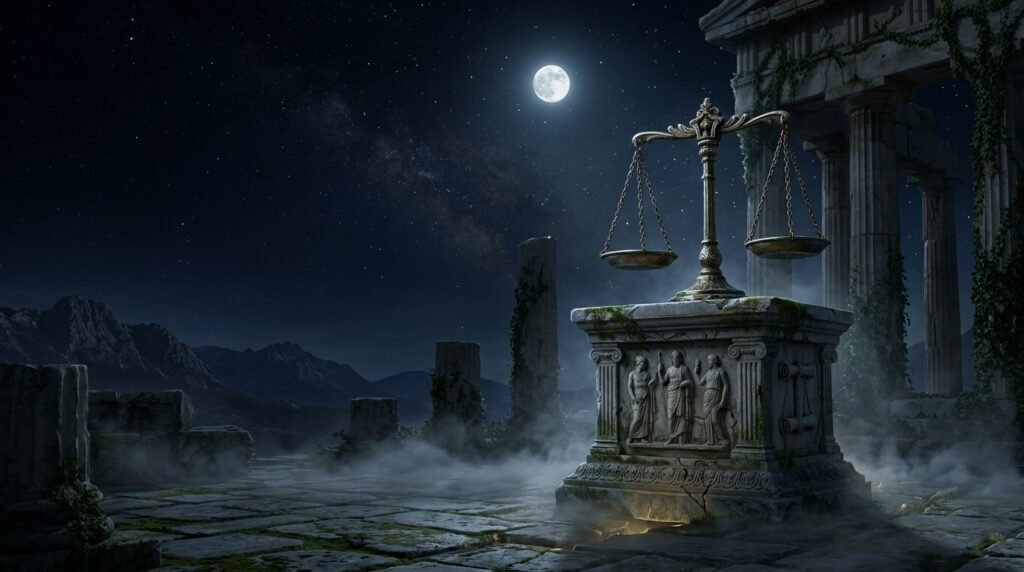
Themis’s association with law and justice outlasted her original mythological context by an enormous margin. Her name and general iconography, most often shown holding scales to weigh competing claims, fed directly into later Western legal symbolism, including the widely recognized image of Lady Justice. It’s worth noting precisely what carried over and what didn’t: ancient depictions of Themis typically show her with scales but without a blindfold, an element that entered the legal tradition considerably later, during the medieval and early modern periods, layered onto a figure whose original Greek form was about clear-eyed, legitimate judgment rather than judgment made blind to circumstance.
Themis and Prophecy Beyond Delphi
Themis’s connection to prophecy extends beyond her tenure at Delphi specifically. Ancient sources associate her more broadly with oracular pronouncement delivered through dreams and with the kind of divinely sanctioned counsel that carries binding authority precisely because it comes from a source concerned with rightful order rather than self-interest. That distinction mattered to ancient audiences: a prophecy or judgment issued by Themis carried different weight than one issued by a god acting purely on personal desire or anger, since her entire identity was built around impartial correctness rather than favor or grievance. This is likely part of why later Greek city-states and civic institutions occasionally invoked her name in connection with formal proceedings and assemblies, a goddess whose authority rested on legitimacy rather than force being a natural figure to associate with structures meant to settle disputes fairly.
For the full picture of how Themis fits among the other Titans, see the Titans guide, part of Godspire’s complete guide to the Greek pantheon.
Frequently Asked Questions
What was Themis the goddess of?
Themis personifies divine law, order, and custom, the sense of what is inherently right, both among the gods and in proper conduct between gods and mortals.
Who are Themis’s children?
With Zeus, Themis is credited as the mother of the Horae (the Seasons) and the Moirai (the three Fates), according to most ancient sources.
Did Themis hold the oracle at Delphi?
Yes. According to Aeschylus’s Eumenides, Themis held the Delphic oracle after Gaia and before passing it to Phoebe, who later passed it to Apollo.
Is the modern image of Lady Justice based on Themis?
Partly. Themis’s association with scales as a symbol of balanced judgment fed into later Western legal symbolism, though the blindfold commonly associated with Lady Justice was added much later and isn’t part of Themis’s original ancient Greek iconography.

Kaiqui Damasceno is a mythology writer and researcher dedicated to exploring the stories, gods, heroes, and ancient traditions that shaped human culture. Through engaging storytelling and thoughtful analysis, Kaiqui brings mythology to life, uncovering the deeper meanings, conflicts, symbols, and timeless lessons hidden within ancient myths.