Published on · Updated on
Table of Contents
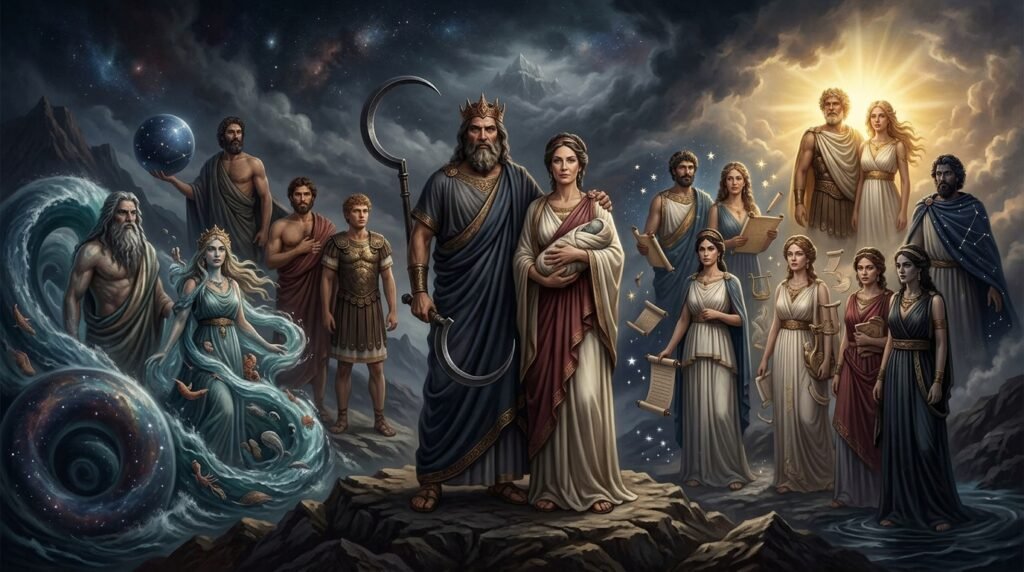
Before Zeus, before Olympus, an entire generation of gods ruled the cosmos — and lost it. The Titans are the children of Gaia and Uranus, born in the primordial age but active in a way their parents never were: they marry, scheme, rule, and eventually go to war with their own children. This guide covers all fourteen figures typically grouped with the Titans, organized by family.
Cronus and Rhea: The Ruling Pair
Cronus is the youngest Titan and the one who overthrows Uranus at Gaia’s urging, ruling the cosmos afterward in what later poets remembered as a Golden Age. Fear of a prophecy — that his own child would depose him just as he had deposed his father — leads him to swallow each of his children at birth.
Rhea, his sister and wife, is the reason that plan fails. When their sixth child, Zeus, is born, she hides him away and hands Cronus a stone wrapped in cloth in his place. That single act of protection is what makes the entire Olympian order possible.
Oceanus and Tethys: The Waters of the World
Oceanus personifies the great river ancient Greeks imagined circling the edge of the known world — a boundary rather than the sea itself, which belongs to the separate primordial deity Pontus. Unlike most of his siblings, Oceanus stays out of the war against Zeus entirely, surviving the transition to Olympian rule through neutrality rather than defeat.
Tethys, his sister and wife, is associated with nourishing, fertile waters. Together, according to Hesiod, they produce three thousand river gods and three thousand Oceanid nymphs — an almost incomprehensible family that includes figures as consequential as Metis and Styx. Homer preserves a fragment of tension in their marriage too: Hera mentions being raised by Tethys after a rift separated her from Oceanus, a rare hint of emotional complication in an otherwise genealogical myth.
Hyperion and Theia: Parents of Light
Hyperion is associated with heavenly light, and with his wife Theia, he fathers three of Greek mythology’s most visible deities: Helios the sun, Selene the moon, and Eos the dawn. Hyperion himself is frequently confused with his son Helios in later tradition, since both are connected to the sun’s daily journey, but Hyperion is the elder generative figure rather than the one driving the chariot.
Theia is linked to sight and radiance, and later poetic tradition sometimes credits her with the gleam found in gold and precious stones — as if the brightness she passed to her children extended into the material world as well.
Coeus and Phoebe: Prophecy’s Ancestors
Coeus is one of the less individually documented Titans, associated in later interpretation with intellect and the axis of the heavens. What makes him significant is fatherhood rather than personal myth: with Phoebe, he becomes grandfather to Apollo and Artemis through their daughter Leto.
Phoebe herself carries a striking role in the history of prophecy. According to Aeschylus, the oracle at Delphi — later famous as Apollo’s sanctuary — passed through a succession of owners before reaching him: from Gaia, to Themis, to Phoebe, and only then to Apollo. That detail frames Apollo’s most famous shrine not as something he simply built, but as something he inherited from an older, earth-rooted tradition of prophecy.
Crius and Iapetus: The Family of Consequence
Crius is among the most sparsely documented Titans in surviving myth, generally associated in later interpretation with constellations and astronomical measurement. His children, by the sea-nymph Eurybia, include Astraeus, Pallas, and Perses — figures who matter more for their own descendants than for any story about Crius himself.
Iapetus, by contrast, is remembered almost entirely through his sons: Atlas, condemned to hold up the sky after the Titans’ defeat; Prometheus, punished for stealing fire and giving it to humanity; and Epimetheus, whose poor judgment lets Pandora’s jar release suffering into the world. Between them, Iapetus’s line carries some of Greek mythology’s most human stories about defiance, punishment, and consequence.
Themis and Mnemosyne: Order and Memory
Themis personifies divine law, custom, and rightful order. She holds the Delphic oracle in the succession Aeschylus describes, before passing it to Phoebe, and later serves as an advisor to Zeus — a role that suggests even the new Olympian regime needed someone to embody sanctioned order rather than raw power.
Mnemosyne personifies memory itself. With Zeus, she becomes mother to the nine Muses, tying the very existence of poetry, history, and the arts directly to the act of remembering — a genealogy that isn’t decorative so much as a direct claim about where inspiration comes from.
Metis and Styx: The Oceanids Counted Among Titans
Metis and Styx are technically Oceanids, daughters of Oceanus and Tethys rather than Titans in the strict genealogical sense, but both are consistently grouped with the Titan generation because of their scale and consequence.
Metis, whose name suggests cunning intelligence, becomes Zeus’s first wife. Warned that her child would surpass him, Zeus swallows her whole — and Athena is later born fully formed from his own head, a myth that keeps Metis’s intelligence alive inside the god who consumed her. Styx personifies the river by which the gods swear their most binding oaths; she sides with Zeus during the Titanomachy, and her name becomes permanently attached to the idea of an unbreakable promise.
From Titans to Olympians
The Titans’ rule ends with the Titanomachy, a ten-year war between Cronus’s generation and the Olympians led by Zeus. Most of the defeated Titans are cast into Tartarus; Oceanus and a handful of others avoid that fate through neutrality or, in Styx’s case, by choosing the winning side early. What replaces Titan rule isn’t a clean break so much as an inheritance — Zeus’s own generation, the children of the Titans covered in Godspire’s guide to the second generation, carries the story forward from here.
For the full structure this fits into, see the complete Greek Gods and Goddesses guide, or start from the beginning with the Primordial Gods, the generation that precedes the Titans entirely.

Kaiqui Damasceno is a mythology writer and researcher dedicated to exploring the stories, gods, heroes, and ancient traditions that shaped human culture. Through engaging storytelling and thoughtful analysis, Kaiqui brings mythology to life, uncovering the deeper meanings, conflicts, symbols, and timeless lessons hidden within ancient myths.