Published on · Updated on
Table of Contents
Every time you use a mnemonic device to remember a list, a name, or a fact, you’re using a word that traces directly back to a single Titan goddess. Mnemosyne personifies Memory itself, and in a culture built on oral poetry recited from memory rather than read from a page, that made her one of the most quietly essential figures in the entire Greek pantheon.
A Titan Whose Name Is Still in Use
Mnemosyne is one of the twelve Titans, daughter of Gaia and Uranus, and her name is, quite directly, the Greek word for memory. That word survives essentially unchanged in English today, in “mnemonic,” a technique or device that aids memory, one of the clearest examples of a Greek deity’s name persisting in ordinary modern vocabulary long after her worship ended.
Hesiod’s Theogony, composed in the late 8th or early 7th century BCE, doesn’t give Mnemosyne a dramatic personal storyline. Her significance, like several other Titans associated with abstract cosmic or social principles, rests less on individual action and more on what she represents and what she generates.
Mother of the Nine Muses
Mnemosyne’s single most consequential myth involves Zeus, who, according to Hesiod, lies with her for nine consecutive nights, after which she gives birth to the nine Muses: Calliope, Clio, Erato, Euterpe, Melpomene, Polyhymnia, Terpsichore, Thalia, and Urania, each eventually associated with a different art or field of knowledge, epic poetry, history, music, dance, tragedy, comedy, astronomy, and beyond.
That genealogy carries real symbolic weight. By making Memory herself the mother of the Muses, Hesiod is making a direct claim about where artistic and intellectual inspiration ultimately comes from: not from nothing, and not purely from divine whim, but from memory, the capacity to hold and transmit knowledge across time. Poetry, music, and history are all, in this framing, children of remembering.
Why Memory Mattered So Much to Greek Poets
It’s worth pausing on why this particular genealogy made sense to its earliest audiences. Archaic Greek poetry, including Hesiod’s own Theogony and Homer’s epics, was composed and transmitted primarily through oral performance, memorized and recited by poets working within a formulaic tradition, long before those works were reliably written down. A poet’s entire craft depended on prodigious memory, holding thousands of lines, formulaic phrases, and narrative patterns ready for performance.
Given that context, opening a poem by invoking the Muses, and therefore invoking Mnemosyne through them, wasn’t just a formal literary convention. It was closer to an acknowledgment of the actual mechanism the poet depended on to do the work at all. Memory wasn’t a passive storage function in this worldview; it was treated as the divine source of the poet’s entire ability to perform.
The Pool of Mnemosyne in Orphic Tradition
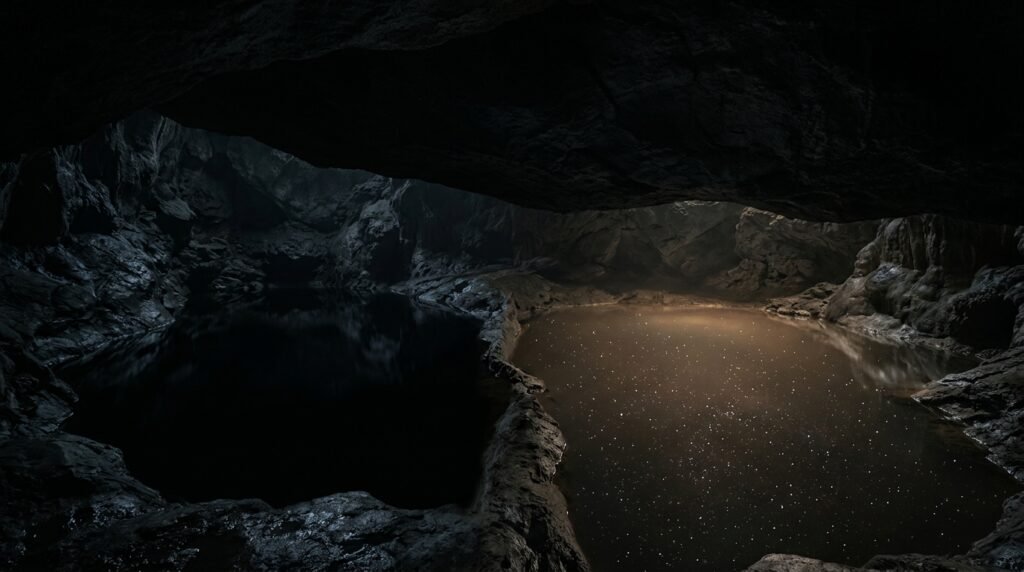
Beyond Hesiod’s mainstream account, Mnemosyne takes on a distinctive and more mysterious role in Orphic religious tradition, the separate body of religious-poetic material preserved mostly on inscribed gold tablets found in burial sites across the Greek world. Several of these tablets instruct the deceased’s soul, upon reaching the underworld, to avoid drinking from the spring of Lethe, whose name means Forgetting, and instead seek out and drink from the pool of Mnemosyne, guarded by attendants who will grant access only to initiates who know the correct sacred formula.
The logic behind this instruction is striking: drinking from Lethe causes the soul to forget its divine origin and previous existence, while drinking from Mnemosyne’s pool preserves that memory, allowing the initiated soul a different, more favorable fate in the afterlife than the forgetting and further cycling that awaits ordinary souls. In this Orphic framework, Memory isn’t simply an abstract cosmic principle or the mother of the arts; she becomes directly tied to salvation itself, the specific thing an initiated soul needs to hold onto in order to escape an unfavorable cycle of rebirth.
A Titan Absent From the War
Like several Titans whose domain is more abstract or cosmological than political, Mnemosyne has no clearly attested role in the Titanomachy, the war between the Titans and the Olympians led by Zeus. She isn’t listed among the Titans cast into Tartarus after their defeat, and her later union with Zeus to produce the Muses suggests a continued, even honored, place within the new Olympian order rather than exile or punishment, another example of a Titan whose function proved too useful, or too fundamental, for the new regime to simply discard.
Mnemosyne’s Quiet Afterlife in Language
Beyond her direct mythological role, Mnemosyne’s name embedded itself into Western vocabulary more thoroughly than almost any other Titan’s. “Mnemonic,” “amnesia” (a lack of memory), and related terms all trace back to the same Greek root she personifies directly. That linguistic persistence sets her apart from siblings like Crius or Iapetus, whose names remain confined mostly to specialist discussion of Greek mythology. Memory, as a faculty every person relies on daily, apparently kept its ancient name current in a way that more narratively dramatic but less universally experienced concepts did not, a small but telling example of how some mythological figures survive primarily through language rather than through continued storytelling.
For the full picture of how Mnemosyne fits among the other Titans, see the Titans guide, part of Godspire’s complete guide to the Greek pantheon.
Frequently Asked Questions
What was Mnemosyne the goddess of?
Mnemosyne personifies Memory itself. Her name is the direct source of the modern English word “mnemonic.”
Who are Mnemosyne’s children?
With Zeus, after nine consecutive nights together, Mnemosyne is the mother of the nine Muses, each later associated with a different art or field of knowledge, including epic poetry, history, music, and astronomy.
Why is Mnemosyne connected to poetry specifically?
Archaic Greek poetry was composed and performed orally, relying heavily on the poet’s memory. Making Memory the mother of the Muses reflects how central actual remembering was to the practical craft of ancient poetic performance.
What is the pool of Mnemosyne in Orphic tradition?
In Orphic religious tablets, the deceased soul is instructed to drink from Mnemosyne’s pool rather than the spring of Lethe (Forgetting) in the underworld, preserving memory of its divine origin and securing a more favorable afterlife fate for properly initiated souls.

Kaiqui Damasceno is a mythology writer and researcher dedicated to exploring the stories, gods, heroes, and ancient traditions that shaped human culture. Through engaging storytelling and thoughtful analysis, Kaiqui brings mythology to life, uncovering the deeper meanings, conflicts, symbols, and timeless lessons hidden within ancient myths.