Published on · Updated on
Table of Contents
Tartarus is the deepest region of the Greek underworld — both a primordial deity in his own right and the vast abyss where the most dangerous beings in Greek mythology are permanently imprisoned. He is not the same figure as Hades, and Tartarus is not simply another word for the underworld in general; it sits below and beyond the realm most ordinary dead souls experience.
What Is Tartarus in Greek Mythology?
Tartarus appears in Hesiod’s Theogony, composed in the late 8th or early 7th century BCE, as one of the first four beings to exist, alongside Chaos, Gaia, and Eros. Hesiod gives his location a striking, deliberately measurable description: Tartarus lies as far beneath the earth as the sky is above it. He then makes that abstraction concrete with one of Greek mythology’s most vivid images — a bronze anvil dropped from the heavens would fall for nine full days and nights before reaching the earth on the tenth, and if dropped again from the earth’s surface, it would fall for another nine days and nights before finally reaching Tartarus.
That level of specificity is unusual for a mythological description of distance, and it seems to be intentional. Hesiod wants his audience to understand that Tartarus isn’t merely “very deep,” it’s precisely, almost mathematically, unreachable, a scale of distance so extreme it functions as a statement about absolute separation rather than ordinary geography.
Is Tartarus a God or a Place?
Both, and this dual identity confuses modern readers more than almost anything else about him. In the earliest layer of Greek cosmogony, Tartarus is a primordial being, personified enough to father the monster Typhon with Gaia. At the same time, “Tartarus” is also simply the name of the abyss itself, the physical location where later imprisonment happens.
This overlap between deity and place isn’t unique to Tartarus. Gaia is both goddess and earth; Pontus is both god and sea. Ancient Greek religion was comfortable letting a name refer to both a personality and the physical reality that personality represents, without treating that as a contradiction requiring resolution, a pattern that runs through nearly all of the primordial generation.
Tartarus and the Titanomachy
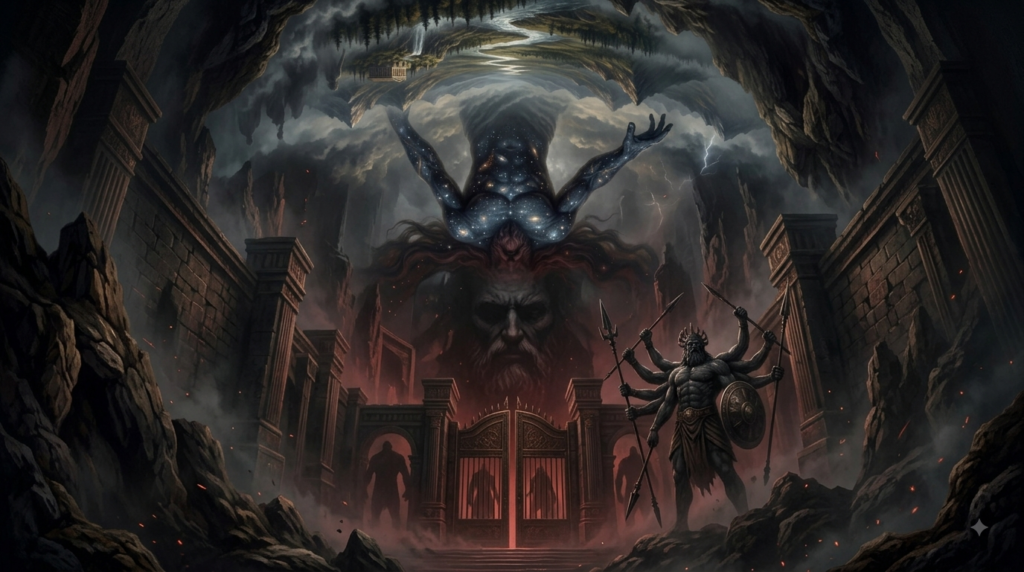
Tartarus becomes central to Greek mythology’s larger narrative during the Titanomachy, the ten-year war between the Olympian gods led by Zeus and the older generation of Titans. After Zeus and his allies win, the defeated Titans are cast down into Tartarus and sealed behind massive bronze gates, guarded by the Hundred-Handed Ones, the same fifty-headed, hundred-armed giants who had once been imprisoned by Uranus and later freed by Zeus specifically to serve as jailers for his former rivals.
This imprisonment functions less like a straightforward punishment and more like a cosmic quarantine. The old divine order isn’t destroyed outright; it’s contained, sealed away in the one place from which nothing is meant to escape, so that Zeus’s new Olympian order can stand without constant challenge from the generation it replaced. That distinction between destruction and containment matters for understanding Greek myth’s broader logic: even the gods rarely disappear entirely once defeated.
How Is Tartarus Different From Hades?
Hades refers to both the god who rules the underworld and, by extension, the broader realm where the souls of the ordinary dead reside. Tartarus is a separate, deeper region, reserved not for typical mortal souls but for divine rebels, monstrous threats, and a small number of especially notorious human offenders in later literary tradition.
If Hades is a kingdom, Tartarus functions more like the most secure cell within it, or, in the earliest cosmogonic sources, a structure that exists independently of Hades’ rule entirely, older and lower than his domain. The two are related, sharing the same general “underworld” territory in the ancient imagination, but ancient authors were generally careful not to treat them as interchangeable, especially in more philosophically or theologically minded texts where precision about cosmic geography mattered.
Who Was Imprisoned in Tartarus?
The Titans are Tartarus’s most famous prisoners, cast down as a group after their defeat in the Titanomachy. Later literary tradition, especially Roman poetry such as Virgil’s Aeneid, expands the population of Tartarus considerably, populating it with mortal sinners who committed crimes against the gods or violated the sacred codes of hospitality and family loyalty.
Figures like Ixion, condemned to spin eternally on a wheel of fire for attempting to seduce Hera, and Tantalus, punished for serving his own son to the gods as a meal, become associated with this deepest layer of underworld punishment in later tradition, even though the earliest Greek sources sometimes place their torments more loosely within the underworld generally rather than specifically inside Tartarus. Sisyphus, condemned to eternally push a boulder up a hill only to watch it roll back down, is another figure later tradition frequently relocates into Tartarus specifically, even though Homer’s earlier account simply places him in the underworld without that precise geographic detail.
Tartarus in Roman Literature
By the time Virgil composed the Aeneid in the first century BCE, Tartarus had become a far more elaborately imagined space than anything in Hesiod’s brief, measurement-focused description. Virgil gives it fortified walls, a triple ring of defenses, a river of fire called Phlegethon, and a monstrous guardian figure watching its gates, details that owe as much to Roman literary invention as to inherited Greek tradition. This expanded, architecturally detailed Tartarus proved enormously influential on later Western depictions of infernal punishment, including medieval and Renaissance imaginings of hell that borrowed its general shape while replacing its inhabitants with figures drawn from an entirely different religious framework.
For the full picture of how Tartarus fits among the other primordial gods, see the Primordial Gods guide, part of Godspire’s complete guide to the Greek pantheon.
Frequently Asked Questions
Is Tartarus the same as Hell?
Not exactly. Tartarus predates Christian concepts of Hell by many centuries and functions differently, it’s specifically reserved for divine rebels and the most extreme offenders, not for ordinary sinners, and it exists within a polytheistic cosmology rather than a moral afterlife judgment system.
Is Tartarus a god or a place in Greek mythology?
Both. Tartarus is one of the primordial deities named in Hesiod’s Theogony, and the same name also refers to the physical abyss he personifies.
How deep is Tartarus according to Hesiod?
Hesiod illustrates the depth using the image of a bronze anvil: dropped from the sky, it would fall nine days and nights before reaching earth, and dropped again from earth, another nine days and nights before reaching Tartarus.
Who guards the gates of Tartarus?
The Hundred-Handed Ones (Hecatoncheires), fifty-headed, hundred-armed giants, guard the gates of Tartarus, keeping the imprisoned Titans permanently sealed inside.
What is the difference between Tartarus and Hades?
Hades is both the ruling god of the underworld and the general realm of the dead. Tartarus is a separate, deeper region within or beneath that realm, reserved for divine rebels and the harshest punishments rather than ordinary deceased souls.

Kaiqui Damasceno is a mythology writer and researcher dedicated to exploring the stories, gods, heroes, and ancient traditions that shaped human culture. Through engaging storytelling and thoughtful analysis, Kaiqui brings mythology to life, uncovering the deeper meanings, conflicts, symbols, and timeless lessons hidden within ancient myths.