Published on · Updated on
Table of Contents
Most Greek gods can be bargained with, flattered, tricked, or occasionally defeated. Ananke is different by design. Her name means Necessity, not fate as a story that can be argued with, but the underlying condition that makes argument itself irrelevant.
A Figure Outside Hesiod’s Main Account
Search for Ananke in Hesiod’s Theogony, composed in the late 8th or early 7th century BCE and the foundational source for most of the primordial generation, and you’ll find very little. She barely registers in the poem that gives Chaos, Gaia, and the rest of the primordial family their clearest early treatment. Her real prominence comes from a separate tradition: Orphic cosmogony, a body of religious-poetic material associated with the mythical figure Orpheus, preserved mostly in fragments and later summaries rather than in one complete surviving poem.
That gap is worth stating plainly rather than smoothing over. Ananke isn’t a minor character within Hesiod’s story who simply doesn’t get much attention, she largely belongs to a different cosmological account altogether, one that ran alongside the more famous Hesiodic tradition without ever fully merging with it.
Necessity and Time, Coiled Together
In several Orphic sources, Ananke appears paired with Chronos, Time, not to be confused with the Titan Cronus, a separate figure entirely despite the similar name. The two are sometimes described as serpentine forces coiled together around the origins of the cosmos, jointly responsible for shaping a great cosmic egg from which the radiant primordial deity Phanes eventually emerges.
The pairing itself carries clear symbolic weight, whether or not any single ancient source spells it out explicitly: Time provides sequence, the fact that one moment follows another; Necessity provides the unyielding structure within which that sequence unfolds. Together, in this reading, they represent a universe that moves forward according to both motion and unbreakable law, change happening, but never randomly or without constraint.
A Concept Philosophy Found Useful
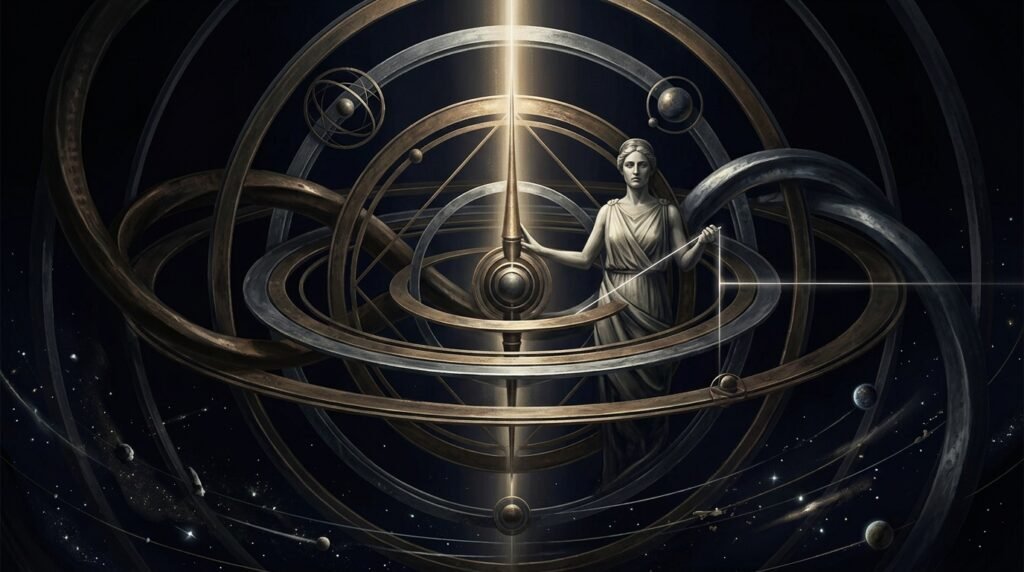
Ananke’s afterlife in Greek philosophy turned out to be considerably longer than her presence in mainstream myth. Plato invokes Ananke directly in the Republic, in the Myth of Er, describing her as the figure whose spindle turns the axis of the entire cosmos, the literal mechanism by which the heavens revolve, attended by her three daughters, the Fates, who sing of what was, what is, and what is to come while the spindle turns beneath their mother’s hands.
That philosophical use is part of why Ananke can feel less like a “character” than most other primordial figures. She was never really built for storytelling. She was built to name something abstract, the fact that some things simply have to be the way they are, and then handed to poets and philosophers who found different ways to make that abstraction visible.
Ananke and the Moirai
Ananke’s connection to the Fates, or Moirai, deserves particular attention, since it reveals how Greek thought organized different layers of destiny into a single coherent picture. Where the Moirai, Clotho, Lachesis, and Atropos, handle the specific work of spinning, measuring, and cutting each individual mortal life, Ananke represents something even more fundamental: the overarching principle of necessity that makes the Fates’ work possible and binding in the first place. In Plato’s telling, the Fates are almost subordinate to her, daughters assisting at the great spindle she herself controls, a hierarchy that positions personal destiny as one expression of a much larger cosmic inevitability rather than a freestanding force of its own.
Later Reception in Roman and Stoic Thought
Roman writers, working within a philosophical culture heavily influenced by Stoicism, found Ananke’s basic concept especially useful even when they used their own Latin vocabulary, particularly fatum, to express similar ideas. Stoic philosophy in particular built an entire ethical system partly around accepting necessity rather than resisting it, treating equanimity in the face of an unchangeable cosmic order as the foundation of a well-lived life. While these later thinkers rarely invoked Ananke by her original Greek mythological name and imagery, the underlying concept she personified, that certain outcomes are simply built into the structure of reality and cannot be negotiated away, remained philosophically central for centuries after her brief appearances in Orphic poetry had faded from common religious practice.
Why Ananke Rarely Appears in Art
Unlike Zeus with his thunderbolt or Poseidon with his trident, Ananke has no standardized visual attribute in surviving Greek art, and depictions of her are considerably rarer than for almost any other primordial figure discussed in this series. That scarcity makes sense given her nature: painters and sculptors generally worked from myths with concrete scenes, a birth, a battle, a transformation, and Ananke offers none of that. Necessity isn’t easy to paint. The closest visual tradition comes from later philosophical and allegorical art influenced by Plato’s spindle imagery, occasionally showing her as a shadowy, veiled figure turning a great mechanism rather than as a clearly individualized goddess with a face and a story, an appropriately abstract treatment for a concept that was always more useful to philosophers than to storytellers.
For the full picture of how Ananke fits among the other primordial gods, see the Primordial Gods guide, part of Godspire’s complete guide to the Greek pantheon.
Frequently Asked Questions
Is Ananke in Hesiod’s Theogony?
Not prominently. Ananke appears mainly in Orphic cosmogony, a separate religious-poetic tradition, rather than in Hesiod’s more widely known account of the primordial gods.
Who is Ananke paired with in Orphic tradition?
Ananke is often paired with Chronos, the personification of Time, described in some Orphic sources as coiled together with him around the origins of the cosmos, shaping the cosmic egg from which the deity Phanes emerges.
Did Ananke have any role in Greek philosophy?
Yes. Plato refers to Ananke directly in the Republic’s Myth of Er, describing her as the figure whose spindle turns the axis around which the cosmos revolves, a philosophical use of the concept that outlasted her presence in mainstream myth.
How is Ananke related to the Fates?
In Plato’s account, the three Fates, or Moirai, are described as her daughters, assisting at the great spindle Ananke herself controls, positioning personal destiny as an expression of the larger cosmic necessity she personifies.

Kaiqui Damasceno is a mythology writer and researcher dedicated to exploring the stories, gods, heroes, and ancient traditions that shaped human culture. Through engaging storytelling and thoughtful analysis, Kaiqui brings mythology to life, uncovering the deeper meanings, conflicts, symbols, and timeless lessons hidden within ancient myths.