Published on · Updated on
Table of Contents
Cronus overthrows his father, rules the cosmos for an entire generation, and then spends that whole reign trying to outrun a single prophecy — that one of his own children would do to him exactly what he had done to Uranus. He fails. That failure is one of Greek mythology’s oldest and most complete stories about power, fear, and the cost of trying to stop time itself.
Youngest, and the Only One Willing
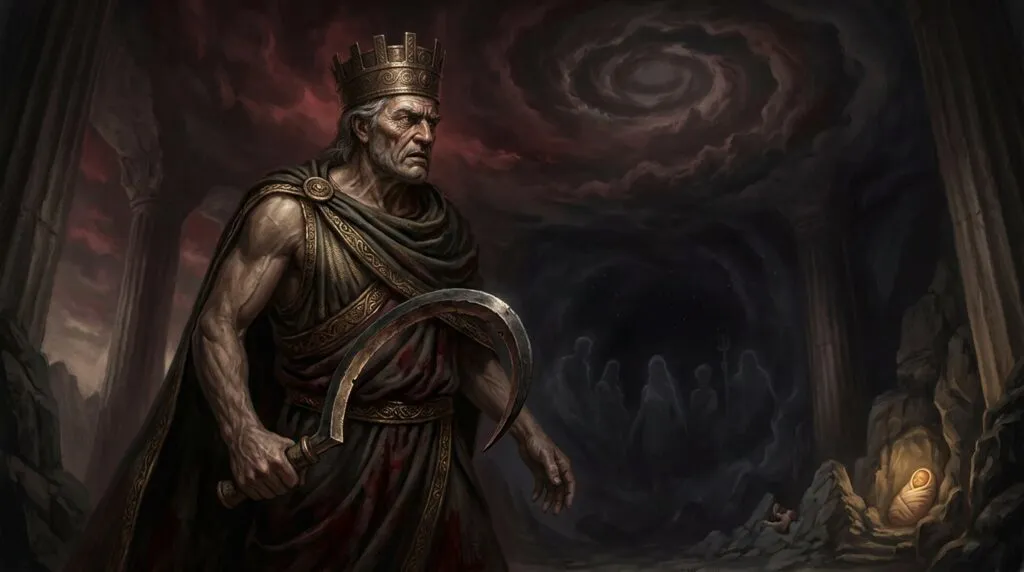
Cronus is the youngest of the twelve Titans, children of Gaia (Earth) and Uranus (Sky). According to Hesiod’s Theogony, composed in the late 8th or early 7th century BCE, Uranus feared his own children and forced each of them back inside Gaia’s body as soon as they were born, causing her constant pain. Gaia’s response was to fashion a sickle from grey flint and ask her imprisoned children which of them would use it against their father. Only Cronus agreed.
When Uranus next descended to lie with Gaia, Cronus ambushed him from hiding and castrated him, ending his father’s reign. The severed flesh, thrown into the sea, gathers foam around it — and from that foam, in Hesiod’s account, Aphrodite is born near Cyprus. It’s worth noting that this isn’t the only tradition about her birth; Homer instead makes her the daughter of Zeus and Dione, and the two accounts simply coexisted in Greek literary tradition rather than one replacing the other. Hesiod’s blood and severed flesh also give rise, in his telling, to the Erinyes, the avenging Furies, and to the Giants — meaning Cronus’s act of violence doesn’t just end one reign, it seeds several other divine lineages at the same moment.
A Golden Age, and a Growing Fear
With Uranus overthrown, Cronus becomes ruler of the cosmos, and later Greek poets remembered his reign as a Golden Age — a period, described by Hesiod in a separate poem, Works and Days, when humans lived without toil, hardship, or old age, and the earth gave freely of its own accord, without need for plowing or planting. That detail matters for understanding what gets lost later: Cronus’s rule isn’t remembered as tyranny from the start. It’s remembered as abundance, undone by fear rather than by any cruelty in how he governed mortals.
The fear comes from Uranus himself. Before Cronus overthrew him, Uranus warned — or in some tellings, cursed — his son that he too would one day be overthrown by one of his own children, just as he himself had been. Cronus takes that warning seriously enough to act on it in the most direct way available to him, and that single piece of information shapes every decision he makes as a father from that point forward.
Swallowing the Prophecy
Cronus marries his sister Rhea, and as each of their children is born — Hestia, Demeter, Hera, Hades, Poseidon — he swallows them whole, one after another, to prevent the prophecy from ever having a chance to come true. Hesiod doesn’t dwell on Cronus’s emotional state here; the poem states the act almost procedurally, which somehow makes it more unsettling rather than less. There is no confrontation, no debate. Each birth simply ends the same way.
Rhea, watching this happen five times, decides the sixth child will be different. When Zeus is born, she hides him away — most traditions place him on Crete, raised in secret, sometimes nursed by the goat Amalthea and guarded by armed attendants called the Curetes, who clashed their spears against their shields to drown out the infant’s cries so Cronus wouldn’t hear him — and hands Cronus a stone wrapped in swaddling cloth instead. Cronus swallows it without noticing the substitution, and the stone remains inside him, undigested, for years.
The Prophecy Arrives Anyway
Zeus grows up hidden, and when he’s ready, he returns and forces Cronus to disgorge his swallowed siblings, who emerge alive and fully grown, along with the stone that had stood in for Zeus himself. That stone, later traditions say, was set up at Delphi as a sacred object, a physical relic anyone could visit and touch. What follows the rescue is the Titanomachy, a ten-year war between Cronus and his fellow Titans on one side and Zeus’s generation on the other. Cronus loses.
His fate afterward varies by source. Some traditions place him among the Titans imprisoned in Tartarus; others, particularly later and more forgiving ones, describe him ruling peacefully over the Isles of the Blessed, a kind of paradise reserved for exceptional figures after the cosmic order settles. That variation isn’t a contradiction to resolve so much as a sign of how differently later Greek and Roman writers wanted to remember him — as a defeated tyrant, or as a king whose Golden Age was worth softening the ending for.
Cronus Among the Athenians: The Kronia Festival
Despite his dramatic mythology, Cronus did receive some direct cult worship in ancient Greece, most notably through the Kronia, an Athenian festival held in his honor during the summer month of Hekatombaion. Ancient sources describe it as an unusually relaxed occasion: enslaved people and free citizens reportedly feasted together, a temporary reversal of ordinary social hierarchy that later Roman writers explicitly compared to their own Saturnalia. That comparison wasn’t accidental. By the time these comparisons were being drawn, Cronus and the Roman god Saturn had been thoroughly identified with each other, and Saturn’s own festival, complete with its famous role-reversals and licensed disorder, was already understood as the Roman continuation of the same underlying idea: a brief, sanctioned return to the easier world Cronus was remembered as having once ruled.
For the full picture of how Cronus fits among the other Titans, see the Titans guide, part of Godspire’s complete guide to the Greek pantheon.
Frequently Asked Questions
Why did Cronus swallow his own children?
Uranus had warned or cursed Cronus that he would be overthrown by one of his own children, just as Cronus had overthrown him. Cronus swallowed each child at birth in an attempt to prevent that prophecy from coming true.
How did Zeus escape being swallowed?
Cronus’s wife, Rhea, hid the infant Zeus away, usually described as being raised in secret on Crete, and gave Cronus a stone wrapped in swaddling cloth in his place, which Cronus swallowed without realizing the substitution.
What happened to Cronus after he was overthrown?
Accounts vary. Some traditions place Cronus among the Titans imprisoned in Tartarus after their defeat in the Titanomachy; others describe him later ruling over the Isles of the Blessed.
Is Cronus the same as Chronos?
No. Cronus is the Titan described here. Chronos is a separate figure who personifies Time, particularly in Orphic tradition, and the two names became confused in later art and literature despite originating as distinct figures.
Was Cronus worshipped in ancient Greece?
Yes, though not as widely as major Olympians. Athens held an annual festival called the Kronia in his honor, notable for its temporary suspension of normal social hierarchy, a tradition the Romans later echoed in their own festival of Saturnalia once Cronus and Saturn were identified with one another.

Kaiqui Damasceno is a mythology writer and researcher dedicated to exploring the stories, gods, heroes, and ancient traditions that shaped human culture. Through engaging storytelling and thoughtful analysis, Kaiqui brings mythology to life, uncovering the deeper meanings, conflicts, symbols, and timeless lessons hidden within ancient myths.