Published on · Updated on
Selene Greek goddess is the divine personification of the Moon in Greek mythology. As a younger Titaness born from Hyperion and Theia, she gives the night its visible rhythm through lunar light, recurring phases, and the famous story of Endymion. This guide explains her genealogy, symbols, myths, worship, and enduring meaning.
Table of Contents
Selene Greek Goddess: a powerful quick guide
To understand Selene Greek goddess traditions, begin with three connected ideas: Selene is the Moon made divine, she belongs to the celestial family of Helios and Eos, and her myth of Endymion turns recurring lunar time into a story of love, sleep, and loss. These points answer the main search question while opening the deeper history explored below.
Quick answer: who is Selene?
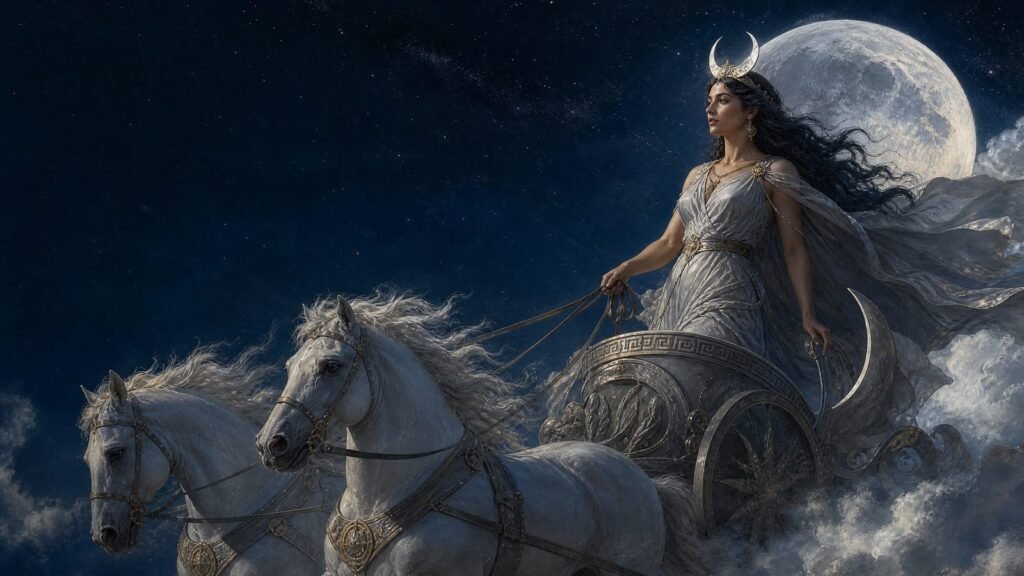
Selene is the Greek Titan goddess of the Moon. In the most familiar genealogy, she is the daughter of the Titans Hyperion and Theia and the sister of Helios, the Sun, and Eos, the Dawn. Ancient poets imagine her crossing the night sky in a luminous chariot, often with a crescent or lunar disk above her head. Her most famous myth is her love for Endymion, a beautiful mortal shepherd or king whom Zeus places in an eternal sleep so that Selene can visit him without the passage of age changing him.
Selene is sometimes confused with Artemis because later Greek and Roman traditions connected several goddesses with the Moon. The distinction matters: Selene is the Moon itself in divine form, while Artemis is primarily a goddess of the hunt, wilderness, childbirth, and protection. The two figures can overlap in later religious interpretation, but they are not identical in the oldest literary descriptions. This difference makes Selene essential for understanding how Greek mythology personified natural cycles rather than treating the sky as an impersonal mechanism.
Selene’s family and genealogy
Hesiod’s Theogony gives Selene a place in the family of heavenly radiance. Hyperion and Theia have three children: Helios, Selene, and Eos. The arrangement is symbolically powerful because the siblings represent the visible sequence of the sky. Helios carries the Sun across the day, Selene illuminates the night, and Eos opens the boundary between darkness and morning. The Godspire guide to the second-generation children of the Titans uses this family to show how the descendants of the elder Titans shape the world experienced by mortals.
You can also read the related profiles of Hyperion and Theia to see how the parents’ association with light continues through their children. The genealogy is not merely a list of names. It provides a mythic explanation for why the Sun, Moon, and Dawn belong to one connected celestial family.
Ancient sources do not always agree about Selene’s parentage. The Homeric Hymn to Helios names Euryphaessa instead of Theia in one version, while other traditions associate Selene with Pallas, Zeus, or even Helios. These variations are normal in Greek mythology. Different poems, local cults, and later mythographers preserved different layers of tradition. The safest formulation is therefore that Selene is traditionally the daughter of Hyperion and Theia, while acknowledging that other genealogies also circulated. Theoi’s collection of ancient sources about Selene is useful for comparing these accounts.
How Selene personifies the Moon
Selene is more than a goddess who happens to travel at night. In the oldest poetic imagination, she is the Moon made personal. Her movement is the movement of the lunar body; her light is the light seen by humans; her changing position becomes the subject of divine narrative. This is why Greek writers could describe her as a shining presence that watches over the earth while also giving her family relationships, desires, and responsibilities.
The Moon’s regular return makes Selene a figure of rhythm and recurrence. She appears, disappears, and returns again. That pattern invites myths about longing, sleep, fertility, time, and memory. Her association with Endymion is especially effective because the sleeping mortal remains unchanged while the Moon continues to pass above him. The story turns the lunar cycle into an image of desire that is renewed night after night.
Selene’s identity also helps distinguish Greek myth from a modern scientific description of the Moon. A scientific explanation asks how reflected sunlight, orbital movement, and phases work. A mythic explanation asks what it feels like for a luminous body to rise, watch, and return. Selene answers the second kind of question. She gives emotional and social meaning to a natural phenomenon that every ancient community could observe. That is why the figure remains useful in modern educational writing: she shows how ancient people linked observation with story rather than separating astronomy from religion.
The lunar chariot and symbols
Ancient art commonly represents Selene in a chariot drawn by horses, winged horses, oxen, or other pale animals depending on the period and source. The chariot creates a visual parallel with Helios, whose own vehicle crosses the sky during the day. In some images, Selene rides sidesaddle on a horse rather than standing in a conventional chariot. The variety is a reminder that mythological iconography developed over centuries rather than following one fixed design manual.
Her most recognizable symbol is the crescent Moon. It may appear as a crown, a luminous arc, or part of a veil that rises around her head. Horn imagery sometimes connects the crescent with cattle, an association that can make the Moon appear both celestial and earthly. A long robe and a calm, full face distinguish Selene in many artistic traditions from the more athletic representations of Artemis. Wings, a glowing diadem, silver fabric, and a night sky can also signal her identity, although artists use these details with different degrees of literalness.
For a website image, the strongest visual signals are a silver crescent, a dark blue sky, a lunar chariot, pale horses, and a composed adult goddess rather than a generic fantasy queen. These symbols communicate the entity immediately without requiring text inside the image. The accompanying hero image prepared for this article follows that editorial logic and leaves visual space for the title when used as a featured image.
Selene and Endymion
The myth of Selene and Endymion is the most famous story connected with the Moon goddess. Endymion is described in different traditions as a shepherd, a king, or an exceptionally beautiful young man associated with Mount Latmos in Caria. Selene falls in love with him and visits him while he sleeps. Zeus grants Endymion a choice, and he chooses eternal sleep, eternal youth, or an unaging condition depending on the version. The cave of Latmos becomes a fitting setting because it places the sleeping mortal below the path of the Moon.
The story has a tragic ambiguity. At first glance, eternal sleep seems to solve the problem of mortal aging. Endymion will not grow old, and Selene can return to him. Yet he is also removed from ordinary human life. He does not wake to share a mutual relationship in the way a mortal couple would. The myth therefore balances beauty and loss: Selene’s love preserves the beloved, but preservation requires stillness.
Ancient authors use the story to connect the Moon with sleep and nighttime visitation. The Moon sees what the daylight world cannot see. It enters caves, crosses silent landscapes, and becomes a witness to private longing. A modern reader may also notice how the myth questions the desire to stop time. Endymion receives what many mortals want—youth without decay—but loses movement, choice, and ordinary participation in the world. Selene’s role is not simply that of a jealous or romantic goddess; she is also the force that repeatedly returns to a world where the beloved cannot change.
The tradition varies in detail. Some accounts attribute fifty daughters to Selene and Endymion, a number connected by ancient writers with the months of a four-year cycle. Other versions emphasize only the love itself. The variation should not be treated as a contradiction that needs to be eliminated. It shows how a story can be adapted to different symbolic systems: romance, calendrical time, regional cult, and poetic allusion.
Selene’s children and related myths
Selene is associated with several children in ancient sources. With Zeus, she is said to have mothered Pandia, a figure whose name suggests all-brightness or complete radiance. Ersa, associated with dew, is also connected with Selene and Zeus in some lyric traditions. Other sources relate Selene to the Menai, the months, or to the Horai, the seasons. These traditions reinforce the idea that the Moon regulates or marks time.
One unusual story links Selene to the Nemean Lion. Some ancient writers say the monstrous lion fell from the Moon or was nourished in a lunar cave before Heracles defeated it. This is not the central myth of Selene, but it reveals how the Moon could be imagined as a place where extraordinary beings originate. The lunar sphere was not empty space; it was a divine environment with its own dangers and wonders. When presenting this story, it is important to identify it as a later or less central tradition rather than implying that every ancient author accepted it.
Selene’s children also show why genealogy in Greek mythology is flexible. The same divine figure can be linked to different descendants in different poems, and an epithet can preserve a symbolic relationship without producing a single standardized family tree. For readers learning the mythology, the best approach is to distinguish the most widely repeated genealogy from minority traditions instead of flattening every source into one account.
Selene, Helios, Eos, and Artemis
Selene’s family forms a complete cycle of celestial transition. Helios represents the Sun’s daily passage, Eos announces the morning, and Selene rules the night. Their relationship is especially useful for understanding Greek myth as a system of connected images rather than a catalogue of isolated gods. When one profile mentions another, the link is part of the story: dawn belongs to the same family as night and day.
Artemis creates a second important comparison. Selene is the lunar body, while Artemis is a goddess who moves through forests and protects young life. Later writers and worshippers sometimes merged their lunar symbolism, and Roman Diana could carry several traits associated with both. Hecate adds another layer, representing night, crossroads, magic, and liminality. This three-way comparison should be explained rather than presented as a simple equation. A useful companion is the article on Leto, Artemis’s mother and another major figure in the second-generation family.
Worship and cultural meaning
Selene’s literary fame does not mean that every Greek community worshipped her in exactly the same way. Greek religion was local, and the importance of a deity could vary from one sanctuary to another. In some places Selene appeared in art and poetry; in others, lunar functions were absorbed into the cults of Artemis, Hecate, or other goddesses. Roman Luna continued several aspects of Selene’s identity, especially the chariot, crescent, and nocturnal radiance.
Her cultural meaning remains powerful because she brings together the measurable and the intimate. The Moon determines calendars, marks festivals, guides travelers, and changes the appearance of the landscape. At the same time, it becomes a symbol of desire, solitude, sleep, and return. Selene’s mythology preserves these different meanings without reducing them to one moral lesson. She is not simply a goddess of “the night”; she is a figure through whom ancient people could think about recurring time and the emotional experience of watching the sky.
Selene among the second-generation Titans
Selene belongs to a generation that stands between the elder Titans and the Olympian gods. The group is a modern organizational category rather than a single ancient religious institution, but it is useful for comparing how these figures shape later mythology. Selene and Eos express night and dawn; Helios represents the Sun; Leto carries the family into the stories of Apollo and Artemis; and Asteria connects the night sky with stars and Delos.
Read together, these profiles reveal a family of transition. The children of Hyperion and Theia govern the changing sky, while the daughters of Coeus and Phoebe connect the Titan genealogy to Apollo, Artemis, Hecate, and Delos. Dione adds prophecy and an alternative genealogy tied to Aphrodite. For the broader pantheon, consult Godspire’s complete guide to Greek gods and goddesses.
Readers searching for Selene Greek goddess usually want a clear answer first, followed by genealogy, primary myths, symbols, and cultural context. The sections below provide that complete path without treating later interpretations as if they were identical to the oldest sources.
Frequently asked questions about Selene
Who is Selene in Greek mythology?
Selene is the Titan goddess and personification of the Moon. She is traditionally the daughter of Hyperion and Theia and the sister of Helios and Eos.
Is Selene a Titan?
Selene is commonly called a younger Titaness because she is the daughter of the Titans Hyperion and Theia. She belongs to the second generation rather than to the twelve elder Titans.
What is Selene the goddess of?
Selene is the goddess and personification of the Moon. Her chariot crossing the night sky is one of the central images associated with her.
Who was Selene’s lover?
Selene’s most famous lover was Endymion, a mortal who remained eternally young through an unending sleep.
Is Selene the same as Artemis?
Not originally. Selene is the lunar personification, while Artemis is an Olympian goddess of hunting and wilderness. Later traditions sometimes connected their lunar symbolism.
Who are Selene’s parents?
The most familiar genealogy names the Titans Hyperion and Theia as her parents, although ancient sources preserve alternative accounts.
Further reading: consult Theoi’s collection of ancient sources about Selene, its overview of Titans and Titanesses, and the broader Britannica entry on Endymion.

Kaiqui Damasceno is a mythology writer and researcher dedicated to exploring the stories, gods, heroes, and ancient traditions that shaped human culture. Through engaging storytelling and thoughtful analysis, Kaiqui brings mythology to life, uncovering the deeper meanings, conflicts, symbols, and timeless lessons hidden within ancient myths.