Published on · Updated on
Table of Contents
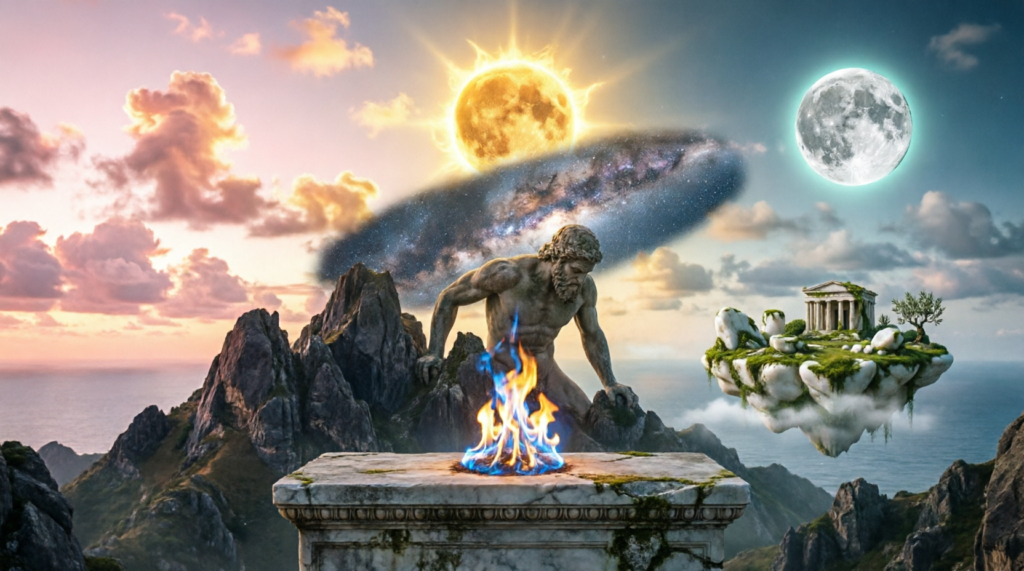
Between the Titans and the Olympians sits a generation that rarely gets its own name, the children born to Titan parents who never rule the cosmos themselves, but who shape nearly everything that makes Greek mythology recognizable: the sun, the moon, the dawn, fire given to humanity, and the mother of Apollo and Artemis. This guide covers nine figures typically grouped into this second generation, organized by family.
Atlas, Prometheus, and Epimetheus: The Sons of Iapetus
Iapetus and the Oceanid Clymene produce three sons whose stories, taken together, read almost like a meditation on humanity’s own condition. Atlas fights on the losing side of the Titanomachy and is condemned to bear the sky on his shoulders at the western edge of the world, a punishment with no stated end. Later tradition sometimes softens this into holding up the earth instead, and his name eventually attaches to a mountain range in North Africa.
Prometheus becomes one of Greek mythology’s most consequential figures, credited in some traditions with shaping humanity from clay and, more famously, with stealing fire from the gods and giving it to mortals against Zeus’s wishes. His punishment, chained to a rock while an eagle devours his regenerating liver each day, lasts until the hero Heracles eventually frees him.
Epimetheus, whose name means “afterthought” in pointed contrast to his brother’s “forethought,” ignores Prometheus’s explicit warning never to accept a gift from Zeus. He accepts Pandora, the first woman, sent as punishment for Prometheus’s theft, and with her the jar containing the world’s evils, releasing suffering into the world with only Hope left trapped inside.
Helios, Selene, and Eos: The Children of Hyperion and Theia
Hyperion and Theia, a Titan pairing associated with heavenly light and radiance, produce the three deities who govern the sky’s most visible daily phenomena. Helios drives the sun in a chariot across the sky each day, and later myth gives him a son of his own, Phaethon, whose disastrous attempt to drive his father’s chariot nearly sets the world ablaze.
Selene crosses the night sky in her own chariot as the moon, and is best remembered for her love of the mortal Endymion, who Zeus grants eternal sleep and eternal youth so that Selene might visit him forever unchanged. Eos opens the gates of dawn each morning so that Helios can begin his journey, and her own mythology is markedly more melancholy: she repeatedly falls in love with mortal men, and those unions tend to end badly, most famously with Tithonus, granted immortality by Zeus but not eternal youth, left to age forever without the release of death.
Leto and Asteria: The Daughters of Coeus and Phoebe
Coeus and Phoebe produce two daughters whose stories intertwine directly. Leto, pursued by Zeus, becomes pregnant with Apollo and Artemis, and Hera, furious at the affair, forbids any solid land from hosting the birth. Leto wanders in desperate search of refuge until she reaches Delos, an island not yet fixed to the seafloor and therefore technically not solid ground, where she is finally able to give birth.
That island is, in fact, her own sister. Asteria, pursued by Zeus in turn, transforms herself into a quail and leaps into the sea rather than submit, becoming the floating island later known as Delos. The symmetry is hard to miss: one sister’s act of resistance becomes the exact refuge that saves the other sister’s children, a rare case in Greek myth where two sisters’ separate stories resolve into a single, connected outcome.
Dione: A Second Account of Aphrodite’s Mother
Dione’s exact genealogical placement varies across ancient sources, with some traditions counting her among the Titans and others treating her as an Oceanid, but she is consistently significant for one reason: Homer names her, rather than the sea-foam of Hesiod’s account, as the mother of Aphrodite by Zeus. Greek mythology preserved both origin stories for Aphrodite side by side without ever resolving them into one official version, and Dione’s brief but important appearance in the Iliad, comforting her wounded daughter after a battlefield injury, remains one of the few surviving glimpses of tenderness between an Olympian goddess and her mother in the entire Homeric corpus.
A Generation Defined by Consequence
Unlike the Titans, whose defining event is the Titanomachy itself, this second generation is defined by what its members set in motion for everyone who comes after: fire and its costs through Prometheus and Epimetheus, the sun and moon’s daily governance through Helios and Selene, the birth of two major Olympians through Leto, and a second account of Aphrodite’s own origin through Dione. None of these figures rule the cosmos the way Zeus’s generation does. Their significance lies instead in how directly their stories touch the world mortals actually experience, daylight, moonlight, fire, and the sometimes unbearable cost of defying the gods.
Why This Generation Rarely Gets Its Own Name
Ancient sources never group these nine figures together under a single collective term the way “the Titans” or “the Twelve Olympians” function as recognized categories. That absence is worth noting rather than glossing over. Hesiod’s Theogony presents them simply as the next branch of an ongoing genealogy, children of Titans who never collectively rule anything or face a single shared war the way their parents’ generation does. Grouping them here as a “second generation” is a modern organizational convenience rather than an ancient category, useful for mapping how Greek cosmology moves from primordial forces, through the Titans, toward the Olympians, but it’s worth remembering that the ancient Greeks themselves likely never thought of Prometheus, Helios, and Leto as members of one named cohort the way they clearly did think of the twelve Titans or the twelve Olympians as coherent groups.
For the full structure this fits into, see the complete Greek Gods and Goddesses guide, or explore the generation before this one in the Titans guide, and the very beginning of the cosmos in the Primordial Gods guide.

Kaiqui Damasceno is a mythology writer and researcher dedicated to exploring the stories, gods, heroes, and ancient traditions that shaped human culture. Through engaging storytelling and thoughtful analysis, Kaiqui brings mythology to life, uncovering the deeper meanings, conflicts, symbols, and timeless lessons hidden within ancient myths.