Published on · Updated on
Table of Contents
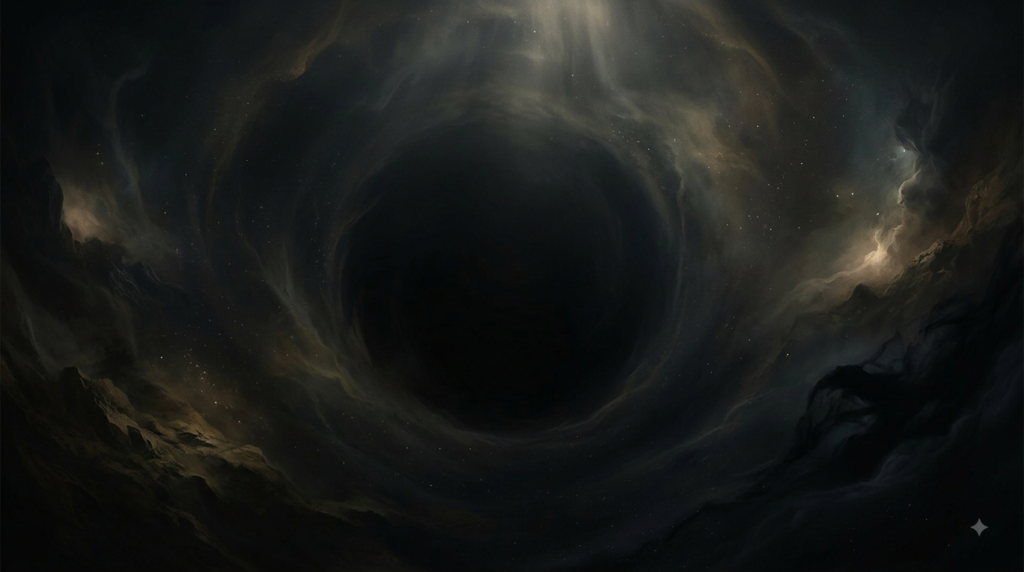
Chaos is the very first entity in Greek mythology’s account of creation — not a god of disorder or destruction, but a primordial gap or void that existed before the earth, sky, and sea took shape. If you’re picturing a chaotic battle or a wild storm, that’s not what the Greeks meant by the word. Khaos, the original Greek term, describes an opening, a chasm, a vast emptiness — the necessary blank space a universe needs before anything can be built inside it.
What Does Chaos Mean in Greek Mythology?
The Greek word khaos comes from a verb meaning “to gape” or “to yawn open.” It describes a wide, formless gap rather than confusion or noise. Picture the empty space inside a cave before anyone has stepped into it — not evil, not violent, just open.
That distinction matters because English speakers inherited the word “chaos” and gradually reshaped its meaning into something closer to mayhem. The Greek Chaos of Hesiod’s Theogony predates that shift by roughly 2,700 years. When Hesiod, writing in the late 8th or early 7th century BCE, says Chaos came first, he means an opening came first — not a storm, not a battle, not a monster.
Chaos in Hesiod’s Theogony
Hesiod’s Theogony is the oldest and most influential surviving account of Chaos, and it places Chaos at the absolute beginning of the poem: “First of all came Chaos, and after her Gaia the broad-breasted.” No parent, no origin story, no explanation — Chaos simply is, before anything else exists to explain it.
From this single primordial opening, Hesiod says two children emerge without any partner: Erebus (Darkness) and Nyx (Night). Erebus and Nyx then unite to produce Aether (the bright upper air) and Hemera (Day).
That sequence is worth sitting with: darkness and night, paired together, are what generate light. The Greek cosmos doesn’t begin bright and then get shadowed — it begins as an open gap, produces darkness first, and only then produces the light that darkness makes possible.
Was Chaos a God, a Place, or Both?
Chaos functions less like a personal deity with a face and a temperament, and more like a cosmological condition — closer to “the gap” than to “a person named Gap.” Ancient Greek religion had no cult of Chaos, no priests, no altars, no festivals. You won’t find worshippers bringing offerings to Chaos the way they would to Zeus or Demeter.
That absence is itself informative. The earliest, most elemental figures in Greek cosmogony — Chaos, and to a lesser extent Gaia and Tartarus — occupy a strange middle ground between “location” and “being.” Chaos has agency in the sense that it produces offspring, yet it never speaks, never acts, and never appears in any narrative scene. It exists to explain how everything else became possible, then steps entirely out of the story.
Chaos, Gaia, Tartarus, and Eros: The First Four
Immediately after naming Chaos, Hesiod lists three more primordial entities that arise in short order: Gaia (Earth), Tartarus (the deep abyss beneath the earth), and Eros (desire, the drive that makes union and generation possible). Together, these four form the absolute foundation of everything that follows.
The order matters. Chaos is the opening. Gaia is the solid ground that fills part of that opening. Tartarus is a further depth beneath even that ground. Eros is the force that will let Gaia and the beings born after her actually create new generations, rather than sitting static and alone. Without Eros in the mix, Hesiod’s cosmos would have structure but no way to grow.
How Ovid’s Chaos Differs From Hesiod’s
Roughly seven centuries after Hesiod, the Roman poet Ovid opens his Metamorphoses with a very different picture of Chaos. Where Hesiod’s Chaos is an empty gap, Ovid describes a “rudis indigestaque moles” — a rough, unsorted mass in which the seeds of earth, sea, and sky already exist, but jumbled together, undifferentiated, waiting to be separated out.
This is a genuinely different idea, even though both get translated into English as “Chaos.” Hesiod’s version is absence — nothing is there yet. Ovid’s version is a disorganized abundance — everything is already there, just not sorted. Modern phrases like “primordial soup” owe far more to Ovid’s crowded, unsorted mass than to Hesiod’s original empty gap. If you’ve ever pictured Chaos as a swirling mixture of elements, that image is Roman, not classical Greek.
Chaos in the Orphic Tradition
A separate strand of Greek religious poetry, associated with the mystic teacher Orpheus and known as Orphic cosmogony, tells a noticeably different creation story. In several Orphic fragments, Chaos appears alongside Aether and Erebus as raw material that the god Chronos (Time — not to be confused with the Titan Cronus) shapes into a great cosmic egg. That egg eventually cracks open to release Phanes, a radiant, self-generating deity of light and life.
Orphic cosmogony was never as widely known or standardized as Hesiod’s version; it survives mainly in scattered quotations and later summaries rather than one complete surviving poem. Still, it shows that even within ancient Greek religion, “how did the world begin” didn’t have one single accepted answer. Chaos could be an empty gap in one tradition and raw cosmic material in another, depending on which poets and which cult you were listening to.
For the full picture of how Chaos fits among the other primordial gods, see the Primordial Gods guide, part of Godspire’s complete guide to the Greek pantheon.
Frequently Asked Questions
Is Chaos a god in Greek mythology?
Chaos is usually described as a primordial entity rather than a god in the traditional sense — it has no cult, no temples, and no active role in myth beyond producing the first generation of primordial beings.
What is the difference between Chaos and Khaos?
Khaos is simply the original Greek spelling of the word; Chaos is the Latinized form most commonly used in English. Both refer to the same primordial figure from Hesiod’s Theogony.
Did Chaos create the universe?
Not exactly. Chaos is the first thing to exist, but Hesiod doesn’t describe Chaos actively creating anything. Instead, other primordial beings — Gaia, Tartarus, Eros — simply come into existence after Chaos, without a clear act of creation described.
What are Chaos’s children?
According to Hesiod, Chaos alone produced Erebus (Darkness) and Nyx (Night). Those two then paired together to produce Aether (bright air) and Hemera (Day).
Is Ovid’s Chaos the same as Hesiod’s Chaos?
No. Hesiod’s Chaos is an empty void or gap, while Ovid’s Chaos, written centuries later in Latin, is a disorganized mass already containing the unformed elements of earth, sea, and sky.

Kaiqui Damasceno is a mythology writer and researcher dedicated to exploring the stories, gods, heroes, and ancient traditions that shaped human culture. Through engaging storytelling and thoughtful analysis, Kaiqui brings mythology to life, uncovering the deeper meanings, conflicts, symbols, and timeless lessons hidden within ancient myths.