Published on · Updated on
Table of Contents
Rhea watches her husband swallow five of their children, one by one, and decides the sixth will not meet the same fate. That decision — quiet, deliberate, carried out with a stone and a piece of cloth rather than any weapon — is the reason Zeus exists to become king of the gods at all.
A Titan Daughter, a Titan Wife
Rhea is one of the twelve Titans, daughter of Gaia and Uranus, and sister to Cronus, whom she marries. In Hesiod’s Theogony, that marriage places her at the center of the generation immediately before the Olympians: Cronus and Rhea’s children are Hestia, Demeter, Hera, Hades, Poseidon, and Zeus — the core of what becomes the Olympian order that eventually rules from Mount Olympus.
Ancient sources don’t give Rhea much independent narrative outside her relationship to that family. She isn’t a character who acts alone in dramatic scenes the way some later goddesses do, and no surviving epic gives her a personal adventure separate from her role as mother and wife. Her significance is genealogical and, in one crucial moment, quietly strategic — which is, in its own way, exactly what makes her interesting. Greek myth doesn’t always reward loud action; sometimes the most consequential figure in a story is the one making a single careful decision no one else notices until much later.
Five Children, Swallowed
Cronus, warned that one of his own children would overthrow him just as he had overthrown his father Uranus, swallows each child Rhea bears — Hestia, Demeter, Hera, Hades, and Poseidon — as soon as they’re born. Hesiod’s account doesn’t linger on what this cost Rhea emotionally; the poem states it almost as a repeating procedure. But the repetition itself is the point. Five times, the same outcome, and no indication in the earliest sources that Rhea has any power to stop it directly. She can only watch and wait for a different opportunity.
A Stone in Place of a Son
When Rhea is pregnant with her sixth child, she goes to Gaia and Uranus for advice on how to protect this birth, and with their counsel, she gives birth to Zeus in secret. Different regional traditions locate this birth differently — most famously on Crete, in a cave on Mount Ida or Mount Dikte, where the infant is raised hidden away, sometimes by nymphs, sometimes fed by the goat Amalthea, while armed attendants called the Curetes danced and clashed their spears against their shields to mask the sound of his crying. A separate, less dominant tradition places the birth in Arcadia instead, a reminder that Greek myth rarely settled on one single authoritative version of even its most famous stories, since local sanctuaries often had their own competing claims to divine birthplaces.
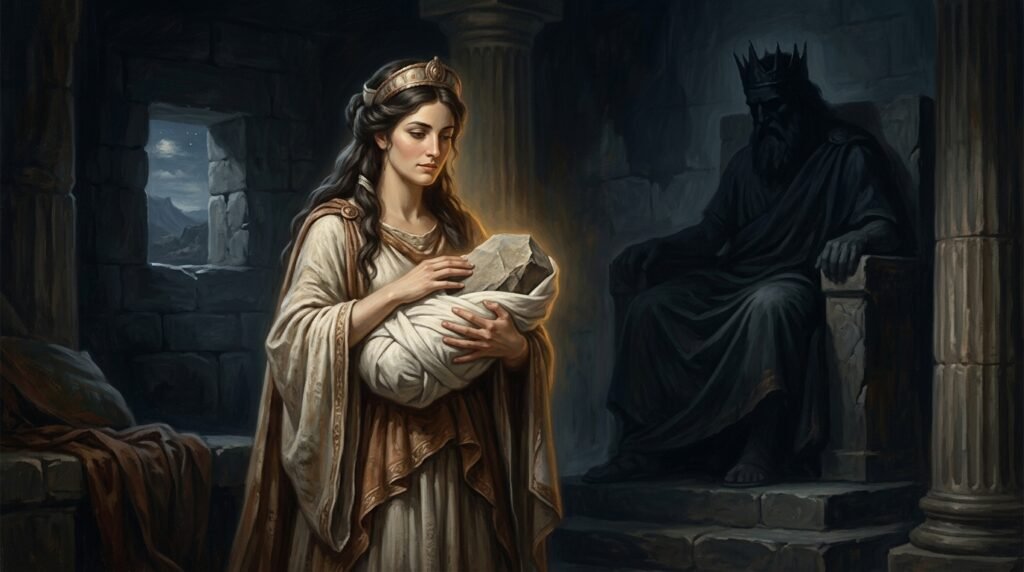
Rhea then wraps a large stone in swaddling cloth and presents it to Cronus in place of the newborn. Cronus, without checking, swallows it exactly as he had swallowed his other children. That single substitution is the entire mechanism of the myth’s turning point. No battle happens here, no divine confrontation. Rhea’s plan works because it’s simple enough that Cronus never thinks to question it, and because a father who has already swallowed five children without hesitation has no reason to expect deception from a wife he assumes has no power to oppose him.
What Rhea’s Choice Makes Possible
Zeus grows up away from his father’s reach, and when he’s ready, he returns and forces Cronus to disgorge the siblings he swallowed years earlier — Hestia, Demeter, Hera, Hades, and Poseidon emerge alive, along with the stone itself, which later tradition says was set up at Delphi as a sacred marker. Together with Zeus, these rescued siblings become the core of the Olympian generation. The Titanomachy that follows, the ten-year war between the Titans and the Olympians, only happens because Rhea’s earlier act of protection gave Zeus the chance to grow up and lead it.
It’s worth being direct about what this means structurally: without Rhea’s decision, there is no rescue, no war, no Olympian order as later Greek religion understood it. She doesn’t fight in the Titanomachy herself in most accounts, but the entire event depends on a choice she made alone, years before the war began, using nothing more than a well-chosen rock and a piece of fabric.
Rhea and Zeus’s Later Relationship
Rhea’s role in myth doesn’t fully end once Zeus reaches adulthood. Some later sources describe her continuing to act as an intermediary or advisor within the new divine order, a figure whose primordial standing still commands respect even after her own generation has lost formal power. This pattern — an older Titan retained in an advisory capacity rather than simply erased by the new regime — also appears with Themis, who continues to counsel Zeus after the Titanomachy, suggesting that Greek myth imagined the transition from Titan to Olympian rule as something more layered than total replacement. Wisdom and standing, in this telling, could survive a change of government even when direct power didn’t.
Later Reception and Cybele
In later antiquity, especially in Hellenistic and Roman contexts, Rhea was sometimes identified with Cybele, an Anatolian mother-goddess whose worship involved ecstatic ritual practice, drumming, and processions distinct from anything associated with Rhea in earlier Greek sources. That merging says more about how later religious syncretism worked — matching goddesses across cultures based on shared “mother of the gods” roles, a common strategy as Greek and Anatolian religious practices increasingly overlapped in the Hellenistic world — than it does about Rhea’s own original character in Hesiod’s account, where she remains a Titan defined chiefly by marriage, motherhood, and one decisive act of protection rather than by public, ecstatic cult.
For the full picture of how Rhea fits among the other Titans, see the Titans guide, part of Godspire’s complete guide to the Greek pantheon.
Frequently Asked Questions
How did Rhea save Zeus from being swallowed by Cronus?
Rhea gave birth to Zeus in secret, usually described as taking place on Crete, and then presented Cronus with a large stone wrapped in swaddling cloth in place of the newborn. Cronus swallowed the stone without realizing the substitution.
Who are Rhea’s children?
With Cronus, Rhea is the mother of Hestia, Demeter, Hera, Hades, Poseidon, and Zeus — the deities who become the core of the Olympian generation after the Titanomachy.
Where was Zeus hidden as an infant?
The most common tradition places his hiding place on Crete, in a cave on Mount Ida or Mount Dikte, though a separate regional tradition locates his birth and upbringing in Arcadia instead.
Is Rhea the same as Cybele?
Not originally. Rhea is a Greek Titan defined by Hesiod’s genealogy and her role in protecting Zeus. Later Hellenistic and Roman tradition sometimes identified her with Cybele, an Anatolian mother-goddess with a distinct cult and ritual practice, but the two begin as separate figures.

Kaiqui Damasceno is a mythology writer and researcher dedicated to exploring the stories, gods, heroes, and ancient traditions that shaped human culture. Through engaging storytelling and thoughtful analysis, Kaiqui brings mythology to life, uncovering the deeper meanings, conflicts, symbols, and timeless lessons hidden within ancient myths.