Published on · Updated on
Table of Contents
Ask what the difference is between Thalassa and Pontus, and you’ve asked the right question. Both are primordial personifications of the sea, both predate the Olympians by generations, and the answer isn’t that one is more important than the other — it’s that Greek myth sometimes gave the same natural force two faces, one masculine and one feminine, each carrying a slightly different emphasis.
The Sea, Given a Feminine Name
Thalassa’s name is, quite directly, the Greek word for “sea” — thalassa, as opposed to pontos, the term more associated with the open or deep sea and with Pontus specifically. Unlike Pontus, who receives a clear origin story in Hesiod’s Theogony — born from Gaia “without sweet union,” meaning without a father, as part of the earth’s own primordial self-generation — Thalassa doesn’t get the same treatment in the earliest surviving sources. Hesiod doesn’t develop her as an independent figure the way he does Pontus. She becomes more visible later, particularly in Roman-era mythography and in visual art, where she appears more often than she’s narrated.
That pattern — present in name and concept from early on, but only fully fleshed out by later writers — isn’t unique to Thalassa. Several primordial figures follow the same arc: real from the start, implied by the very structure of Greek cosmology, but elaborated centuries after their first appearance, once later mythographers went looking for a complete and tidy family tree to explain every natural phenomenon.
Paired With Pontus
Later mythographers, particularly the Roman writer Hyginus, working in Latin centuries after Hesiod, describe Thalassa and Pontus together as the parents of the fish — a lineage that reads less like a family story and more like an explanation of where an entire category of life comes from. If Pontus represents the sea as an ancient, generative masculine force, father to Nereus the trustworthy “Old Man of the Sea,” to the monstrous line through Phorcys and Ceto that eventually produces the Gorgons, and to wonder itself through Thaumas, then Thalassa represents the same essential body of water in feminine form, less genealogically elaborate but no less fundamental.
Greek myth used this kind of doubling more than once. Sky and Day, Darkness and Night, primordial forces often traveled in gendered pairs, each half explaining a different register of the same underlying reality. Uranus and Aether both touch on “sky,” just as Pontus and Thalassa both touch on “sea,” without one simply being a copy of the other. The overlap isn’t redundancy; it’s Greek cosmology’s way of giving a single natural force more than one face to think through.
Distinguishing Thalassa From Amphitrite and the Nereids
Modern readers sometimes fold Thalassa together with the later, more narratively active sea goddesses of Greek myth — Amphitrite, Poseidon’s queen, or the fifty Nereids who serve as her attendants and appear throughout heroic myth. That conflation is understandable but worth untangling. Amphitrite and the Nereids belong to the world of the Olympians: they have court politics, marriages, and named individual personalities drawn from a specific genealogy tracing back to Nereus and, further back, to Pontus.
Thalassa belongs to an older and more abstract register entirely. She isn’t a nymph attending a king; she is closer to being the substance the king rules over. That distinction matters for the same reason it matters with Gaia and the goddesses of individual mountains or rivers: personification and deification in Greek religion operated at multiple scales simultaneously, from the cosmic (Thalassa, the sea as such) down to the local (a nymph tied to one particular spring or bay).
A Face in the Mosaic
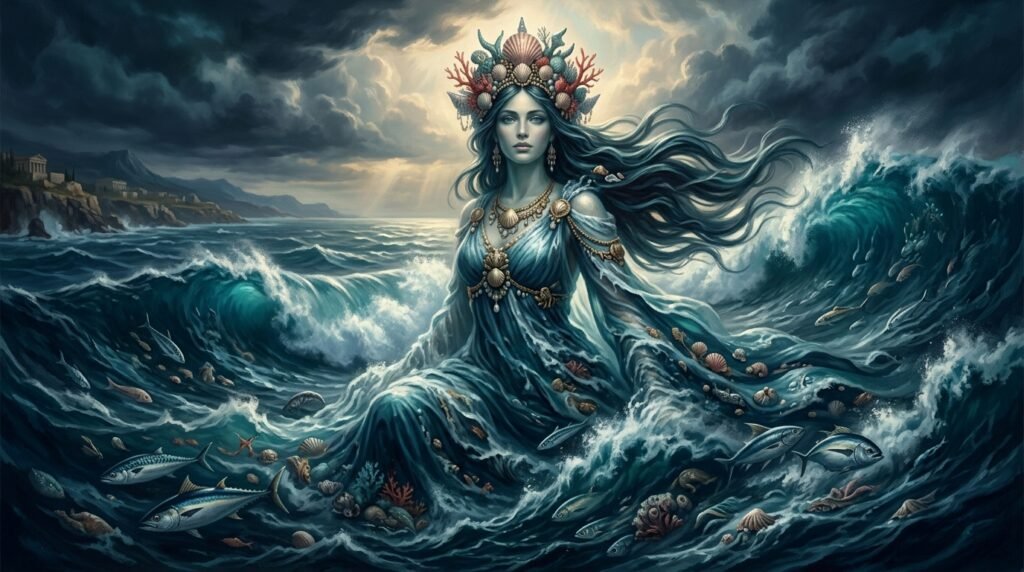
Where ancient poetry is relatively quiet about Thalassa, ancient art is not. Late Roman and Byzantine mosaics, especially from sites across the eastern Mediterranean, frequently depict her as a female bust or figure rising from the waves, surrounded by fish and marine life, her name sometimes inscribed directly beside the image in Greek lettering. That labeling matters: it shows that ancient viewers distinguished her from generic sea nymphs or unnamed marine decoration. She was a specific figure worth naming, even in periods when few people were writing new myths about her, and even in regions far from where the earliest Greek poetry about the primordial gods had been composed.
That visual tradition also tells you something about how her identity survived across centuries when literary interest in primordial figures had largely moved on to more actively worshipped Olympian gods. Thalassa didn’t need an epic to remain recognizable. A woman’s face surfacing from tessellated waves, labeled in Greek letters on a bathhouse floor or a wealthy villa’s dining room, was enough to keep her legible to educated viewers who might never have read a line of Hesiod.
A Name That Outlived the Myth
Thalassa’s afterlife extends well past ancient mythology and into modern vocabulary in a way most primordial deities don’t manage. The Greek root survives in words like “thalassotherapy,” treatment using seawater, and “thalassocracy,” a term historians use for sea-based empires such as ancient Athens or later Venice. None of that later usage requires any awareness of the goddess herself; the word had already become the ordinary Greek term for “sea” long before it needed a mythological identity attached to it. But the persistence of the root is a reminder of how directly Thalassa’s name and function were fused from the very beginning — unlike a name such as Aphrodite, which doesn’t obviously mean anything in ordinary Greek, “thalassa” never stopped being both a common noun and a goddess’s name at once.
For the full picture of how Thalassa fits among the other primordial gods, see the Primordial Gods guide, part of Godspire’s complete guide to the Greek pantheon.
Frequently Asked Questions
Is Thalassa the same as Pontus?
No. Both are primordial personifications of the sea, but Pontus is the masculine form, born from Gaia according to Hesiod, while Thalassa personifies the sea in feminine form and is developed more fully in later Greek and Roman sources than in the earliest texts.
Does Thalassa appear in Hesiod’s Theogony?
Not as a major, independently developed figure. Hesiod gives Pontus a clear origin and family line; Thalassa becomes more prominent in later mythography, especially in Roman-era writers like Hyginus, and in visual art rather than in the earliest surviving poetry.
How was Thalassa typically depicted in ancient art?
Most surviving depictions come from late Roman and Byzantine mosaics, which show her as a female figure or bust rising from ocean waves, often surrounded by fish, and sometimes labeled by name in Greek.
Is Thalassa the same as Amphitrite?
No. Amphitrite is an Olympian-era sea goddess, wife of Poseidon and one of the Nereids, with her own distinct genealogy and role in myth. Thalassa is an older, more abstract primordial personification of the sea itself, closer in kind to Pontus than to any Olympian-affiliated sea deity.

Kaiqui Damasceno is a mythology writer and researcher dedicated to exploring the stories, gods, heroes, and ancient traditions that shaped human culture. Through engaging storytelling and thoughtful analysis, Kaiqui brings mythology to life, uncovering the deeper meanings, conflicts, symbols, and timeless lessons hidden within ancient myths.