Published on · Updated on
Table of Contents
Confuse Chronos with Cronus and you’re in good company — Roman poets, Renaissance painters, and most modern retellings have made the same mix-up. But they’re not the same figure, and the difference matters more than a spelling quirk. One is a Titan with a family, a throne, and a war he loses. The other is barely a character at all.
Time, Not the Titan Who Ate His Children
Chronos personifies Time. Cronus is the Titan son of Uranus and Gaia who overthrows his father, swallows his own children out of fear, and eventually loses his throne to Zeus. The two names look alike in English and sound close in Greek — chronos meaning “time,” Kronos being the Titan’s name — and centuries of art blended them into a single bearded old man carrying a scythe, an image that really belongs to Cronus, whose sickle overthrew Uranus. Later artists and writers reused that image for Chronos because “Father Time cutting down all things” made for a tidy visual metaphor, one clean enough that it eventually became the default picture of Time itself in Western art, hourglass and all.
Strip that borrowed imagery away and Chronos looks like a different kind of figure entirely: less a character with a family drama, more a condition of existence given a name. He doesn’t scheme, doesn’t marry in any well-attested myth, doesn’t fight a war. What he does is anchor a cosmology.
A Figure Hesiod Barely Mentions
If you go looking for Chronos in Hesiod’s Theogony — the earliest and most complete surviving account of the Greek gods’ origins, composed in the late 8th or early 7th century BCE — you won’t find much. He isn’t part of the main genealogical sequence that runs from Chaos through Gaia, Uranus, and the Titans. His real presence is in a separate body of material: Orphic cosmogony, a religious-poetic tradition connected to the mythical figure Orpheus, preserved today mostly in scattered fragments and later summaries rather than one complete surviving poem.
That’s worth being precise about, because it means Chronos isn’t a minor character within Hesiod’s story who just doesn’t get much attention. He largely belongs to a different creation account altogether, one that circulated alongside Hesiod’s more famous version without ever fully merging into it. Ancient Greek religion, unlike many later organized faiths, had no single authority empowered to declare one cosmogony official and another false. Both existed, read by different audiences for different purposes.
Time and Necessity, Wound Together
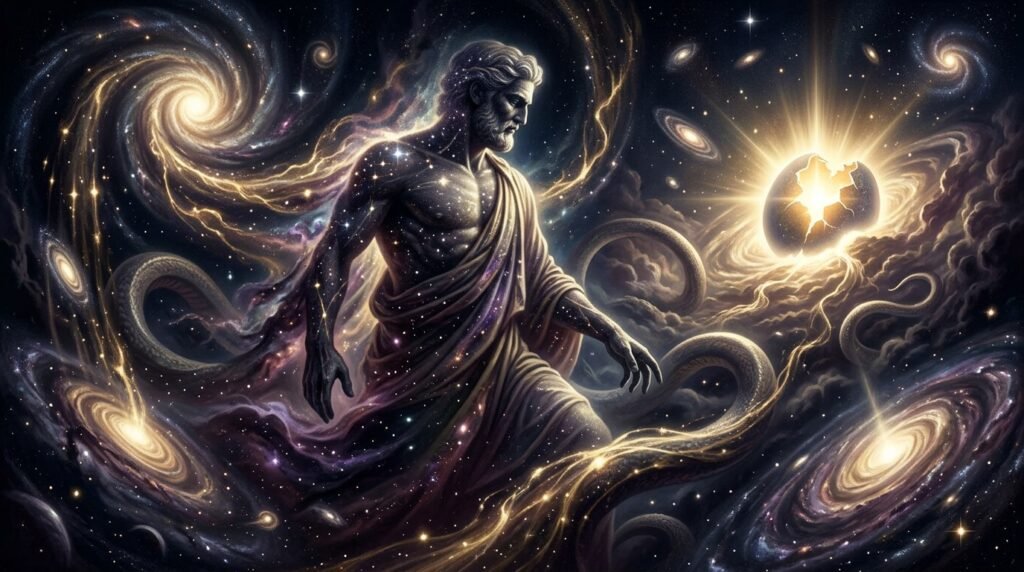
Several Orphic sources describe Chronos alongside Ananke, the personification of Necessity, the two of them pictured as serpentine forces coiled around the beginning of the cosmos. Together they shape a great cosmic egg, and from that egg the radiant primordial deity Phanes eventually emerges — a first-born power of light, sometimes described as bisexual or containing the seeds of all future gods within himself, who sets the ordered universe into motion.
It’s a strange image to sit with: Time and Necessity, not ruling anything yet, simply wrapped around the raw material of a world that doesn’t exist yet. Whether any single ancient source spells out the symbolism explicitly, the pairing reads as a statement about how the Orphic tradition imagined creation working — not through a single act of will, the way Hesiod’s Chaos simply produces offspring, but through sequence (Chronos) constrained by inevitability (Ananke). Time doesn’t act freely in this picture. It moves within limits that Necessity sets, and only within those limits does anything new become possible.
Later Orphic fragments extend the lineage further, making Chronos father to Aether and Chaos in some versions — a genuinely different creation sequence from Hesiod’s, where Chaos comes first and generates everything else. Readers encountering both traditions side by side sometimes try to reconcile them into one timeline. Ancient audiences don’t seem to have felt that pressure. The two accounts simply offered different answers to the same question.
A Word With Two Lives
The confusion between Chronos and Cronus wasn’t only visual. Ancient etymologists themselves sometimes played with the resemblance, treating the Titan’s name as if it secretly meant “Time” even though the linguistic connection doesn’t hold up under modern scrutiny. That kind of folk etymology was common in the ancient world, where a striking sound-alike could feel like evidence of a deeper truth, especially once Orphic and Stoic thinkers started looking for ways to read philosophical meaning into the old genealogies.
By the time Latin authors and then Renaissance humanists inherited both figures, the distinction had mostly collapsed in popular imagination, even if scholars continued to note it. Saturn — the Roman god merged with Cronus — already carried associations with agriculture, time’s harvest, and old age. Add a scythe, a long beard, and the word “Time” itself, and the composite figure known today as Father Time was essentially complete.
From Myth to Metaphysics
Chronos had a longer afterlife in Greek philosophy than in mainstream myth. Plato invokes him directly in the Timaeus, where time itself is described as something that comes into being together with the ordered universe, “a moving image of eternity.” That’s a philosophical claim built partly on the old mythic personification — Time isn’t just a backdrop events happen against; it’s something with its own origin, coextensive with the cosmos itself rather than an empty container that existed before anything else did.
Later Stoic and Neoplatonist writers kept returning to the same well, using Chronos as shorthand for questions about duration, change, and whether time itself needed a cause. None of that later philosophical work required a dramatic myth attached to it. It needed exactly what the primordial Chronos already was: a name for something too fundamental to have adventures, useful precisely because it stayed abstract while gods like Zeus and Apollo accumulated centuries of increasingly specific stories.
For the full picture of how Chronos fits among the other primordial gods, see the Primordial Gods guide, part of Godspire’s complete guide to the Greek pantheon.
Frequently Asked Questions
Is Chronos the same as the Titan Cronus?
No. Chronos personifies Time; Cronus is the Titan son of Uranus and Gaia who fathers Zeus. The two are separate figures whose names and later imagery merged over centuries, but they begin as distinct traditions.
Where does Chronos appear in ancient sources?
Chronos is largely absent from Hesiod’s Theogony, the main early source for Greek cosmogony. He appears primarily in Orphic cosmogony, a separate religious-poetic tradition, and later in the work of philosophers like Plato.
What is Chronos’s role in Orphic cosmology?
In several Orphic accounts, Chronos is paired with Ananke (Necessity) and credited with shaping the cosmic egg from which the primordial deity Phanes emerges, setting the ordered universe in motion.
Why do people picture Chronos as an old man with a scythe?
That image actually originates with the Titan Cronus, whose sickle overthrows Uranus, and with the Roman god Saturn, associated with agriculture and harvest. Later artists merged those attributes with the abstract idea of Time, producing the familiar “Father Time” figure.

Kaiqui Damasceno is a mythology writer and researcher dedicated to exploring the stories, gods, heroes, and ancient traditions that shaped human culture. Through engaging storytelling and thoughtful analysis, Kaiqui brings mythology to life, uncovering the deeper meanings, conflicts, symbols, and timeless lessons hidden within ancient myths.