Published on · Updated on
Table of Contents
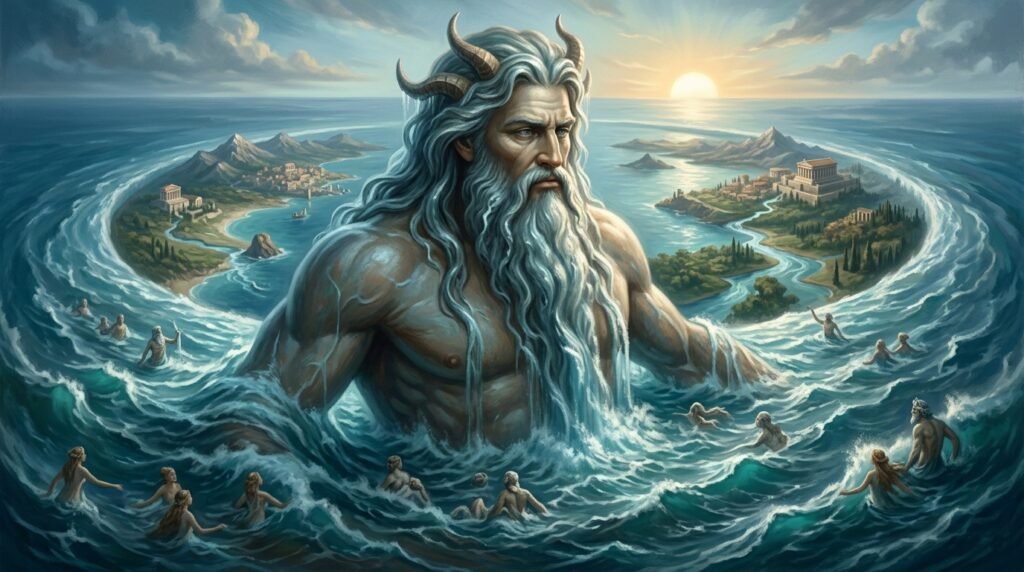
Ancient Greeks didn’t picture the sea the way modern maps do. Beyond the familiar Mediterranean waters lay something stranger in their imagination: a single vast river, circling the entire inhabited world like a boundary drawn in water. That river has a name and a divine identity — Oceanus, oldest of the Titans, and one of the few who never went to war against Zeus.
The Titan Who Is a River, Not a Sea
Oceanus is a son of Uranus and Gaia, one of the twelve Titans in Hesiod’s Theogony, composed in the late 8th or early 7th century BCE, but his domain is distinct from what later readers might assume. He isn’t a sea god in the way Poseidon becomes one — commanding waves, causing earthquakes, ruling from an underwater palace, and intervening directly in the affairs of sailors and cities. Oceanus personifies something more specific: the great encircling river that ancient Greek cosmography imagined running around the edge of the known world, separating the human sphere from whatever lay beyond it, whether that was simply more sea, the realm of the dead, or lands so distant they belonged more to myth than geography.
That distinction is worth holding onto, because Pontus, a separate primordial deity, already personifies the sea itself in Hesiod’s account. Oceanus is something adjacent but different — not the sea’s depth, but its outer boundary, the edge rather than the substance.
A Household of Rivers and Nymphs
With his sister-wife Tethys, Oceanus fathers an almost incomprehensibly large family: three thousand river gods and three thousand Oceanid nymphs, according to Hesiod. Those numbers aren’t meant as an exact census; they signal overwhelming abundance, the sense that every stream and spring on earth ultimately traces its origin back to this single primordial union. Named rivers like the Nile, the Alpheus, and the Scamander, the river that runs through the plain of Troy in the Iliad, are all counted among his sons, while his daughters, the Oceanids, become associated with springs, clouds, and the generative aspects of fresh water throughout Greek myth.
Several of those daughters carry real narrative weight elsewhere in mythology, far beyond anything attributed to their father directly. Metis, who becomes Zeus’s first wife and mother of Athena, born from his own head after he swallows her, is an Oceanid. So is Styx, the river by which the gods swear their most binding oaths, whose name becomes permanently attached to the underworld itself in later tradition. Through his children, Oceanus’s presence reaches into stories that never mention him directly by name, a quiet genealogical undercurrent running through much of later Greek myth.
The Titan Who Sat Out the War
When the Titanomachy erupts — the war between the Olympians led by Zeus and the Titans led largely by Cronus — Oceanus is notably absent from the roster of defeated Titans cast into Tartarus. Ancient sources generally treat this as deliberate neutrality rather than an oversight. Oceanus doesn’t join the losing side, and he doesn’t seem to fight for Zeus either, at least not in any battle scene that survives. He simply doesn’t participate in the way his siblings do, a choice that later Greek writers found interesting enough to build a whole scene of characterization around.
That choice fits a broader pattern visible in how later authors describe him. In Aeschylus’s Prometheus Bound, Oceanus visits the chained Titan Prometheus and counsels compromise rather than continued defiance of Zeus, arriving on a strange winged creature and offering to intercede on Prometheus’s behalf — advice Prometheus rejects, sharply and at length. The scene captures Oceanus as a cautious, pragmatic elder rather than a rebel, someone whose instinct is always toward accommodation. He survives the transition from Titan rule to Olympian rule not by winning a fight, but by never fully entering one, and Aeschylus uses that survival to draw a pointed contrast with Prometheus’s own stubborn, costly defiance.
A Marriage With a Crack in It
Not every ancient reference to Oceanus and Tethys presents a purely harmonious household. In the Iliad, Hera recalls being reared by Tethys after Rhea entrusted her to the couple’s care, and in the same passage hints at a rift or separation between Oceanus and Tethys that has kept them apart. Homer doesn’t explain the quarrel in detail, and no fuller account survives to fill the gap. That silence is itself informative: it suggests Greek audiences already knew some version of the story well enough that Homer didn’t need to spell it out, even though the specifics never made it into any text that has come down to us. It’s a small, tantalizing crack in what otherwise reads as a purely generative, conflict-free primordial marriage.
Where the World’s Edges Meet
Homer treats Oceanus as something close to the outer limit of reality itself. The sun is described moving toward Oceanus at day’s end, sinking beneath its stream each evening; distant or fantastical peoples, such as the Ethiopians or the Cimmerians shrouded in mist, are sometimes placed near its waters; and the very shield of Achilles, described in extraordinary detail in Book 18 of the Iliad, has Oceanus running around its outer rim, framing the entire scene of human life, war, and peace depicted within it.
That image is worth sitting with. If the inhabited world is a shield, Oceanus is the rim holding the picture together, not a participant in the events at its center, but the boundary that makes “center” a meaningful idea in the first place. Ancient geography eventually outgrew the literal idea of a single encircling river, especially as exploration expanded the known world well past what earlier poets had imagined, but the poetic force of that image outlasted the cartography it was based on, still surfacing in later literature long after educated readers had stopped believing in a literal river at the world’s edge.
For the full picture of how Oceanus fits among the other Titans, see the Titans guide, part of Godspire’s complete guide to the Greek pantheon.
Frequently Asked Questions
Is Oceanus the same as Poseidon?
No. Oceanus is a Titan who personifies the great river ancient Greeks imagined circling the edge of the known world. Poseidon is a later Olympian god who actively rules the sea, causes earthquakes, and intervenes directly in myth and cult worship.
Did Oceanus fight in the Titanomachy?
The main tradition treats Oceanus as neutral or absent from the war between the Titans and the Olympians, unlike most of his siblings. He is not listed among the Titans imprisoned in Tartarus after their defeat.
Who are Oceanus’s children?
With his wife Tethys, Oceanus is described by Hesiod as the father of three thousand river gods and three thousand Oceanid nymphs, including notable figures like Metis and Styx.
Was there ever conflict between Oceanus and Tethys?
Homer’s Iliad includes a brief reference, spoken by Hera, to a rift or separation between the couple, though no surviving source explains the cause in detail. It remains one of Greek mythology’s more intriguing loose threads.

Kaiqui Damasceno is a mythology writer and researcher dedicated to exploring the stories, gods, heroes, and ancient traditions that shaped human culture. Through engaging storytelling and thoughtful analysis, Kaiqui brings mythology to life, uncovering the deeper meanings, conflicts, symbols, and timeless lessons hidden within ancient myths.