Published on · Updated on
Table of Contents
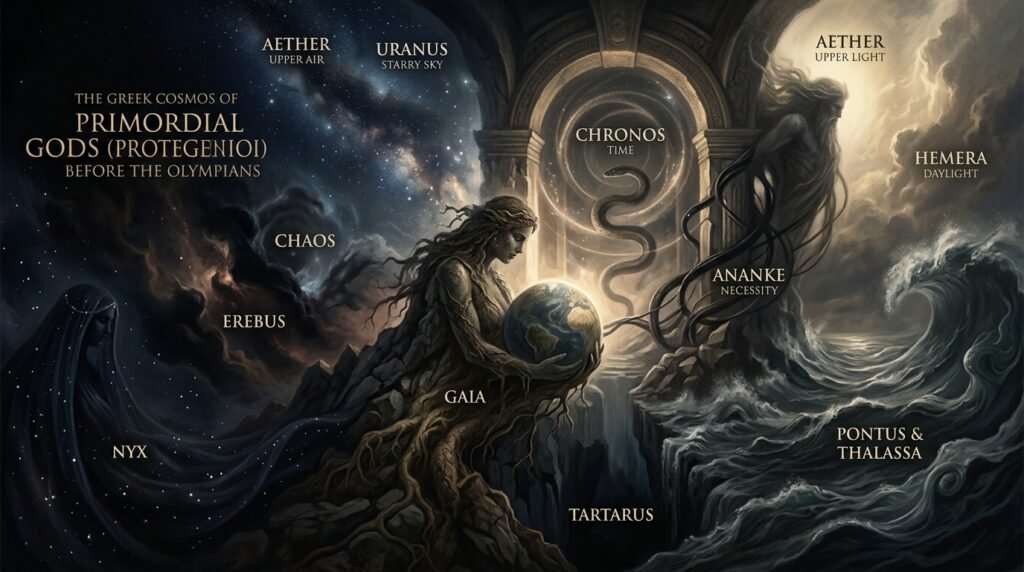
Before Zeus, before the Titans, before anything resembling a divine family with rivalries and marriages, Greek mythology has a stranger, quieter layer: the primordial gods. Hesiod’s Theogony names them at the very start of the cosmos — not rulers, not warriors, but the raw conditions of existence itself, given divine identity. This guide covers each of the twelve figures that make up this generation.
Chaos
Chaos is the first entity to exist in Hesiod’s Theogony. Despite the modern meaning of the word, khaos in Greek describes a yawning gap or opening rather than disorder — a formless void that exists before earth, sky, and sea take shape. From Chaos alone, without any partner, come Erebus (Darkness) and Nyx (Night), who then unite to produce Aether (bright air) and Hemera (Day). In this sequence, light itself doesn’t exist from the start; it has to be generated, and its origin point is darkness. Roman poetry offers a different picture: Ovid, writing centuries later, describes Chaos not as an empty gap but as a “rudis indigestaque moles,” a disorganized mass already containing the unformed seeds of earth, sea, and sky. Both versions get translated into English as “Chaos,” but they describe genuinely different ideas. Read more at the Theoi Project’s entry on Chaos.
Gaia
Gaia is the personification of Earth, arriving immediately after Chaos in Hesiod’s account. Alone, she produces Uranus (Sky), the mountains, and Pontus (Sea); with Uranus, she becomes mother to the twelve Titans, the Cyclopes, and the Hundred-Handed Ones. When Uranus, afraid of his own children, forces them back inside her body, Gaia crafts the sickle that her son Cronus uses to overthrow him — the founding act of Greek succession myth. She doesn’t disappear from the story once the Titans take over, either. Generations later, angry that Zeus has imprisoned the defeated Titans in Tartarus, Gaia unites with Tartarus himself to produce Typhon, a monster powerful enough to nearly overthrow Zeus. Across Greek mythology, Gaia functions as a recurring check on whichever generation currently holds power. Read more at the Theoi Project’s entry on Gaia.
Uranus
Uranus is the primordial sky, born from Gaia and later her husband, so that he could “cover her on every side.” Their union produces the Titans, but Uranus, fearing his children, forces each one back into Gaia’s body rather than letting them be born. Gaia’s response — arming Cronus with a sickle to castrate his father — ends Uranus’s reign and produces several other beings from his blood and severed flesh, including, in Hesiod’s account, Aphrodite, born from sea-foam near Cyprus. Homer offers a different origin for Aphrodite entirely, making her the daughter of Zeus and Dione — a reminder that Greek myth preserved competing traditions rather than settling on one. Uranus’s final act is a prophecy: he warns Cronus that he, too, will one day be overthrown by his own child, setting up the next stage of the succession pattern. Read more at the Theoi Project’s entry on Uranus.
Tartarus
Tartarus names both a primordial deity and the deepest abyss in the Greek cosmos — a dual identity it shares with figures like Gaia and Pontus, where a name refers to both a being and the physical reality that being represents. Hesiod places Tartarus as far beneath the earth as the sky is above it, illustrating the distance with a striking image: a bronze anvil dropped from the heavens would fall nine days and nights before reaching earth, and another nine before reaching Tartarus. After the Titanomachy, Tartarus becomes the prison for the defeated Titans, sealed behind gates guarded by the Hundred-Handed Ones. With Gaia, Tartarus later fathers Typhon, meaning the deepest, most sealed-away part of the cosmos still finds a way to challenge Olympian order once more. Read more at the Theoi Project’s entry on Tartarus.
Nyx
Nyx is the personification of Night, born from Chaos alongside her sibling Erebus. Her name is, quite literally, the Greek word for night — identity and name collapsed into the same thing. With Erebus, she produces Aether and Hemera; on her own, Hesiod credits her with an extraordinary family of children, including Hypnos (Sleep), Thanatos (Death), the Oneiroi (Dreams), and Nemesis (Retribution) — nearly all of them forces that arrive when human control loosens. The clearest evidence of her standing comes from Homer’s Iliad: when Hypnos flees Zeus’s anger by taking refuge with his mother, Zeus holds back rather than risk offending Night. It’s a brief scene, but it says something significant about Greek myth’s internal hierarchy — some primordial powers exist outside the ordinary chain of Olympian authority entirely. Read more at the Theoi Project’s entry on Nyx.
Erebus
Erebus is the personification of primal darkness, closely paired with Nyx as sibling or consort — a pairing distinct enough from Night that Greek poets treated the two as related but not identical. Where Nyx represents the recurring nightly cycle, Erebus is heavier and more absolute, closer to the gloom of the underworld than to an ordinary nightfall. His union with Nyx produces Aether and Hemera, meaning that light and day, in Hesiod’s cosmology, are generated from darkness rather than existing independently from the start. In Homeric usage, “Erebus” can also function as a place-name for the darkness of the underworld itself or the route the dead take downward — the same overlap between deity and location found elsewhere among the primordials. Read more at the Theoi Project’s entry on Erebus.
Pontus
Pontus is the primordial sea, born from Gaia “without sweet union” — meaning without a partner, emerging directly as part of the world’s earliest structure. With Gaia, Pontus fathers Nereus, Thaumas, Phorcys, Ceto, and Eurybia, a family that captures the sea’s full emotional range in Greek imagination: Nereus is wise and honest, Thaumas connects to wonder and the rainbow messenger Iris, while Phorcys and Ceto become parents to some of mythology’s most feared monsters, including the Gorgons. Pontus himself remains a distant, abstract figure compared to the later Olympian sea god Poseidon — less a character with a throne and a trident than the sea’s raw existence given a name. Read more at the Theoi Project’s entry on Pontus.
Aether
Aether personifies the bright, pure upper air breathed by the gods — a distinct concept from aer, the ordinary lower atmosphere that mortals breathe. Born from the union of Erebus and Nyx, Aether is sibling to Hemera, Day, and the two are often understood together as the light and radiance that emerge from the primordial generation’s darker figures. Ancient cosmology imagined reality in layers: earth in the middle, Tartarus sunk below, and Aether as the most refined, elevated register above the visible sky. The word later took on a very different life in Greek and then early modern science, where “aether” became a proposed medium filling space — a scientific concept related in name only to the mythic figure. Read more at the Theoi Project’s entry on Aether.
Hemera
Hemera is the personification of Day, daughter of Nyx and Erebus and sibling to Aether. One of the most memorable images associated with her comes from later poetic tradition: Night and Day are described sharing a single bronze threshold at the edge of the world, one always departing exactly as the other arrives, never occupying the house together. Hemera is sometimes confused with Eos, the Titan goddess of dawn, but the two represent different things — Eos is the momentary event of daybreak, while Hemera is the daylight period that follows it. That distinction matters for keeping the primordial and Titan generations properly separated. Read more at the Theoi Project’s entry on Hemera.
Ananke
Ananke personifies Necessity or inevitability — a force even the gods cannot bargain with. She is far more prominent in Orphic cosmology than in Hesiod’s Theogony, where she barely appears at all. In several Orphic accounts, Ananke is paired with Chronos (Time) as a primal cosmic force, the two of them coiled together around the origins of the universe, shaping the conditions from which everything else eventually emerges. Later Greek philosophy, including Plato, picks up Ananke as a way of describing the unyielding structure underlying fate itself — less a character with a personality than a name for the limits reality imposes on everyone, gods included. Read more at the Theoi Project’s entry on Ananke.
Chronos
Chronos personifies Time, and should not be confused with the Titan Cronus — a mix-up that became extremely common in later antiquity and art, partly because the two names sound alike and partly because the image of a sickle-wielding old man conveniently fit both figures. The genuine Chronos belongs mainly to Orphic cosmology and later philosophical tradition rather than to Hesiod’s account. In some Orphic sources, Chronos generates Aether and Chaos and shapes them into a cosmic egg, from which the radiant primordial deity Phanes eventually emerges — a creation story genuinely different from Hesiod’s, not simply a variant detail. Read more at the Theoi Project’s entry on Chronos.
Thalassa
Thalassa personifies the sea in feminine form, distinct from the primordial Pontus. Hesiod doesn’t develop her as a major figure the way he does Pontus; she becomes more visible in later Greek and Roman mythography, particularly in accounts where she and Pontus are described together as parents of the fish. Late Roman and Byzantine mosaics frequently depict Thalassa as a female figure rising from the waves, surrounded by marine life, distinguishing her visually from other sea deities of the period. The relationship between Thalassa and Pontus works much like other primordial pairs in Greek myth — two versions, one male and one female, of the same essential natural force. Read more at the Theoi Project’s entry on Thalassa.
This guide is part of Godspire’s complete Greek Gods and Goddesses guide, which organizes the full pantheon into every category, from the primordial generation covered here through the Titans and Olympians still being added.

Kaiqui Damasceno is a mythology writer and researcher dedicated to exploring the stories, gods, heroes, and ancient traditions that shaped human culture. Through engaging storytelling and thoughtful analysis, Kaiqui brings mythology to life, uncovering the deeper meanings, conflicts, symbols, and timeless lessons hidden within ancient myths.