Published on · Updated on
Table of Contents
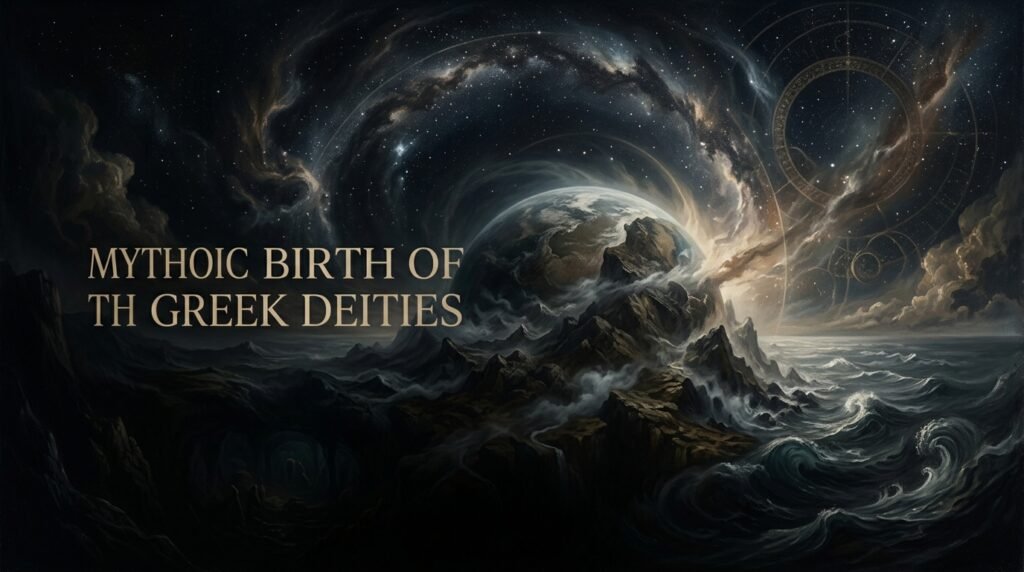
The Greek pantheon isn’t one flat list of gods — it’s a layered family spanning several generations, each with a different kind of role in the mythology. This guide covers all 102 figures that make up the Greek divine world, organized into the thirteen categories they actually fall into, from the primordial forces that predate the cosmos itself down to the specialized gods of healing, the arts, and fate. For a deeper look at the first section below, see the standalone Primordial Gods guide.
Primordial Deities
Chaos
The first entity to exist in Hesiod’s Theogony — not disorder, but a yawning gap or void that predates earth, sky, and sea. From Chaos alone come Erebus and Nyx, whose own union eventually produces light and day. (Theoi Project)
Gaia
The personification of Earth itself, born shortly after Chaos. Gaia becomes the mother of Uranus, the Titans, the Cyclopes, and the Hundred-Handers, and repeatedly intervenes across generations whenever she believes the current cosmic order needs to be challenged. (Theoi Project)
Uranus
The primordial sky, born from and later united with Gaia. Their children include the Titans, but Uranus imprisons them out of fear, prompting Gaia to arm their son Cronus with the sickle that ends his reign. (Theoi Project)
Tartarus
Both a primordial deity and the deepest abyss in the Greek cosmos, located as far beneath the earth as the sky is above it. After the Titanomachy, Tartarus becomes the prison for the defeated Titans. (Theoi Project)
Nyx
The personification of Night, born from Chaos. Nyx is one of the few figures ancient sources describe Zeus treating with real caution — a sign of how much authority primordial age carried in Greek thought. (Theoi Project)
Erebus
Primordial Darkness, closely paired with Nyx as sibling or consort. Their union produces Aether and Hemera, meaning that light itself, in Hesiod’s account, originates from darkness and night. (Theoi Project)
Pontus
The primordial sea, born from Gaia without a father. With Gaia, Pontus fathers Nereus, Thaumas, Phorcys, Ceto, and Eurybia — a lineage that includes both the wise “Old Man of the Sea” and the ancestors of several major monsters. (Theoi Project)
Aether
The personification of the bright upper air breathed by the gods, distinct from the ordinary air (aer) that mortals breathe. Aether is the child of Erebus and Nyx, and sibling to Hemera, Day. (Theoi Project)
Hemera
The personification of Day, daughter of Nyx and Erebus. In one recurring image, Hemera and her mother Night are described sharing a single threshold, one always departing exactly as the other arrives. (Theoi Project)
Ananke
The personification of Necessity or inevitability, a figure most prominent in Orphic cosmology rather than Hesiod’s account. Ananke is sometimes paired with Chronos as a primal cosmic force binding the universe together. (Theoi Project)
Chronos
The personification of Time in later Greek philosophical and Orphic tradition — not the same figure as the Titan Cronus, despite frequent confusion between the two names in later antiquity and art. (Theoi Project)
Thalassa
A personification of the sea in feminine form, distinct from the primordial Pontus. Later mythographers, particularly Roman sources, describe Thalassa and Pontus together as parents of the fish. (Theoi Project)
Titans
Cronus
The youngest Titan, who overthrows his father Uranus at Gaia’s urging. Fearing a prophecy that one of his own children would depose him in turn, Cronus swallows each of them at birth — until Zeus escapes that fate. (Wikipedia)
Rhea
Cronus’s wife and sister, and mother of the Olympians. When Cronus begins swallowing their children, Rhea hides the infant Zeus on Crete and tricks Cronus into swallowing a stone instead. (Wikipedia)
Oceanus
The Titan who personifies the great river believed to encircle the entire inhabited world. Unlike most Titans, Oceanus remains largely neutral during the Titanomachy and survives the transition to Olympian rule. (Wikipedia)
Tethys
Oceanus’s wife and sister, associated with nourishing, life-giving waters. Together they are said to have produced three thousand river gods and three thousand Oceanid nymphs. (Wikipedia)
Hyperion
A Titan associated with heavenly light, father by Theia of Helios, Selene, and Eos — the sun, moon, and dawn. Hyperion himself is often confused with his son Helios in later tradition. (Wikipedia)
Theia
Hyperion’s wife, associated with sight and radiance. As mother of Helios, Selene, and Eos, Theia is sometimes described in later poetry as the source of the gleam in gold and precious stones. (Wikipedia)
Coeus
A Titan linked in later interpretation to intellect and the axis of the heavens. With Phoebe, Coeus fathers Leto and Asteria, making him the grandfather of Apollo and Artemis. (Wikipedia)
Phoebe
A Titaness associated with brightness and prophecy, wife of Coeus. Aeschylus describes the oracle at Delphi passing from Gaia to Themis to Phoebe before finally reaching Apollo. (Wikipedia)
Crius
One of the less individually documented Titans, generally associated with the constellations and astronomical measurement in later interpretation. His children, by Eurybia, include Astraeus, Pallas, and Perses. (Wikipedia)
Iapetus
A Titan remembered chiefly through his sons — Atlas, Prometheus, Epimetheus, and Menoetius — whose myths of defiance, punishment, and poor judgment form some of Greek mythology’s most human stories about consequence. (Wikipedia)
Themis
The Titaness of divine law, order, and custom. Themis holds the oracle at Delphi before Phoebe and later serves as an advisor to Zeus, personifying the idea of rightful, sanctioned order. (Wikipedia)
Mnemosyne
The Titaness of memory. With Zeus, Mnemosyne becomes the mother of the nine Muses, tying the very existence of poetry and the arts directly to the act of remembering. (Wikipedia)
Metis
An Oceanid closely grouped with the Titans, known for cunning intelligence. Metis becomes Zeus’s first wife; warned that her child would surpass him, Zeus swallows her, and Athena is later born from his own head. (Wikipedia)
Styx
An Oceanid who personifies the river by which the gods swear their most binding oaths. Styx sides with Zeus in the Titanomachy and is honored afterward as the oath river of the cosmos. (Wikipedia)
Children of the Titans (Second Generation)
Atlas
Son of Iapetus, condemned after the Titanomachy to hold up the sky itself rather than being imprisoned in Tartarus like most defeated Titans — a punishment built entirely around endurance. (Wikipedia)
Prometheus
Atlas’s brother, who steals fire from the gods and gives it to humanity in direct defiance of Zeus. His punishment — chained while an eagle eats his regenerating liver — is one of Greek myth’s most vivid images of suffering. (Wikipedia)
Epimetheus
Prometheus’s brother, whose name means “afterthought,” the opposite of Prometheus, “forethought.” Despite his brother’s warning, Epimetheus accepts Pandora as a wife, and with her, the release of suffering into the human world. (Wikipedia)
Helios
Son of Hyperion and Theia, who drives the sun across the sky each day in a blazing chariot. Because nothing on earth escapes his daylight gaze, Helios frequently appears in myth as a witness to hidden crimes. (Wikipedia)
Selene
Helios’s sister, goddess of the moon, crossing the night sky in her own chariot. Selene’s best-known myth involves the mortal Endymion, granted eternal sleep and eternal youth so she could visit him nightly. (Wikipedia)
Eos
Goddess of the dawn, sister to Helios and Selene, who opens the gates of heaven each morning. Eos’s own myths follow a painful pattern: she repeatedly falls in love with mortal men, and the stories rarely end well. (Wikipedia)
Leto
Daughter of Coeus and Phoebe. Pursued by Hera’s jealousy after Zeus fathers children with her, Leto searches desperately for any place willing to shelter her, finally giving birth to Apollo and Artemis on the floating island of Delos. (Wikipedia)
Asteria
Leto’s sister, who escapes Zeus’s pursuit by transforming into a quail and leaping into the sea, becoming the island later known as Delos — the very island that eventually shelters her sister’s labor. (Wikipedia)
Dione
A Titaness whose exact parentage varies by source. In Homer’s account, rather than Hesiod’s, Dione is the mother of Aphrodite by Zeus, offering a rival tradition to Aphrodite’s birth from sea foam. (Wikipedia)
The Twelve Olympians
Zeus
King of the Olympian gods, ruler of the sky and thunder, who leads the Olympians to victory over the Titans. Zeus’s authority is constantly tested by prophecy, rivalry, and his own numerous affairs. (Wikipedia)
Hera
Zeus’s wife and sister, queen of the Olympians, associated with marriage and family. Hera’s myths are dominated by her rivalry with Zeus’s lovers and children, most famously her persecution of Heracles. (Wikipedia)
Poseidon
God of the sea, earthquakes, and horses, brother to Zeus and Hades. Poseidon is a far more active, temperamental figure in myth than the primordial sea god Pontus, contesting cities and punishing offenders directly. (Wikipedia)
Demeter
Goddess of the harvest and agriculture. Demeter’s central myth is her grief-driven search for her daughter Persephone, abducted by Hades — a story tied directly to the changing of the seasons. (Wikipedia)
Athena
Goddess of wisdom, strategic warfare, and crafts, born fully armed from the head of Zeus after he swallows her mother, Metis. Athena is patron of Athens and a frequent, calculating ally to Greek heroes. (Wikipedia)
Apollo
God of prophecy, music, healing, and plague, son of Zeus and Leto. Apollo’s oracle at Delphi becomes the most important prophetic site in the Greek world, inherited, in myth, from older earth-based traditions. (Wikipedia)
Artemis
Goddess of the hunt, wilderness, and protector of young creatures, Apollo’s twin sister. Fiercely independent in most traditions, Artemis becomes strongly associated with the moon in later Greek and Roman poetry. (Wikipedia)
Ares
God of war in its violent, chaotic aspect, son of Zeus and Hera. Unlike Athena’s strategic warfare, Ares represents battle’s bloodshed and frenzy directly, and is one of the less popular Olympians in Greek literature. (Wikipedia)
Aphrodite
Goddess of love, beauty, and desire. Hesiod describes her born from sea foam after Uranus’s castration; Homer instead makes her the daughter of Zeus and Dione — two traditions Greek myth preserved side by side. (Wikipedia)
Hephaestus
God of the forge, fire, and craftsmanship, son of Hera, in some accounts born without a father. Lame and often mocked by the other gods, Hephaestus is nonetheless the maker of their most powerful weapons and objects. (Wikipedia)
Hermes
Messenger of the gods, associated with travel, trade, thresholds, and trickery. Hermes is famous for his precocious infancy, reportedly stealing Apollo’s cattle on the very day of his birth. (Wikipedia)
Hestia
Goddess of the hearth and domestic life. In several traditions, Hestia voluntarily gives up her seat among the Twelve Olympians to Dionysus, reflecting her quiet, non-confrontational role compared to her siblings. (Wikipedia)
Dionysus
God of wine, festivity, and ecstatic ritual, son of Zeus and the mortal Semele. Dionysus’s cult involves some of Greek religion’s most intense, boundary-dissolving practices, and his position as the twelfth Olympian is itself a point ancient sources debate. (Wikipedia)
Underworld and Death
Hades
God and ruler of the underworld, brother to Zeus and Poseidon. Hades is a serious, largely fair figure in most myths rather than a villain — his most famous story is the abduction of Persephone. (Wikipedia)
Persephone
Daughter of Demeter, abducted by Hades to become queen of the underworld. Her seasonal return to the surface world is directly tied, in myth, to the cycle of the agricultural year. (Wikipedia)
Thanatos
The personification of Death, son of Nyx. Thanatos appears rarely as an active character in myth, most notably in the story of Sisyphus, who manages to trick and briefly imprison him. (Wikipedia)
Hypnos
The personification of Sleep, Thanatos’s brother and fellow child of Nyx. In the Iliad, Hypnos helps Hera by putting Zeus to sleep, then flees to his mother’s protection when Zeus wakes furious. (Wikipedia)
Hecate
A goddess associated with magic, crossroads, and the night, often linked to the underworld and to Persephone specifically. Hecate’s exact origins vary by source, with some traditions tracing her to the Titan line through Asteria. (Wikipedia)
Melinoe
A chthonic goddess associated with ghosts and nighttime apparitions in later Orphic tradition, sometimes described as a daughter of Persephone and Zeus, who approached Persephone disguised as Hades. (Wikipedia)
Macaria
A minor figure associated in some traditions with blessed death or a peaceful afterlife, occasionally named as a daughter of Hades, reflecting the underworld’s less purely negative associations in Greek thought. (Wikipedia)
Love, Beauty, and Desire
Eros
The primal or, in later tradition, Aphrodite’s son — the personification of desire and erotic love. Hesiod lists Eros among the earliest primordial forces; later poets recast him as Aphrodite’s mischievous child. (Wikipedia)
Himeros
The personification of longing or intense desire, frequently depicted alongside Eros and Aphrodite as part of her divine retinue. (Wikipedia)
Pothos
The personification of yearning, especially longing for someone absent, closely related to Himeros and often grouped with Eros as an attendant of Aphrodite. (Wikipedia)
Anteros
The personification of requited love, sometimes described as the avenger of unrequited affection — a counterpart and occasional rival to his brother Eros. (Wikipedia)
Peitho
The personification of persuasion, particularly in matters of seduction and love, closely associated with Aphrodite’s power to charm and convince. (Wikipedia)
Hymenaios
The god of marriage ceremonies and the wedding hymn, invoked at Greek weddings to bless the union — his name gives English the word “hymn” in its ceremonial sense. (Wikipedia)
Hebe
Goddess of youth, daughter of Zeus and Hera. Hebe serves as cupbearer to the gods before eventually marrying the deified hero Heracles after his ascension to Olympus. (Wikipedia)
The Graces (Charites)
A group of three goddesses — commonly Aglaea, Euphrosyne, and Thalia — who personify charm, beauty, and creative inspiration, frequently attending Aphrodite and the Muses alike. (Wikipedia)
War and Victory
Enyo
A goddess of war associated with the destruction and bloodshed of battle, often described as a companion or counterpart to Ares. (Wikipedia)
Eris
The personification of strife and discord. Eris’s most famous act is tossing the golden apple “for the fairest” among the goddesses, setting off the chain of events leading to the Trojan War. (Wikipedia)
Phobos
The personification of fear or panic, son of Ares and Aphrodite, who accompanies his father into battle alongside his brother Deimos. (Wikipedia)
Deimos
The personification of terror or dread, Phobos’s brother and fellow son of Ares and Aphrodite, also a constant battlefield companion to their father. (Wikipedia)
Nike
The personification and goddess of victory, frequently depicted with wings, closely associated with Zeus and Athena as a symbol of triumph in both war and competition. (Wikipedia)
Bia
The personification of force or raw power, sister to Nike, Kratos, and Zelos, and one of the loyal enforcers who bring Prometheus to his punishment at Zeus’s command. (Wikipedia)
Zelos
The personification of zeal, rivalry, or eager emulation, sibling to Nike, Kratos, and Bia, and part of the same group of enforcers loyal to Zeus. (Wikipedia)
Kratos
The personification of strength and power, brother to Nike, Bia, and Zelos, who appears alongside Bia escorting Prometheus to his chains in Aeschylus’s Prometheus Bound. (Wikipedia)
Sea and Sky
Triton
Son of Poseidon and Amphitrite, a merman-like herald of the sea who calms or stirs the waters by blowing his conch shell. (Wikipedia)
Nereus
Known as the “Old Man of the Sea,” a son of Pontus and Gaia famous for his honesty and prophetic wisdom, in contrast to more monstrous branches of Pontus’s lineage. (Wikipedia)
Proteus
A shape-shifting sea god capable of changing form at will to avoid answering questions, though he will reveal the truth to anyone able to hold onto him through his transformations. (Wikipedia)
Amphitrite
A sea goddess, one of the Nereids, who becomes Poseidon’s wife and queen of the sea in Olympian mythology, distinct from the primordial Thalassa. (Wikipedia)
The Nereids
The fifty daughters of Nereus, sea nymphs associated with the Mediterranean’s calmer, more benevolent waters, including notable figures like Thetis and Amphitrite. (Wikipedia)
The Oceanids
The three thousand daughters of Oceanus and Tethys, nymphs associated with springs, streams, clouds, and fertility, from whom several major mythic lineages, including Metis and Styx, descend. (Wikipedia)
Aeolus
The keeper of the winds, who assists Odysseus in the Odyssey by gifting him a bag containing all winds but the favorable one needed to reach home. (Wikipedia)
The Winds (Anemoi)
The personified winds — commonly Boreas (north), Notus (south), Eurus (east), and Zephyrus (west) — each associated with a direction and a distinct seasonal character. (Wikipedia)
Iris
Goddess of the rainbow and messenger of the gods, particularly associated with Hera, who serves as a visible link between the divine and mortal worlds. (Wikipedia)
Fate and Fortune
The Fates (Moirai)
Three goddesses — Clotho, Lachesis, and Atropos — who spin, measure, and cut the thread of every mortal life, representing a form of destiny even the Olympian gods generally respect. (Wikipedia)
The Seasons (Horae)
Goddesses of the seasons and natural order, associated with agricultural cycles and, in some traditions, with justice and the proper timing of events. (Wikipedia)
Nemesis
The personification of righteous retribution against hubris and excess, ensuring that good or bad fortune is ultimately balanced according to what a person deserves. (Wikipedia)
Tyche
The personification of fortune or chance, capable of bringing sudden luck or ruin regardless of merit — a figure whose importance grows considerably in the Hellenistic period. (Wikipedia)
The Arts
The Muses
Nine goddesses, daughters of Zeus and Mnemosyne (Memory), each presiding over a different art or field of knowledge, from epic poetry and history to music, dance, and astronomy — the divine source of inspiration itself. (Wikipedia)
Healing
Asclepius
God of medicine, son of Apollo, skilled enough to raise the dead — a power that led Zeus to kill him with a thunderbolt for disrupting the natural order between life and death. (Wikipedia)
Hygieia
Goddess of health and cleanliness, daughter of Asclepius, whose name is the direct root of the English word “hygiene.” (Wikipedia)
Panacea
Goddess of universal remedy, another daughter of Asclepius, whose name survives in English as a word for a cure-all solution to any problem. (Wikipedia)
Minor and Nature Deities
Pan
God of the wild, shepherds, and rustic music, depicted with the legs and horns of a goat. Pan’s sudden, startling presence in the wilderness is the origin of the English word “panic.” (Wikipedia)
Priapus
A minor fertility god associated with livestock, gardens, and male generative power, often depicted guarding orchards and vineyards. (Wikipedia)
Adonis
A beautiful mortal youth loved by Aphrodite, whose death and yearly return are tied to vegetation myths about seasonal death and rebirth. (Wikipedia)
Cybele
A mother-goddess figure of Anatolian origin absorbed into Greek and later Roman religion, associated with mountains, wild nature, and an intense, ecstatic form of worship. (Wikipedia)
Ganymede
A beautiful Trojan prince abducted by Zeus to serve as cupbearer to the gods on Olympus, later associated with the constellation Aquarius. (Wikipedia)
Hermaphroditus
Child of Hermes and Aphrodite, who merges into a single dual-sexed being after a forced union with the nymph Salmacis — the mythic origin of the term “hermaphrodite.” (Wikipedia)
Silenus
An older, wine-loving companion and tutor of Dionysus, often depicted drunk and jovial, sometimes credited with wise or prophetic sayings when caught and questioned. (Wikipedia)
Foundational and Structural Topics
Mount Olympus
The mountain home of the Olympian gods, functioning in myth less as a literal geographic peak than as the seat of divine authority itself. (Wikipedia)
The Titanomachy
The ten-year war between the Olympian gods, led by Zeus, and the Titans, led by Cronus — the conflict that establishes Olympian rule over the cosmos. (Wikipedia)
The Gigantomachy
A later, separate war between the Olympians and the Giants, born from the blood of Uranus, often read as a further test and confirmation of Zeus’s authority. (Wikipedia)
The Greek Creation Myth
The overarching cosmogonic sequence — from Chaos through the primordial generation, the Titans, and finally the Olympians — that Hesiod’s Theogony lays out as the structure of the universe’s origin. (Wikipedia)
The Golden Age of Man
The first and most peaceful of the mythic ages of humanity described by Hesiod, ruled over by Cronus, before a gradual decline through Silver, Bronze, Heroic, and Iron Ages. (Wikipedia)
The Twelve Olympians (Overview)
A concept rather than a single figure: the idea of a fixed ruling council of twelve gods, whose exact membership ancient sources themselves don’t fully agree on. (Wikipedia)
The Greek Pantheon Family Tree
The genealogical structure connecting every figure in this guide, from Chaos down through the Titans and Olympians to the minor gods — the framework that makes Greek mythology a coherent system rather than a scattered collection of tales. (Wikipedia)

Kaiqui Damasceno is a mythology writer and researcher dedicated to exploring the stories, gods, heroes, and ancient traditions that shaped human culture. Through engaging storytelling and thoughtful analysis, Kaiqui brings mythology to life, uncovering the deeper meanings, conflicts, symbols, and timeless lessons hidden within ancient myths.